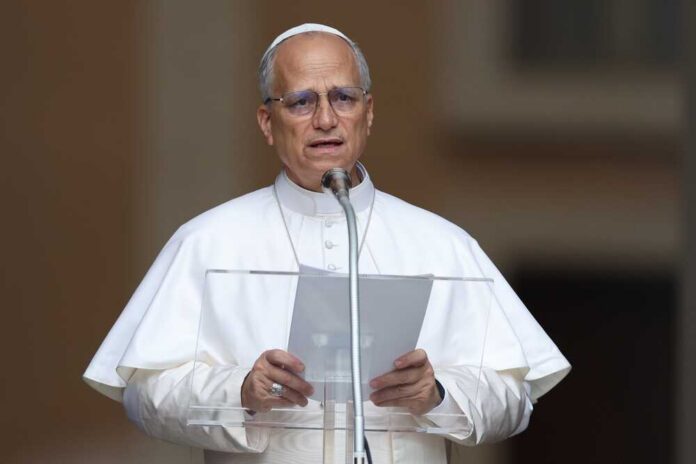
The Pope is warning priests that outsourcing sermons to chatbots doesn’t just save time—it risks hollowing out the very human faith and moral formation that hold communities together.
Story Snapshot
- Pope Leo XIV told clergy in Rome to resist using AI tools to prepare homilies, stressing that a chatbot cannot “share faith” the way a living priest can.
- Reports describe his guidance as an appeal or urging, even when some headlines frame it as a ban; no enforcement mechanism has been reported.
- The Pope tied AI dependence to “atrophy” of human intellect, urging priests to exercise their minds rather than outsource spiritual work.
- He also cautioned against social-media “illusions,” including treating likes and online attention as a substitute for real relationships and pastoral care.
What Pope Leo XIV Actually Told Priests in Rome
Pope Leo XIV delivered the message during a closed-door meeting with clergy from the Diocese of Rome held late in the week before Feb. 25, 2026, according to multiple reports citing Vatican coverage. The core warning was straightforward: priests should resist the temptation to use AI chatbots to prepare homilies, because a machine can assemble text but cannot transmit faith person-to-person. The Pope emphasized the irreplaceable role of a living priest in ministry.
Coverage of the meeting converges on another theme: spiritual leadership requires human presence, not automated output. Pope Leo XIV framed sermon-writing as more than “content creation,” arguing that priests are meant to reflect, pray, and teach from lived faith rather than rely on machine-generated phrasing. This point lands beyond Catholic circles because it addresses a broader cultural question: when institutions hand human judgment to algorithms, they often trade depth for speed and lose accountability along the way.
“Use Your Muscles”: The Pope’s Warning About Intellectual Atrophy
Pope Leo XIV reportedly compared the human intellect to muscles that weaken when neglected. That analogy matters because it targets a modern habit: letting technology do the hard mental work, then calling the result “productive.” In the Pope’s framing, AI convenience can become a form of dependency that reduces critical thinking and weakens the priest’s ability to counsel, teach, and confront moral confusion in real time. The practical takeaway is discipline: preparation is part of pastoral responsibility.
The Pope’s guidance also overlaps with concerns many Americans have voiced as AI spreads into schools, workplaces, and even public life. When people stop practicing writing, reasoning, and discernment, they can become easier to manipulate—whether by online outrage cycles or by whatever narrative an algorithm serves next. The reporting does not claim AI is inherently evil; instead, it stresses limits, especially where moral authority and personal witness are central to the job.
Social Media “Illusions” and the Crisis of Real Community
Several outlets highlighted that Pope Leo XIV didn’t just talk about AI tools; he also criticized social media habits that can substitute performance for genuine bonds. The warning about “illusions” points to a cultural drift where public approval—likes, shares, and trend-chasing—gets confused with real human connection. For faith leaders, the concern is obvious: online popularity can reward shallow messaging, while the hard work of family formation, repentance, and service rarely goes viral.
For a conservative audience that watched “woke” politics and corporate HR language seep into nearly every institution over the last decade, the Pope’s critique reads as a pushback against a screen-driven culture that prizes slogans over truth. The sources don’t portray his remarks as partisan; they present a pastoral argument: ministry is relational and embodied, and technology that tempts leaders to posture—or to outsource the core work—undermines that mission.
The Vatican’s Own AI Use Adds a Complicating Detail
Reporting also noted an internal contrast: while the Pope urged priests not to use AI for homily preparation, Vatican-linked initiatives have explored AI for real-time liturgical translation across many languages. That doesn’t necessarily contradict the Pope’s point, but it clarifies it. The line being drawn is about function and authority: translation tools can assist communication, while sermon preparation shapes doctrine, conscience, and moral formation. The sources available do not describe new formal rules—only guidance and emphasis.
Headlines using words like “ban” or “forbid” can overstate what’s been published so far, because the underlying coverage repeatedly frames the Pope’s remarks as an urging to resist temptation rather than a documented disciplinary decree with penalties. What is clear is the direction: Pope Leo XIV is trying to keep spiritual authority anchored in human responsibility. In an era when institutions often hide behind “the algorithm,” that insistence on personal accountability is the real story.
Sources:
https://forklog.com/en/pope-prohibits-use-of-ai-in-sermons/
https://futurism.com/artificial-intelligence/pope-priests-ai
https://www.usccb.org/news/2026/let-communication-be-conducted-real-human-beings-not-ai-pope-says
https://www.wordonfire.org/articles/lessons-from-the-vaticans-ai-guidelines/