When a shutdown left America’s busiest airport bordering on chaos, the federal government turned to ICE—raising a bigger question for conservatives: why does Washington keep lurching from crisis to crisis instead of simply funding core functions?
Quick Take
- Hartsfield-Jackson Atlanta International Airport saw TSA security waits spike as high as three hours after a large share of screeners called out during a partial government shutdown.
- President Donald Trump announced ICE agents would be deployed to help manage lines and support TSA operations, since ICE personnel were funded and available.
- Local officials said ICE support at the airport was limited to assistance with screening operations and crowd control—not immigration enforcement.
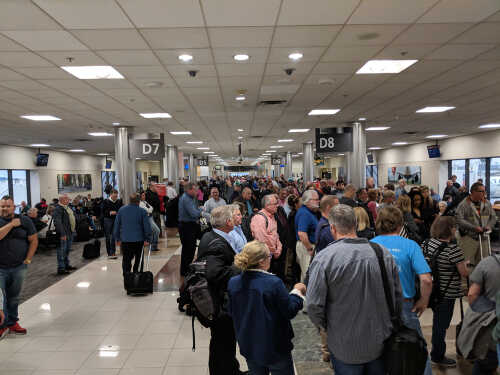
- Early on-the-ground reports showed lines still stretching outside and through baggage claim, with mixed traveler accounts and no clear, quantified reduction in wait times yet.
Shutdown-driven staffing gaps pushed ATL security lines to a breaking point
Hartsfield-Jackson Atlanta International Airport (ATL) experienced severe TSA delays during a partial federal government shutdown, with wait times reported as high as three hours. Airport leadership attributed the surge to staffing shortages, including a reported 34% TSA call-out rate as essential workers missed paychecks and stress built across the system. Travelers were urged to arrive far earlier than normal, and airlines adjusted expectations as lines backed up into public areas.
The operational reality mattered more than political messaging: security throughput depends on trained screeners and consistent staffing, and a shutdown is a blunt instrument that predictably hits the public first. ATL, as the world’s busiest airport, is a stress test for the whole system. When lines wrap toward baggage claim, families miss flights, business trips collapse, and confidence in basic governance takes another hit.
Trump ordered ICE to assist TSA—while local leaders emphasized “no enforcement”
President Trump said ICE would assist TSA at impacted airports starting Monday, positioning the move as an immediate fix while the shutdown dragged on. DHS officials publicly supported the plan, describing it as using available personnel to support travelers and strained airport operations. ICE agents arrived at ATL and were seen moving through checkpoints and monitoring lines, with reports describing them in a visible support role.
Atlanta’s mayor publicly stressed that ICE activity at the airport was limited to assistance and not immigration enforcement. That distinction matters for two reasons. First, it clarifies what travelers should expect at the checkpoint. Second, it shows how quickly even a temporary staffing solution can become entangled in political suspicion—especially in a major city where officials are sensitive to perceptions of federal immigration activity in public spaces.
Did ICE “dramatically” cut waits? Early reports were mixed, and hard data was limited
On Monday morning, reports still described long lines at ATL—often 1.5 to 2+ hours—with crowds extending outside and through baggage claim areas. TSA messaging reportedly shifted toward telling passengers to arrive as early as four hours before departure. Some travelers described lines moving faster with added personnel and direction, while others questioned how much difference the deployment made in real time.
ICE support may have helped manage crowd flow and staffing pressure, but early coverage did not offer quantified proof of a dramatic, sustained reduction at ATL.
For conservatives, the bigger issue is governance: fund essentials, avoid emergency workarounds
Conservatives are right to demand competent execution from government agencies that affect daily life and national security. Airports are critical infrastructure, and TSA screening is a core federal responsibility—not a discretionary “nice to have.” The shutdown demonstrated how quickly “essential” employees become leverage points in budget fights, and how the public pays the price in lost time, missed flights, and a growing sense that Washington can’t manage basics.
Thanks to ICE, Wait Times in Atlanta's Airport Security Lines Have Dropped Dramatically
https://t.co/snu5d4TRO6— Townhall Updates (@TownhallUpdates) March 24, 2026
The ICE-to-TSA assist model also sets a precedent conservatives should evaluate carefully. Using one federal workforce to plug holes in another can be practical in a crisis, but it is not a substitute for stable funding, clear staffing plans, and measurable performance metrics. In an era when many voters are tired of constant emergencies—whether at the border, in energy markets, or in foreign conflicts—this episode underscores a simple point: competent government starts with doing the fundamentals on time.
Sources:
Atlanta airport wait time hits 3 hours as Trump promises ICE assistance
ICE agents arrive at Atlanta airport Monday morning
ICE agents airports TSA wait times begins Monday
Airport security lines are long. Here’s what to know if you’re flying