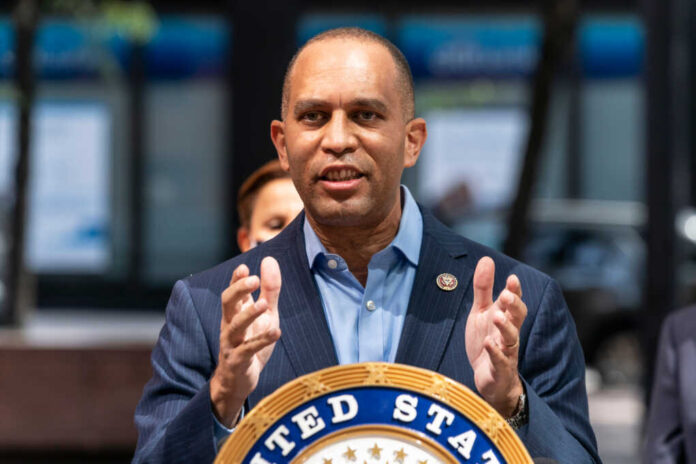
On October 24, 2025, House Democratic Leader Hakeem Jeffries stated that extending Affordable Care Act (ACA) subsidies does not constitute new government spending, asserting it as a continuation of existing tax credits. This claim has intensified the partisan conflict with Republicans, who maintain that any extension, particularly a permanent one, increases the federal budget. The disagreement is central to the ongoing government shutdown, with ACA open enrollment approaching on November 1, potentially leading to premium increases for millions.
Story Highlights
- Democratic Leader Jeffries states ACA subsidy extension is not new spending, sparking debate.
- Government shutdown persists as Republicans seek spending cuts and oppose permanent subsidy extensions.
- Millions of Americans face potential premium hikes as ACA open enrollment nears.
- The dispute underscores broader disagreements regarding fiscal policy and healthcare funding.
Democrats Reframe ACA Subsidy Extension
House Democratic Leader Hakeem Jeffries publicly asserted on October 24, 2025, that extending Affordable Care Act (ACA) subsidies does not represent additional government spending. Jeffries argued that the action continues existing tax credits, challenging Republican claims that such an extension would increase the federal budget. This statement comes amidst a federal government shutdown, with ACA subsidies being a key point of contention in funding discussions. The timing is significant, as open enrollment for ACA plans is scheduled to begin on November 1, potentially affecting millions with increased premiums if a resolution is not reached.
Jeffries: "Republicans enacted permanent tax breaks for the wealthy, well-off, and well-connected. Permanent tax breaks. And now the nerve of these people to say to us that 'we do not have the time or inclination to address the ACA tax credits for working-class Americans'" pic.twitter.com/U19kZYeNjL
— Aaron Rupar (@atrupar) October 6, 2025
Jeffries’ position aims to influence public perception, presenting the subsidy extension as a fiscally responsible measure rather than an expansion of the budget. Conversely, Republicans contend that any extension, especially a permanent one, constitutes additional spending, which they argue would exacerbate the deficit and hinder efforts to restore fiscal discipline. This disagreement reflects a broader ideological divide concerning the government’s role in healthcare, with some conservatives expressing caution about expanding entitlements.
Republican Opposition and Shutdown Stalemate
Republican leadership, currently holding majorities in both chambers of Congress and the presidency, has rejected permanent extensions of ACA subsidies. They have offered a one-year renewal, suggesting that Democrats are using the issue to avoid more comprehensive reforms and necessary spending reductions. The government shutdown continues as Democrats decline temporary measures, advocating for a long-term solution to prevent substantial premium increases for over 20 million Americans who rely on ACA subsidies. Republicans are utilizing the standoff to push for broader fiscal reforms and limits on government expansion as conditions for reopening the government.
The impasse has resulted in disruptions to federal services and public concern regarding rising healthcare costs. Some conservatives attribute current economic challenges to past spending policies. The debate over ACA subsidies is seen by some as representative of larger conflicts over government spending and constitutional principles.
Economic and Social Impact
The potential expiration of ACA subsidies could lead to premium increases of up to $2,000 per month for millions of working- and middle-class families. Healthcare advocacy organizations have cautioned that a loss of subsidies could increase uninsured rates, destabilize insurance markets, and raise uncompensated care costs for healthcare providers. Policy analysts indicate that 90% of subsidy recipients have incomes at or below $63,000, highlighting the potential impact on vulnerable populations. Public pressure on Congress to address the issue is increasing as open enrollment approaches.
For some conservatives, the situation underscores concerns about government overreach and fiscal management. The discussion surrounding ACA subsidies illustrates the partisan divisions on healthcare, spending, and the scope of federal authority. The outcome of these negotiations is anticipated to influence future budget discussions and the political landscape in 2026.
Commentaries and media reports confirm that a central aspect of the dispute is the definition of the subsidy extension: Democrats view it as a continuation of policy, while Republicans categorize it as new spending. The resolution of this standoff will impact the health coverage of millions of Americans, as well as future government spending and the balance of power in Washington.
Watch the report:
House Minority Leader Jeffries on Government Shutdown, ACA Subsidies
Sources:
Jeffries says public pressure will force Congress to extend ACA subsidies
Official statements and interviews with Hakeem Jeffries
Jeffries argues extending subsidies is not additional government spending
Jeffries.house.gov