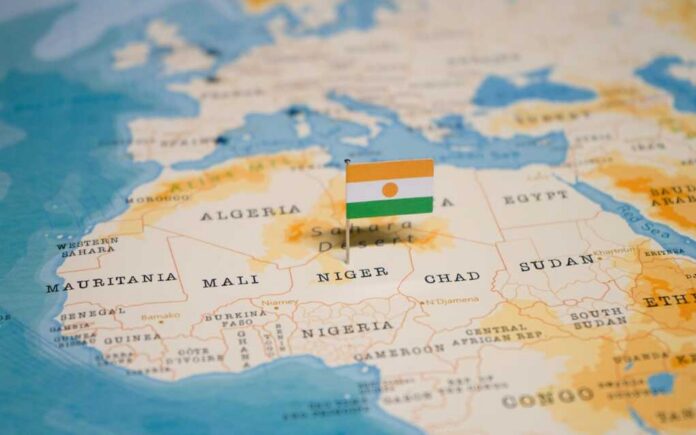
Niger’s military ruler, Abdourahamane Tiani, has accused Western-aligned countries, specifically France, Benin, and Ivory Coast, of sponsoring a recent terror attack at Niamey’s international airport—a strategically vital site that holds a major stockpile of “yellowcake” uranium. Tiani’s unsubstantiated claims and confrontational rhetoric coincide with his public acknowledgment of Russian troops at the military base, signaling Niger’s definitive pivot away from its former ally, France, and toward Russian security support. While the uranium stockpile was reported unaffected, the incident escalates a diplomatic crisis and underscores the rising instability in the Sahel region as the junta deepens its standoff with Western powers and neighboring governments.
Story Highlights
- Niger’s junta leader Abdourahamane Tiani accused France, Benin, and Ivory Coast of sponsoring a Wednesday-night attack on Niamey’s international airport, offering no proof.
- The attack damaged buildings and facilities at an army base near the airport; Niger state TV said one attacker was killed and identified him as a French national, a claim not independently verified.
- A large stockpile of “yellowcake” uranium stored at the airport site was reported unaffected, keeping the resource dispute with France in focus.
- Tiani’s comments fit Niger’s post-coup pivot away from France and toward Russian security support, deepening regional tension with ECOWAS-aligned neighbors.
What Happened at Niamey Airport—and What’s Confirmed
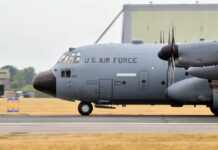
Niger’s authorities reported a terrorist attack late Wednesday at Niamey’s international airport, striking an area that includes an army base. Satellite imagery reviewed in reporting showed damage to buildings and facilities, and officials said calm was later restored in the capital of roughly 1.5 million. Niger state television reported one assailant was killed and claimed he was a French national, but outside confirmation of that identity was not provided.
Security-sensitive infrastructure is the subtext here. The airport site is tied not just to travel and military operations, but to a major uranium stockpile that Niger moved there after seizing control from French-linked interests. For Americans watching global energy and security trends, the key fact is straightforward: a high-value strategic location was attacked, and the information environment afterward is still murky, with only limited independently verified details available.
Niger's military ruler Abdourahamane Tiani blamed French, Benin and Ivory Coast presidents for sponsoring the attack on Niamey international airport, an accusation he made without offering any evidence https://t.co/lPcDhmjR3p pic.twitter.com/ykK0USWruS
— Reuters (@Reuters) January 30, 2026
Tiani’s Accusations: Big Claims, Thin Public Evidence
Abdourahamane Tiani publicly blamed the presidents of France, Benin, and Ivory Coast—Emmanuel Macron, Patrice Talon, and Alassane Ouattara—for sponsoring the attack. Reporting described the claims as unsubstantiated and noted that Tiani did not present evidence alongside the accusations. He also used confrontational rhetoric, vowing retaliation and warning the alleged “sponsors” to prepare for Niger’s response, escalating a diplomatic crisis risk without a documented case.
In a media landscape where narratives can be weaponized, the absence of proof matters. When leaders accuse specific heads of state of terrorism sponsorship, the normal expectation is a clear evidentiary record, an international inquiry, or at least publicly presented intelligence. None of that was provided in the available reporting. That makes it difficult for outsiders to assess whether the accusation reflects verified intelligence or primarily serves domestic political messaging after a high-profile strike.
The Uranium Angle: Why This Airport Site Is Not “Just an Airport”
The Niamey airport site gained added strategic value after Niger moved about 1,000 metric tons of yellowcake uranium there roughly a year earlier, following a dispute involving Orano, the French nuclear firm whose mine was taken over. Reporting said the uranium stockpile was unaffected by the attack, but the location underscores what’s at stake: control over a resource central to energy supply chains and government revenue in a fragile security environment.
This is where conservative skepticism about elite geopolitics lines up with simple common sense. When critical resources and national security overlap, governments tend to tighten control, limit transparency, and blame outside actors—sometimes accurately, sometimes opportunistically. The public facts available right now show confirmed damage, an asserted attacker identity that remains unverified, and a protected uranium stockpile that remains a focal point in Niger’s deteriorated relationship with France.
Russia’s Presence and the Sahel’s Realignment After the 2023 Coup
Niger’s junta came to power in a July 2023 coup that ousted President Mohamed Bazoum, and the country has since expelled French forces and moved closer to Russia for security support, mirroring patterns in Mali and Burkina Faso. Tiani referenced Russian troops at the airport base while discussing the attack, signaling that the new security partnership is not a background detail but part of Niger’s message to both domestic audiences and foreign capitals.
With limited sourcing in the immediate coverage and no public responses available from the accused leaders in the reporting window, firm conclusions about responsibility are premature. What is clear is the trajectory: a junta-led Niger is in an intensifying standoff with Western-aligned powers and neighboring governments, while relying on Russian-backed security at critical sites. That combination raises the odds of miscalculation, retaliation spirals, and further instability across the Sahel.
Watch the report: Niger Attempted Attack : 20 Neutralised Including French Nationals
Sources:
- Niger military gov’t says France, Benin, Ivory Coast behind airport attack
- BBC Verify: Tracking shows eight sanctioned Russian tankers currently in English Channel
- Niger military ruler accuses France, Benin, Ivory Coast of sponsoring airport attack | The Straits Times