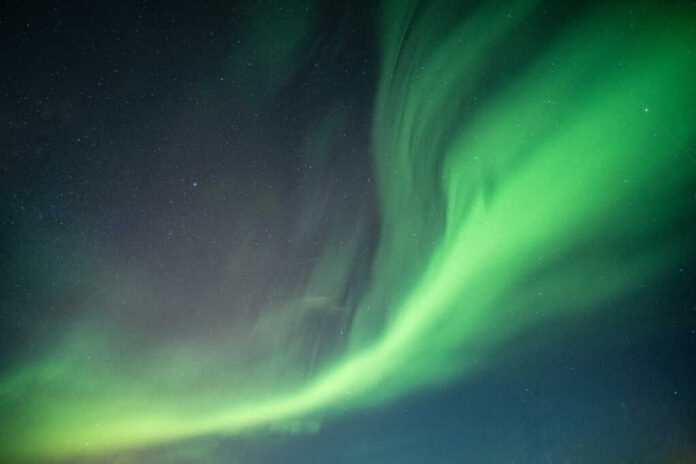
The United States is witnessing an unusual geomagnetic storm classified as G3 (Strong) that enhances the visibility of the Northern Lights. This phenomenon, typically confined to Arctic and sub-Arctic regions, is now visible across as many as 20 states, including Michigan. The storm, triggered by a coronal mass ejection from the Sun on November 4, 2025, reached its peak on November 6-7. NOAA’s Space Weather Prediction Center has been actively monitoring the situation, providing forecasts to ensure the public can witness this rare spectacle.
Story Snapshot
- A G3 geomagnetic storm increases aurora visibility in the U.S., reaching as far south as Michigan.
- The storm, caused by a coronal mass ejection, peaks on November 6-7, 2025.
- NOAA’s Space Weather Prediction Center provides real-time updates, emphasizing optimal viewing in dark skies.
- Public interest surges in space weather and auroral displays, drawing comparisons to past events.
Geomagnetic Storm Brings Rare Auroral Displays
The United States is witnessing an unusual geomagnetic storm classified as G3 (Strong) that enhances the visibility of the Northern Lights. This phenomenon, typically confined to Arctic and sub-Arctic regions, is now visible across as many as 20 states, including Michigan. The storm, triggered by a coronal mass ejection from the Sun on November 4, 2025, reached its peak on November 6-7. NOAA’s Space Weather Prediction Center has been actively monitoring the situation, providing forecasts to ensure the public can witness this rare spectacle.
Amateur astronomers and the general public are seizing this unique opportunity to observe the auroras. The geomagnetic storm has prompted increased activity on social media platforms, where enthusiasts share viewing guides and real-time updates. This heightened interest underscores the importance of space weather forecasting, which not only enables us to appreciate natural wonders but also prepares us for potential disruptions in satellite and communication systems.
✨🌕TWO-FOR-1: The northern lights put on a beautiful show in front of the Supermoon Wednesday night. Where you can catch the aurora the rest of the week: https://t.co/F51epTIAhK pic.twitter.com/6kSoTChpLb
— FOX Weather (@foxweather) November 6, 2025
Implications of the Geomagnetic Storm
While the auroral display provides a chance for public engagement with science, it also raises awareness about the implications of space weather. Geomagnetic storms can affect satellite operations, power grids, and communications infrastructure, though the current G3 storm is unlikely to cause significant damage. Nonetheless, utility companies and satellite operators remain vigilant, monitoring the storm’s progress to mitigate any potential risks. The event serves as a reminder of the delicate balance between celebrating natural phenomena and safeguarding essential services.
Historically, similar geomagnetic storms have drawn comparisons to events like the Halloween Storms of 2003 and the St. Patrick’s Day Storm of 2015, which also produced auroras at lower latitudes. These precedents highlight the unpredictable nature of solar activity and its impacts on Earth, emphasizing the need for continued investment in space weather research and monitoring.
GEOMAGNETIC STORM WATCH: A strong Geomagnetic Storm Watch has been issued for Thursday and Friday, with the possibility of seeing the Northern Lights as far south as Iowa, Pennsylvania and Oregon in the U.S. Learn more: https://t.co/F51epTJ87i pic.twitter.com/kfQv7ERrSo
— FOX Weather (@foxweather) November 6, 2025
Public and Scientific Engagement
The widespread visibility of the Northern Lights has sparked a renewed interest in space weather phenomena. As people flock to dark-sky sites to catch a glimpse of the auroras, local businesses may experience a boost in tourism. The event also presents a valuable educational opportunity, encouraging discussions on the science behind auroras and the broader implications of solar activity. Scientists and educators can leverage this interest to foster a deeper understanding of space weather and its effects on our planet.
The event serves as a poignant reminder of the intricate connections between the Sun and Earth, inspiring both awe and caution as we navigate the challenges and wonders of our cosmic environment.
Sources:
‘Strong’ geomagnetic storm makes Northern Lights sightings possible in US on Thursday, Friday
Northern Lights Michigan Weather
Space Weather Prediction Center
Aurora Dashboard Experimental