The recent sighting of China’s J-10C fighter carrying a new, smaller YJ-21E anti-ship ballistic missile marks a significant shift in the strategic balance of power in the Western Pacific. This development moves a major ship-killing threat from a few large bombers onto a much more numerous and agile fighter fleet, demanding a serious re-evaluation of U.S. and allied defense postures in the region.
Story Highlights
- China’s J-10C fighter has reportedly been seen carrying a new YJ-21E anti-ship ballistic missile tailored for jets and drones.
- The YJ-21E is a smaller offshoot of China’s larger YJ-21/KD-21 missile family, previously associated mainly with H-6K bombers.
- This pairing could expand China’s ability to threaten U.S. and allied ships across the Western Pacific.
- The development highlights the cost of past U.S. complacency and the need for stronger deterrence policies today.
China Arms J-10C Fighters With Ship-Killing Ballistic Missiles
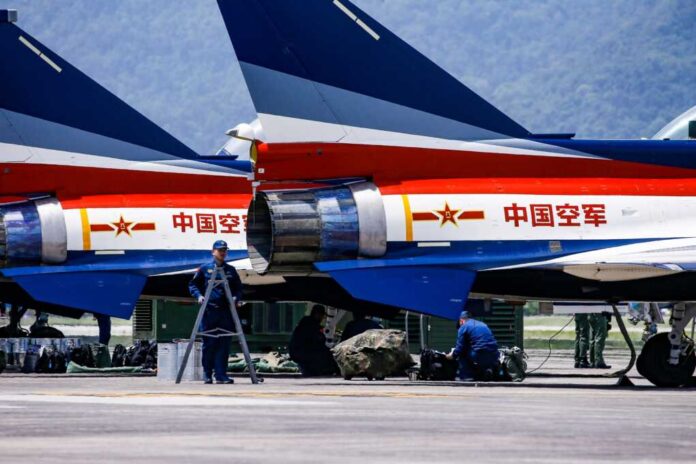
Recent reporting from defense observers indicates that China’s J-10C multirole fighter has been photographed carrying the new YJ-21E anti-ship ballistic missile, marking the first alleged pairing of this airframe with that weapon. The J-10C is a relatively modern, agile fighter widely deployed in the People’s Liberation Army Air Force, giving Beijing a flexible platform to deliver precision strikes. Mounting a ballistic anti-ship weapon on such a fighter significantly broadens where and how that missile can be launched.
Analysts describe the YJ-21E as a smaller derivative of the larger YJ-21, also referred to in some contexts as the KD-21, which has been predominantly observed on China’s H-6K bomber fleet. The original YJ-21 is generally associated with long-range anti-ship roles, offering China a way to hold high-value naval targets at risk. By engineering a more compact YJ-21E, Chinese designers appear to be adapting that same core threat for use on lighter, more numerous tactical aircraft.
🚨 BREAKING: China has introduced the YJ-21E hypersonic missile, which can be fired from J-10C fighter jets. The missile has a reported range of 1,500 km and speeds of Mach 8 to Mach 10. Experts are calling it China’s Kinzhal. pic.twitter.com/Y4npuMCg5r
— Defence Index (@Defence_Index) December 25, 2025
From Bombers to Fighters: Why a Smaller YJ-21E Matters
The decision to shrink the YJ-21 into the YJ-21E and hang it under a J-10C matters because it disperses China’s strike capability across far more platforms. H-6K bombers are large, strategic assets with clear signatures and limited numbers, making them easier to track and prioritize in a conflict. J-10C fighters, by comparison, exist in greater quantities, can operate from more runways, and can complicate U.S. and allied air defense planning by presenting many simultaneous launch points.
Chinese engineers appear to have optimized the YJ-21E’s size and weight for carriage not only by J-10C fighters but potentially by other jets and even drones, according to the research summary you provided. A missile tailored for fighters and unmanned systems could allow swarming or coordinated attacks on surface vessels, saturating defensive systems. For U.S. naval forces, especially carrier strike groups operating in the Western Pacific, this trend adds another layer of complexity to an already challenging anti-ship missile environment.
What This Development Signals About China’s Strategy
This alleged J-10C and YJ-21E pairing fits a broader pattern of China investing heavily in anti-access and area-denial capabilities designed to push U.S. forces farther from contested waters. By fielding anti-ship ballistic and cruise missiles on multiple launch platforms, Beijing is trying to deter U.S. intervention near Taiwan, the South China Sea, and key shipping lanes. The more launch platforms China can field, the harder and more resource-intensive it becomes for the United States to defend every potential vector of attack.
For a conservative audience focused on strong defense and peace through strength, this development underlines why a robust U.S. Navy, credible missile defenses, and continued modernization are essential. While past Washington priorities diverted billions into domestic wish lists and fashionable agendas, China concentrated on tools that directly threaten American carriers and bases. The appearance of a YJ-21E on a front-line fighter is another reminder that adversaries are not standing still while U.S. leaders debate basic defense funding.
Implications for U.S. Security, Allies, and Deterrence
For U.S. sailors and airmen operating in the Indo-Pacific, a fighter-launched YJ-21E raises the stakes. A dispersed anti-ship ballistic missile threat forces more conservative maneuvering, greater emphasis on early warning, and heavier reliance on layered defenses. Allies such as Japan, South Korea, Australia, and the Philippines must also weigh how this affects their own naval deployments and procurement decisions, especially as they deepen security cooperation with Washington.
From a policy standpoint, this kind of Chinese advancement underscores why a U.S. posture built on constitutional responsibility and clear national interest is vital. A government focused on secure borders, a strong industrial base, and serious defense investments is better positioned to counter missiles like the YJ-21E than one distracted by ideological projects and runaway spending. While open-source details about the missile’s exact range, guidance, and production scale remain limited, the key takeaway is straightforward: Beijing is steadily upgrading tools meant to challenge American power at sea.
Watch the report: China Makes J-10C Even More Dangerous! Now Armed with Hypersonic YJ-21E Missile
Sources:
- China’s J-10C Allegedly Seen Carrying YJ-21E Anti-Ship Ballistic Missile for the First Time – The Aviationist
- China’s J-10 Fighter Seen With Possible YJ-21E Hypersonic Anti-Ship Missile in New Images
- Breakthrough in Chinese Airpower: J-10C Fighter Spotted Carrying YJ-21E Hypersonic Missile – Defence Security Asia