Washington’s shutdown drama just hit a new low: instead of negotiating, top Democrats and the Trump White House are trading personal insults on live cameras.
Quick Take
- House Minority Leader Hakeem Jeffries publicly branded White House Press Secretary Karoline Leavitt a “disgrace” and a “stone-cold liar” during a federal government shutdown.
- The flare-up followed Leavitt’s earlier claim that Democrats’ “main constituency” includes “Hamas terrorists, illegal aliens, and violent criminals,” a line Jeffries said was inflammatory and taken out of context.
- The confrontation unfolded alongside a separate controversy involving a swastika-embedded American flag reportedly found in a GOP lawmaker’s office, which the lawmaker denied.
- Leavitt later responded on Fox News, arguing Jeffries was “lashing out” because she was “telling the truth.”
Shutdown Pressure Boils Over Into Personal Attacks
House Democratic Leader Hakeem Jeffries (D-NY) used a Friday press appearance to deliver a direct, personal broadside against White House Press Secretary Karoline Leavitt. Jeffries called Leavitt a “disgrace” and a “stone-cold liar,” and also described her as “sick,” “out of control,” and “demented.” The clash underscored how quickly shutdown messaging has shifted from policy arguments to character attacks.
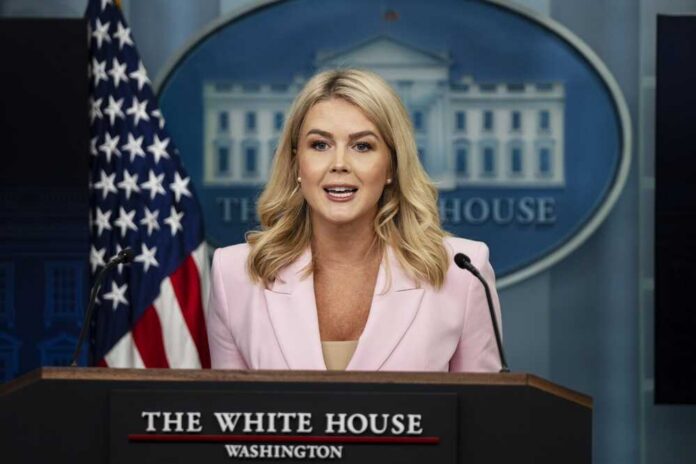
Karoline Leavitt’s remarks that set off the confrontation came the day before, during a White House briefing. Leavitt said the Democratic Party’s “main constituency” consists of “Hamas terrorists, illegal aliens, and violent criminals,” language Democrats treated as a sweeping smear rather than a targeted critique. Jeffries framed the statement as reckless rhetoric at a moment when the public is already frustrated that Washington seems unable to keep basic services running.
A Swastika Incident Adds More Heat, Not More Clarity
The Jeffries-Leavitt fight also intersected with an antisemitism-related controversy that added combustible symbolism to an already raw week. A swastika-embedded American flag being discovered in the office of Rep. Dave Taylor (R-OH). Taylor denied any involvement and suggested the incident was a coordinated attempt by political opponents. Key details remained unsettled but the episode became part of the broader blame game.
Democrats pointed to the alleged incident as evidence Republicans tolerate fringe behavior, while Republicans emphasized the uncertainty about who placed the flag and why. The result was predictable: more arguments about motives, less focus on measurable actions to reopen the government. With federal workers and contractors caught in the middle, the episode highlighted a recurring Washington pattern—leaders elevate the most inflammatory talking points because they spread faster than budget math or legislative text.
Leavitt’s Counterpunch: “Lashing Out” Because “Truth” Hurts
Leavitt responded publicly later Friday, appearing on Fox News and describing Jeffries’ performance as an emotional reaction. She said Jeffries was “lashing out” because she was “telling the truth,” a line that tracks with the Trump administration’s broader messaging on border enforcement and public safety. The White House posture casts Democrats as defending a coalition that includes illegal immigration and permissive criminal-justice policies, even when Democrats insist that framing is unfair.
What This Says About Government Failure—and Why Voters Are Exhausted
The larger issue is not whether Jeffries’ insults landed or whether Leavitt’s phrasing was strategically sharp; it’s that the country is watching leaders fight while the government stays closed. Conservatives who want limited government still expect basic competence: pass budgets, protect borders, and keep the lights on. Liberals who want stronger safety nets still expect the same competence: fund agencies and protect workers. The shared frustration grows when leaders prioritize viral conflict over results.
Hakeem Jeffries Is BIG MAD That Karoline Leavitt Got DIRECTLY Over the Target and Carpet Bombed the Dems https://t.co/M6cQuQ66hP
— Dallys1515 💋 (@Dallys1515) April 28, 2026
The specific shutdown deal points and negotiating positions were not laid out in detail alongside the political theater, which limits what can be concluded about who is closest to a solution. What is clear is that the fight itself is becoming the story, and that dynamic rewards the worst incentives in politics. Until Congress and the White House refocus on terms, votes, and accountability, the shutdown remains a symbol of a federal system that struggles to do its most basic job.