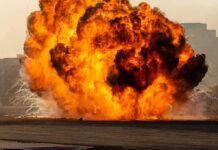
Russia and Belarus are openly rehearsing nuclear strikes on NATO’s doorstep, reminding Americans that nuclear brinkmanship is back on the table while Washington Democrats still daydream about “climate justice” and pronoun wars.
Story Snapshot
- Russia and Belarus ran Zapad‑2025, a major joint drill that included simulated nuclear strikes and hypersonic missile planning.[1][2][3]
- Moscow is folding Belarus under its nuclear umbrella and preparing to station new intermediate‑range missiles there.[1][3][4]
- The exercise played out near Poland and Lithuania, raising the stakes for NATO’s eastern front and European security.[1][2][4]
- NATO observers were invited, but secrecy around real orders and targeting keeps everyone guessing about true intentions.[2][3]
Russia and Belarus Turn “Defensive” Drill Into Nuclear Message to the West
Belarus and Russia used their Zapad‑2025 exercise to do far more than march troops and roll tanks; they practiced how to fight a nuclear war from Belarusian soil, including simulated launches of non‑strategic nuclear weapons and deployment of new missile systems.[2][3] Belarusian generals described staff drills on “planning and the consideration of the application of non‑strategic nuclear weapons,” which means officers walked through actual nuclear decision chains, not just abstract lectures.[3] That is deliberate signaling toward NATO’s eastern flank, not routine peacetime training.
The drill involved about thirteen thousand troops spread across Belarus, western Russia, and nearby seas, a smaller force than Russia’s massive 2021 Zapad but still large enough to test modern weapons and coordination.[1][2][3] Officially, Minsk said the scenario focused on repelling a hypothetical attack and retaking lost territory, the same “defensive” language Moscow used before sending forces into Ukraine in 2022.[2][4] Belarusian Defense Minister Viktor Khrenin said units near Poland and Lithuania would practice repelling a hypothetical enemy, a vague label that clearly points toward NATO without saying so.[1]
Nuclear‑Capable Missiles and a Deepening Russia–Belarus Military Union
Beyond troop maneuvers, Zapad‑2025 highlighted Russia’s growing nuclear footprint inside Belarus, a country that gave up Soviet warheads decades ago and is now back under Moscow’s nuclear shadow.[3][5] Russian President Vladimir Putin previously announced plans to station nuclear‑capable Oreshnik intermediate‑range missiles in Belarus, and Belarusian officials said the drill evaluated and deployed this mobile missile system alongside Iskander‑M short‑range ballistic missiles.[1][3][4] These platforms can carry conventional warheads, but their nuclear capability is the real message to NATO capitals watching from across the border.
Belarusian strongman Alexander Lukashenko openly confirmed his forces had practiced launching tactical nuclear weapons with Russian counterparts as part of the exercise.[3][5] That admission undercuts any claim that this was simply about generic readiness or crisis management; it was about rehearsing nuclear warfighting procedures, step by step.[3][5] Russia has now formally extended its nuclear umbrella over Belarus, and the two militaries are integrating command structures, making Minsk less an independent actor and more a forward operating base for Moscow’s deterrence—and pressure—strategy toward Europe.[3]
Observers, Opacity, and the 2022 Ukraine Invasion Shadow
Belarus tried to project openness by inviting observers from nine North Atlantic Treaty Organization (NATO) states, including United States officers, and publicizing handshakes with its defense minister.[2] Those gestures help Minsk argue Zapad‑2025 was transparent and defensive. Yet neither Belarus nor Russia released full exercise orders, target lists, or after‑action reports, leaving crucial details—like what targets were simulated and how command authority flowed—shrouded in secrecy.[3] That information vacuum lets both sides spin the narrative while ordinary citizens are left to guess how close to the brink these drills really went.
Western reporting points out that the last time Russia and Belarus mounted major joint drills, in early 2022, Russian units rolled from Belarusian territory straight into Ukraine days later.[4] That precedent explains why NATO countries, especially Poland and its neighbors, went on alert and ran their own exercises earlier in the summer.[2][4] Critics argue this track record turns any large Russia–Belarus drill into a potential cover for aggressive action, even if no invasion followed this time.[4] At a minimum, it imposes constant strain on border states, forces higher readiness spending, and keeps Europe living under the shadow of nuclear escalation.
What It Means for American Conservatives Watching a Dangerous Neighborhood
These drills matter for Americans because they reveal where Moscow and its proxies are putting real resources: not into green fantasies or United Nations talking points, but into missiles, nuclear doctrine, and hard military power.[3][4][5] When Russia practices nuclear use from Belarus, it pressures NATO to respond with its own deterrence steps, pulling American forces and tax dollars deeper into Europe’s long‑running security crisis.[2][4] That is happening while many in Washington still undermine domestic energy production and saddle our own military with social experiments instead of war‑fighting focus.
NUCLEAR HOSTAGE: Belarus begins joint nuclear drills with Russia — a dangerous new chapter in Putin’s imperial blackmail. 🇧🇾🇷🇺☢️
The Belarusian Ministry of Defense has announced joint military exercises with Russia focused on the deployment and tactical use of nuclear weapons.… pic.twitter.com/R4deMN0c7H
— Unit News (@Unit_News) May 18, 2026
The record shows the drill was smaller and partly pushed deeper inside Belarus, but that does not erase the nuclear content or the proximity to NATO borders.[2][3] At the same time, there is no public proof that actual warheads were moved or that Russian and Belarusian planners rehearsed a concrete offensive strike on a specific NATO state.[3][5] For conservatives, the lesson is to stay clear‑eyed: acknowledge the very real nuclear risk, demand serious deterrence and energy independence at home, and resist the kind of globalist wishful thinking that ignores how dangerous the neighborhood around us has become.
Sources:
[1] YouTube – Zapad 2025 | Russia & Belarus Unleash Massive Nuclear-Linked Drill
[2] Web – Russia and Belarus Stage Simulated Nuclear Strike During Zapad …
[3] Web – Belarus, Russia Practice Nuclear Operations
[4] Web – Russia-Belarus military drills start this week. Here’s what to know
[5] Web – Nuclear weapons in Belarus: What we Know – ICAN