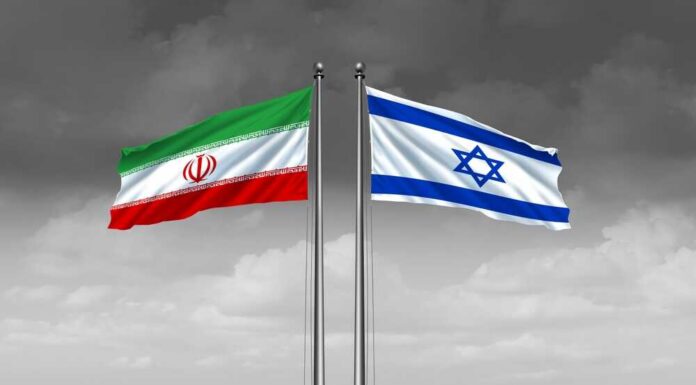
Iran answered Trump’s ceasefire announcement with missiles—minutes later—putting the limits of U.S. restraint on stark display.
Story Snapshot
- President Donald Trump announced a two-week pause in U.S. bombing against Iran, framed as a ceasefire window.
- Iran launched missiles at Israel shortly after the announcement, according to reporting summarized by Fox News and Mediaite.
- The close timing suggests Tehran was unwilling to treat the U.S. pause as de-escalation, at least in the immediate term.
- Public reporting in the provided sources offers no details on damage, casualties, or official Iranian or Israeli confirmations.
What happened minutes after Trump’s two-week pause
President Donald Trump announced a two-week suspension of U.S. bombing campaigns against Iran, described in the available reporting as a ceasefire-style pause in strikes. Shortly afterward, Iran launched missiles targeting Israel. Fox News senior correspondent Mike Tobin described the sequence as happening “minutes after” the president’s declaration, a detail Mediaite also emphasized in its summary of the event.
The key fact pattern in the research is narrow but consequential: a U.S. decision to pause bombing and an almost immediate Iranian strike on America’s close regional ally. Because the sources do not provide a wider timeline of what prompted the pause or the launch, readers are left with a snapshot that highlights timing rather than motive, leaving major unanswered questions about strategy, deterrence, and next steps.
Why the timing matters for deterrence and credibility
Ceasefires and pauses depend on signaling—one side changes behavior to test whether the other will step back as well. In this case, the reported sequence undercuts that logic. If Iran launched missiles at Israel right after the U.S. declared a pause, the immediate effect is to test whether Washington’s restraint is reversible and whether Israel must respond alone. That dynamic matters because credibility often shapes whether future pauses reduce violence or invite more pressure.
At the same time, the research does not include independent confirmation from Israeli or Iranian officials, nor does it provide verified information about the missiles’ impact. That limitation is important for viewers trying to separate what is confirmed from what is implied. Based strictly on the provided sources, the strongest verified claim is the reported timing and target—missiles toward Israel after a U.S. pause—not the operational results or broader intent.
What we know—and don’t know—about the wider conflict context
The provided research indicates an “ongoing U.S.-Iran conflict involving bombing campaigns,” but it does not spell out the lead-up events, prior exchanges, or triggering incidents. That gap makes it difficult to evaluate whether the U.S. pause was meant as a diplomatic opening, a tactical regrouping, or a humanitarian off-ramp. It also leaves unclear whether Iran’s strike was planned irrespective of Trump’s announcement or calibrated as a message in response.
Domestic political stakes: restraint vs. resolve
At home, the episode lands in a familiar American debate that cuts across party lines: how to avoid endless war without projecting weakness. Conservatives who prioritize strength and deterrence will likely focus on the risk that a pause followed by an immediate strike can look like a one-sided concession. Many liberals who distrust military escalation may focus on the need for de-escalation, but even they may question whether pauses work when adversaries keep firing.
https://twitter.com/
In practical terms, this is the kind of moment that tests whether Washington can combine limited, clearly defined military action with disciplined diplomacy—without drifting into open-ended commitments. With only two sources and no official battlefield reporting included here, the public still lacks basic facts about outcomes and responses. Until more verified detail emerges, the most defensible conclusion is also the simplest: a U.S. pause did not immediately produce restraint from Iran.
Sources:
https://www.foxnews.com/video/6392714296112