
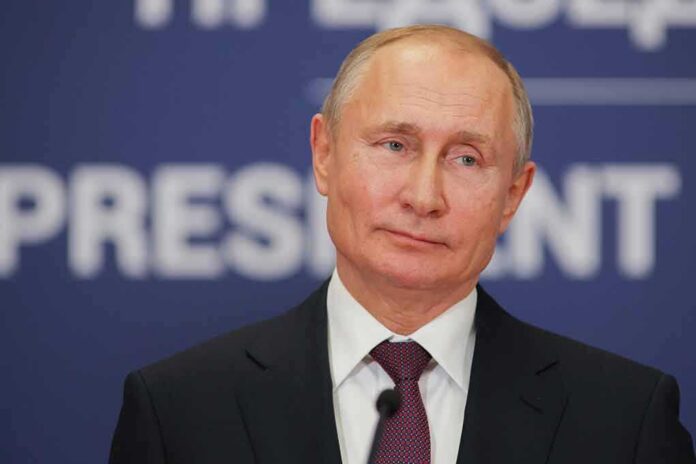
Russian President Vladimir Putin says Russia will not negotiate with Ukraine and promises a response “much more painful” than the drone and missile strikes that tore apart a section of the Crimean Bridge.
Quick Take
- Putin says talks are off and vows a harsher counterattack after bridge strikes.
- Russian officials opened a terrorism case and confirmed major damage to the bridge’s roadway.
- Ukraine calls the strike fair payback for Russian attacks on its cities and power grid.
- Putin made the threat just after meeting Presidents Trump and Xi Jinping in Shenzhen.
- Neither side has released independent proof backing up its full version of events.
Bridge Attacked Three Times in a Week
The Crimean Bridge, which links mainland Russia to occupied Crimea, came under attack for the third time in about a week. Russia’s Transport Ministry said train traffic was “temporarily suspended” after a drone strike. The BBC reported drones and missiles caused the collapse of a key section of the roadway, while the Associated Press confirmed the Kremlin pledged to rebuild it.
Russia’s Federal Investigative Committee opened a terrorism case, saying Ukrainian attacks caused “damage to the structure”. Putin gave a different damage picture than some outside reports, saying the road bridge was badly hurt while the rail bridge had already been fixed. No independent engineering survey has lined up these competing accounts.
Putin Rejects Negotiations, Vows Harsher Response
Speaking at a news conference in Shenzhen on November 19, Putin said, “After the strikes on the Crimean Bridge, we won’t negotiate. We’ll respond to these strikes.” He added Russia’s response would be “much more painful than what the Kyiv regime did to the bridge”. He made the comment right after meeting President Trump and Chinese President Xi Jinping, where a partial ceasefire had reportedly been discussed.
Putin did not name a target, a timeline, or a legal basis for the promised strike. No published memo, parliamentary vote, or military order has surfaced showing Russia already approved a specific plan. That leaves the threat as a public statement rather than a confirmed operation, at least for now.
Ukraine Says Strike Was Retaliation, Not Escalation
Ukraine’s General Staff said the roadway was “out of action” after the strike, and President Volodymyr Zelenskyy called it an “unprecedented operation in response to Russian attacks on our infrastructure”. Zelenskyy said Ukraine had offered Russia repeated steps toward de-escalation, “and every proposal has been met with loud rejection.”
Ukraine’s Defense Ministry argued the strikes bought “time gained and lives saved,” saying less military supply reaching Russian forces in Crimea means fewer attacks on Ukrainian troops. A Ukrainian military officer quoted by a British outlet said the operation was also timed to show Putin was weak just before his meeting with Trump and Xi.
A Familiar Pattern With No Independent Referee
This is not the first time the bridge has been hit, and legal scholars who studied the 2022 attack found that, if Ukraine was responsible, the strike could be lawful because the bridge served a military purpose for Russian forces. That same analysis found parts of Russia’s past retaliation went beyond what the law allows, a warning that applies directly to Putin’s new threat.
🇷🇺🇺🇦 **Russian President Vladimir Putin threatened retaliation over Ukraine’s strike on the Crimean Bridge** while stating in Shenzhen that Moscow, Washington, and Beijing share an interest in resolving the conflict. 🇷🇺🇺🇦 #Russia #Ukraine #Crimea #APEC2026
— Jodie P Holton (@JodiePHolton) November 19, 2026
Both governments are telling citizens two very different stories about who started the latest round and who is simply responding. Neither side has released forensic evidence, debris analysis, or an independent damage survey backing its full account. That gap matters because Putin’s vague threat of a “more painful” strike could affect civilians far beyond the bridge itself, turning a dispute over one piece of infrastructure into a bigger test of how far either side is willing to go while peace talks are supposedly still on the table.
Sources:
insiderpaper.com, themoscowtimes.com, newsukraine.rbc.ua, bbc.co.uk, english.nv.ua, kyivpost.com, abc7news.com, bloomberg.com, abc30.com, apnews.com