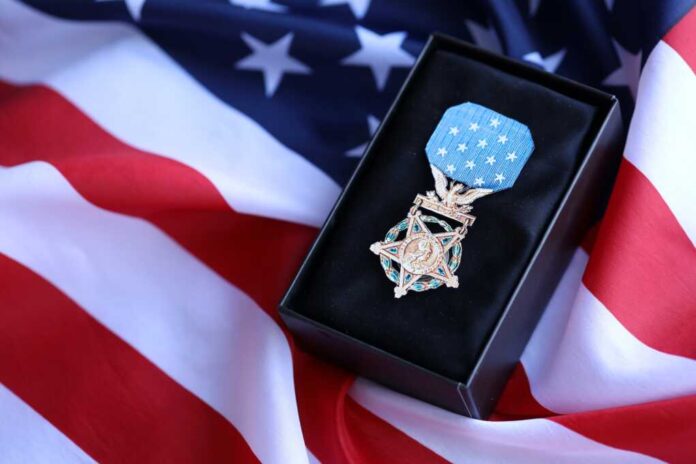
After 80 years, the remains of a World War II Medal of Honor recipient who died as a POW on a Japanese “hell ship” are finally coming home. This story of Captain Willibald Bianchi—a Minnesota farm boy turned war hero—proves America’s unwavering commitment to its servicemembers, no matter how long it takes. His journey, from extraordinary valor in the Philippines to the infamous Bataan Death March and a tragic end by friendly fire, is a testament to the Greatest Generation’s legendary sacrifice and spirit. He will be laid to rest in his Minnesota hometown in May 2026.
Story Highlights
- Army Captain Willibald Bianchi, Medal of Honor recipient, identified after 80 years missing.
- Died in 1945 when U.S. forces unknowingly bombed Japanese ship carrying American POWs.
- DPAA used DNA analysis to identify remains from Hawaii’s “Punchbowl” cemetery.
- Will be buried in his Minnesota hometown near Memorial Day 2026.
Minnesota Farm Boy Turned War Hero
Captain Willibald Bianchi embodied the American spirit that made the Greatest Generation legendary. Born in 1915 on a modest chicken farm near New Ulm, Minnesota, Bianchi left high school after his father’s death to support his family. Despite financial hardships, he earned the nickname “Medals” at the University of Minnesota Farm School—partly from pride in his ROTC uniform, partly because it was among the few clothes he owned. This determination and sacrifice foreshadowed the extraordinary valor he would display in the Pacific Theater.
Commissioned as an Army officer, Bianchi commanded Philippine Scouts on the Bataan Peninsula when Japanese forces launched their ruthless assault in early 1942. The Philippine Scouts represented elite Filipino troops under American leadership, standing as the backbone of resistance against overwhelming enemy numbers and dwindling supplies.
RT @velitesgear | Full Text Article: https://t.co/SLVVZabdA9 | Author: @Militarydotcom Remains of WWII Medal of Honor Recipient, Killed as a POW, Finally Comes Home After more than 80 years, Army veteran Willibald Bianchi was properly identified using advanced forensic science…
— Velit.es (@velitesgear) December 27, 2025
Extraordinary Valor Under Fire
On February 3, 1942, Bianchi volunteered to lead an assault against entrenched Japanese machine-gun positions threatening his unit. Shot in both hands, he continued fighting with a pistol and grenades. Wounded twice more and knocked down by a tank round, Bianchi refused to retreat, inspiring his men through extraordinary personal courage. These actions earned him the Medal of Honor, placing him among only 473 World War II recipients of America’s highest military decoration.
After Bataan’s surrender on April 9, 1942, Bianchi endured the infamous Bataan Death March alongside approximately 9,700 Americans and 66,300 Filipinos. Historian Peter Duffy estimates 500 Americans and 2,500 Filipinos died during the 60-mile forced march under cruel conditions including beatings, executions, and denial of food and water. Bianchi survived this ordeal and subsequent imprisonment at facilities including Bilibid Prison.
Tragic End on Japanese Hell Ship
In December 1944, Japanese forces transferred Bianchi and other POWs aboard the transport ship Oryoku Maru. When U.S. aircraft bombed and sunk the vessel, Bianchi survived and was moved to another transport, Enoura Maru. On January 9, 1945, U.S. naval aircraft struck Enoura Maru in Takao Harbor, Taiwan, unaware the ship carried hundreds of American prisoners. Bianchi died at age 29, killed by friendly fire while serving as a POW after demonstrating extraordinary heroism and endurance.
The Defense POW/MIA Accounting Agency identified Bianchi’s remains on August 11, 2024, through DNA and anthropological analysis as part of the Enoura Maru Project targeting over 928 POWs. Defense Secretary Pete Hegseth announced the identification, emphasizing America’s commitment to accounting for missing servicemembers. Bianchi will be laid to rest in New Ulm, Minnesota, in May 2026, finally receiving the hometown burial he earned through ultimate sacrifice.
Watch the report: Remains of hero lost in WWII are coming home
Sources:
- Remains of WWII Medal of Honor Recipient, Killed as a POW, Finally Comes Home
- Remains of WWII Medal of Honor recipient identified after 80 years
- 3 WWII soldiers home burial