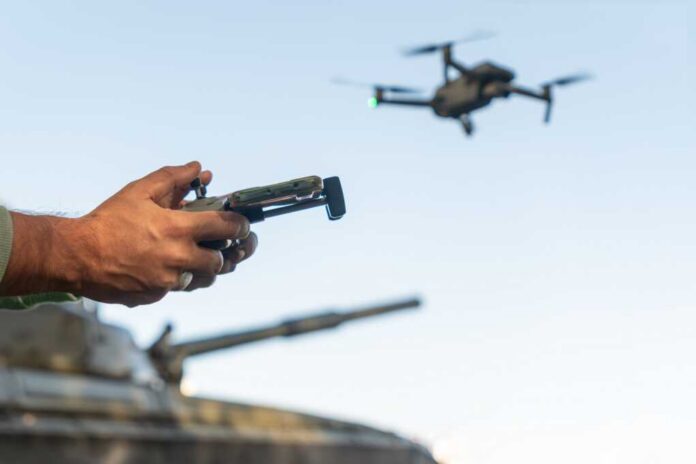
Iran’s cheap drone swarms are being framed as a real “numbers game” threat to America’s most powerful symbol of deterrence: a U.S. aircraft carrier. The deployment of the USS Abraham Lincoln carrier strike group to CENTCOM waters in the Indian Ocean has brought into sharp focus the new kind of asymmetric maritime threat posed by low-cost, high-volume drone technology. Professionals warn that the danger lies not in a single, advanced weapon, but in saturation attacks designed to overwhelm layered defenses, a concern amplified by Iran’s accompanying psychological operations and propaganda.
Story Highlights
- U.S. officials confirmed the USS Abraham Lincoln carrier strike group entered CENTCOM waters in the Indian Ocean as tensions with Iran rose.
- A U.S. drone specialist warned that low-cost, high-volume Iranian drone swarms could attempt saturation attacks designed to overwhelm defenses.
- IRGC-linked accounts circulated footage purportedly showing the carrier, alongside messaging aimed at psychological intimidation.
- Iranian state media also released simulated strike videos, which analysts describe as propaganda rather than proof of an imminent attack.
Carrier Deployment Meets a New Kind of Maritime Threat
Senior U.S. officials confirmed the USS Abraham Lincoln carrier strike group entered CENTCOM waters in the Indian Ocean as the ship moved toward a region shaped by Iranian pressure tactics and repeated threats. The reporting centers on a tactical reality: aircraft carriers are enormous, trackable assets that exist to project power, but that visibility can also make them attractive targets. No attack has been reported in the available updates.
Defense reporting highlighted a warning from a U.S. drone specialist identified as Chell, who described Iranian drone swarms as a credible threat because of cost and volume. The concern is not one “silver bullet” weapon, but a saturation approach—many drones launched together—intended to stress radar, interceptors, and decision cycles. That concept has gained attention as drone warfare continues to evolve faster than traditional procurement timelines.
BREAKING:
Four KC-46A Pegasus tankers just left the U.S. and are flying across the Atlantic Ocean.
They are flying together with six EA-18G Growler electronic warfare aircraft which took off from Virginia. Very bad news for the Islamic regime in Iran… pic.twitter.com/cRgycLwmYL
— Visegrád 24 (@visegrad24) January 29, 2026
Iran’s Psychological Warfare: Footage, Messaging, and Simulations
IRGC-linked social accounts released drone footage said to show the Lincoln, paired with language meant to signal that U.S. forces cannot “hide.” Separate Iranian state media content simulated attacks including a hypersonic-style strike portrayal. Analysts discussing the releases emphasized a key limitation: the videos and claims function primarily as messaging, and the authenticity, timing, and operational relevance of some footage remains unverified in the reporting available.
Iranian commanders and officials also coupled media releases with hardline rhetoric, including statements that framed any strike on Iran as triggering broader conflict. That rhetorical posture matters because propaganda can compress decision-making on both sides, increasing the risk of miscalculation even when neither side is actively seeking a direct war. The public-facing posture also helps Tehran project strength at home while attempting to deter U.S. freedom of maneuver at sea.
Why Drone Swarms Worry Planners More Than “One Big Missile”
Drone swarms change the math because they can be relatively inexpensive and still dangerous when launched in quantity. Chell’s warning focused on the ability of “low-cost, high-volume” drones to complicate layered defenses through sheer saturation, forcing defenders to expend costly interceptors and manage multiple incoming tracks. The threat is amplified at sea because large surface vessels are slow to reposition and can be easier to identify and track.
Reporting also tied the concern to precedents in the broader region, including years of drone and missile activity around the Persian Gulf and Red Sea. Even when proxies are involved, the operational lesson remains consistent: the barrier to entry for disruptive attacks has dropped. That is a strategic shift conservatives should recognize—America’s security can be stressed not only by peer militaries, but by mass-produced systems used creatively against high-value assets.
What This Means for U.S. Deterrence Under a New Administration
With President Trump back in office in 2026, the immediate question is how deterrence will be maintained without stumbling into an avoidable escalation. The reporting shows no confirmed strike, but it does show Iran attempting to shape perception through intimidation content while professionals focus on practical vulnerabilities. Protecting U.S. service members and keeping sea lanes stable requires clear rules, credible response options, and rapid adaptation to the drone-swarm era.
Limited public details are available on specific defensive measures in use around the Lincoln, and responsible reporting avoids guessing about classified capabilities. What is clear from the sources is the direction of travel: Iran is leaning into asymmetric systems and psychological operations, while U.S. commanders must assume that future confrontations may involve large volumes of relatively simple drones rather than a single dramatic “super-weapon.”
Watch the report: US Carrier Strike Group Enters Arabian Sea, Iran in the Line of Fire? | WION News
Sources:
- US carrier strike group is now in Middle East region, sources say | CNN
- USS Abraham Lincoln Aircraft Carrier Strike Group makes move amid threat from Iran
- US aircraft carrier enters Middle East region, officials say | Reuters