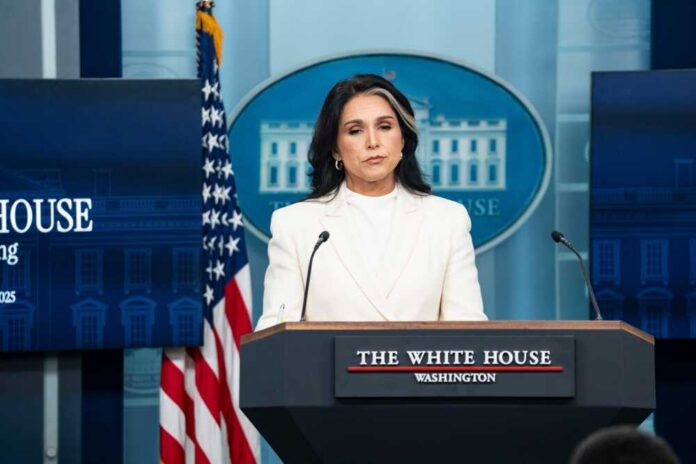
Newly declassified impeachment-era transcripts are reigniting the question many Americans never stopped asking: who really runs Washington when a president threatens the permanent bureaucracy?
Story Snapshot
- DNI Tulsi Gabbard released declassified 2019 closed-door House Intelligence Committee transcripts tied to President Trump’s first impeachment.
- The documents center on the Intelligence Community Inspector General process and former ICIG Michael Atkinson’s handling of the Ukraine-related whistleblower complaint.
- Gabbard argues the testimony shows a coordinated effort inside the intelligence community to advance a narrative that led to impeachment.
- Democrats and critics call the release politically motivated, while supporters frame it as overdue transparency and institutional accountability.
What Gabbard Declassified—and Why It Matters Now
DNI Tulsi Gabbard announced the April 14, 2026 release of declassified records tied to the 2019 House Intelligence Committee’s closed-door impeachment inquiry. The core material includes transcripts from that period and renewed attention to how the whistleblower complaint moved through the inspector general pipeline before reaching Congress. In practical terms, the release reopens a settled political fight with a new focus: whether internal processes meant to protect lawful reporting were instead used to drive a predetermined outcome.
The stakes are larger than a retrospective argument about 2019. Conservatives have long warned that unelected officials can shape outcomes regardless of elections, while many liberals argue internal watchdogs are necessary to restrain presidential misconduct. Gabbard’s move places those claims on a battlefield of transcripts and procedure rather than cable-news talking points. If the public concludes that oversight channels can be gamed, trust in intelligence agencies and congressional investigations takes another hit.
The Whistleblower Process at the Center of the Dispute
The 2019 impeachment began after a whistleblower complaint related to President Trump’s July 25, 2019 call with Ukraine’s President Volodymyr Zelensky. Former Intelligence Community Inspector General Michael Atkinson deemed the complaint “credible” and forwarded it in September 2019, a step that accelerated House Democrats’ impeachment drive. Reporting on the declassified material emphasizes Gabbard’s contention that Atkinson relied heavily on secondhand accounts and did not adequately account for potential bias in the sourcing.
One unresolved element remains central to the public debate: the whistleblower’s identity. Some coverage speculates the complainant was Eric Ciaramella, a former CIA analyst with prior ties to Ukraine policy work; however, the identity has not been officially confirmed. Even so, Gabbard’s argument is less about a name and more about governance: what standards must be met before an allegation becomes a trigger for national upheaval?
Competing Narratives: Transparency vs. Retaliation Politics
Gabbard’s public framing is direct: she alleges “deep state” actors helped “concoct” a narrative to impeach Trump, arguing the release demonstrates coordination and procedural abuses. Critics respond that declassification, in the hands of a presidential administration, can be used to relitigate political grievances and pressure institutions to align with the White House. Both concerns can be simultaneously true in a system where politics and oversight are intertwined and where the same documents can be presented as either accountability or score-settling.
Fox’s reporting also underscores a key legal and procedural tension: inspectors general are typically tasked with a threshold credibility assessment, not necessarily a full-blown investigation at the earliest stage. That fine print is where the dispute lives. If Atkinson operated within statutory boundaries, the “coup” framing weakens. If testimony shows corners were cut, bias was ignored, or jurisdiction was stretched, then the episode becomes a case study in how bureaucratic processes can be weaponized without ever needing a single illegal act.
Why This Resonates with Voters Who Feel the System Is Rigged
For many Americans—right, left, and politically exhausted—this controversy lands on familiar terrain: the belief that government insiders protect themselves, punish outsiders, and rarely face consequences. Conservatives see a cautionary tale about an administrative state that can undermine an elected president. Some liberals see a warning that declassification power can be used to intimidate watchdogs and chill future whistleblowers. Either way, the public’s frustration grows when major institutions appear to serve internal power instead of citizens.
DEEP STATE ALLEGATIONS: Gabbard declassifies records exposing impeachment coup | National Reporthttps://t.co/vHQnKYdq9k
— American Eagle Digital Brigade (@BrigadeSalty) April 15, 2026
The practical question now is what follows. No formal new investigation has been publicly announced, even as Gabbard’s actions intensify calls for reforms to whistleblower handling, inspector general standards, and congressional transparency. Republicans controlling Congress can pursue hearings or legislation, but they also risk turning oversight into pure political theater if they do not define clear standards and measurable reforms. With trust in federal institutions already strained, process integrity—not just partisan victory—may be the real test.
Sources:
Gabbard claims ‘coordinated effort’ by intelligence community to advance narrative to impeach Trump
BOMBSHELL: DNI Tulsi Gabbard exposes deep state plot behind Trump impeachment