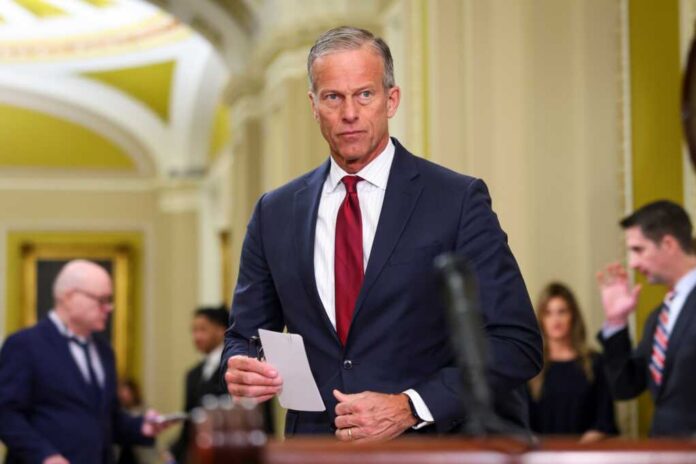
As Iran tensions spike, Senate Republicans are warning that Democrats’ DHS funding blockade is leaving America’s cyber defenses and airport security stuck in shutdown limbo.
Quick Take
- Senate Majority Leader John Thune says Democrats are risking DHS cyber operations as a partial shutdown disrupts core homeland-security functions.
- Thune tied the funding fight to the SAVE America Act, a Republican-backed push to require proof of citizenship for federal voting.
- Shutdown impacts are showing up in daily life, including TSA staffing disruptions at airports, according to Thune’s account.
- Democrats, led by Sen. Chuck Schumer, have focused public messaging on limiting and scrutinizing U.S. military operations in Iran through War Powers oversight.
Thune’s Warning: Cyber Operations and TSA Disruptions Under Shutdown Pressure
Senate Majority Leader John Thune (R-S.D.) used a Tuesday appearance on Fox News’ “Special Report” to argue that Democrats are endangering national security by refusing to fund the Department of Homeland Security during a partial shutdown. Thune specifically pointed to risk for DHS cyber operations while also linking the stalemate to visible disruptions such as TSA agent absences at airports. His argument is straightforward: when DHS funding is uncertain, operational readiness suffers.
This does not include an independent threat assessment showing a specific Iranian cyber operation exploiting the shutdown in real time. What it does show is a clear political warning: Republicans are framing DHS funding as a frontline security requirement during heightened tensions with Iran. In practical terms, DHS covers more than border and airport security; it also supports national cyber functions that depend on staffing continuity, contracts, and day-to-day operational stability.
The SAVE America Act Link: Election Integrity Meets DHS Appropriations
The shutdown fight is also about leverage. President Trump has pushed Congress to include the SAVE America Act—requiring proof of citizenship for federal voting—alongside funding action, and Thune says Senate Republicans intend to force the issue with votes. The Senate moved to open debate on the SAVE Act, with amendments allowed and cloture still requiring 60 votes. Democrats oppose the linkage, while Republicans argue it is basic election security.
This is where the conflict hits conservative nerves: the federal government can find time and money for fashionable priorities, but when it comes to verifying citizenship for voting and keeping homeland security funded, Washington stalls. Thune’s critique as Democrats “holding government hostage” and characterizing their posture as effectively “defund law enforcement.” Those phrases are partisan, but the underlying fact remains that a partial DHS shutdown is ongoing amid a major policy standoff.
Iran Escalation and the Cyber Dimension: What’s Known and What Isn’t
Iran is not a theoretical adversary in U.S. cyber planning, and the history of Iranian cyber operations against U.S. and allied targets. Still, the sources summarized here do not provide technical detail about current Iranian cyber campaigns aimed at DHS systems. Instead, Iran enters the story as a strategic backdrop: tensions rose after U.S. military actions described as “Operation Epic Fury,” and the reports of six U.S. service members killed and oil prices rising about 7%.
In that environment, even the perception of reduced readiness matters. A funding lapse can delay maintenance, slow response hiring, and interrupt coordination across agencies and contractors. Conservatives tend to view this as an avoidable self-inflicted wound: a government that can’t keep its core security functions stable signals weakness. This also acknowledges uncertaint that the shutdown has already produced a successful Iranian cyber breach tied directly to the budget fight.
Democrats’ Countermessage: War Powers Oversight and “Endless War” Concerns
Democrats have largely aimed their public message at the constitutional question of war powers and at the Trump administration’s Iran strategy. The statements from Senate Democratic Leader Chuck Schumer criticizing shifting rationales for U.S. military action and calling for briefings and War Powers enforcement. That line of attack highlights oversight and restraint, rather than DHS funding continuity. It also creates a split-screen debate: Republicans are talking about operational homeland security; Democrats are talking about constraining executive military action.
Senate Majority leader warns Dems are putting cyber operations at risk as Iran threat loomshttps://t.co/aD2zO1N6iD pic.twitter.com/Hz2Sb4SsTj
— Kenosha County GOP (@GOPKenosha) March 18, 2026
Both subjects matter, but they are not interchangeable. A War Powers argument does not pay TSA staff during a shutdown or keep cyber units fully resourced. From a conservative perspective grounded, the practical question is why DHS funding is caught in partisan gridlock at a time when threats—from physical conflict to cyber risk—are already elevated. This does not resolve the impasse; it documents competing priorities and the immediate reality of disruption.
Sources:
Senate Majority leader warns Dems are putting cyber operations at risk as Iran threat looms
Leader Schumer Statement On U.S. Military Operations In Iran