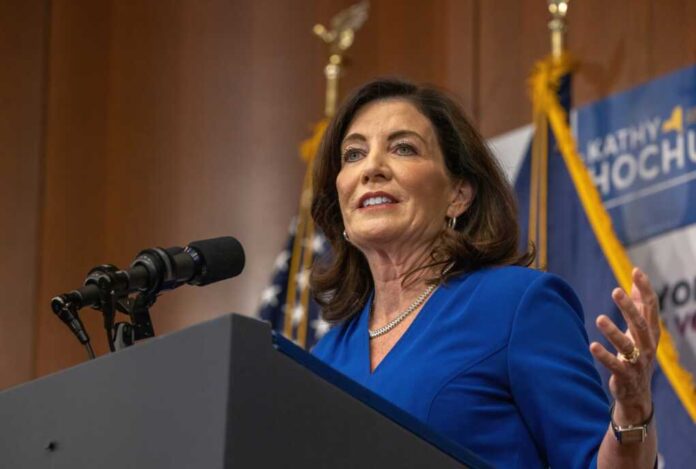
Governor Kathy Hochul’s vow to explore all options for redrawing New York’s congressional maps has ignited a high-stakes constitutional showdown and renewed partisan tensions over national House control.
At a Glance
- Governor Hochul seeks mid-decade redistricting in New York, citing GOP efforts in Texas
- New York’s constitution prohibits such moves without judicial or constitutional triggers
- Legal experts warn Hochul’s strategy is likely unconstitutional and faces steep odds
- The proposal could influence national redistricting norms if pursued
- Political reactions split along party lines, fueling broader electoral concerns
Hochul’s Redistricting Gambit
Governor Kathy Hochul has sparked intense controversy by stating her intention to pursue new congressional maps for New York—a move she frames as a response to recent redistricting efforts in Texas. By invoking another state’s strategy, Hochul signals a willingness to test legal boundaries in order to strengthen Democratic representation in Congress.
Watch now: Redistricting Debate: Can Governors Override State Maps? · YouTube
However, New York’s constitution—amended in 2014—explicitly bars mid-decade redistricting unless ordered by a court or following a constitutional mandate. Critics argue that the governor’s statements are more about political signaling than viable legal action, though they reflect growing pressure among Democrats to counter Republican gerrymandering in red states.
Constitutional and Legal Barriers
New York’s Independent Redistricting Commission was designed to remove partisan influence from map-making, but it has struggled with deadlock and dysfunction. After the commission failed in 2022, a court stepped in to impose interim congressional maps. Those maps remain in effect, with no constitutional trigger allowing for their early replacement.
Legal analysts say Hochul would need either a state constitutional amendment or a favorable court ruling to redraw maps—a tall order in the current legal environment. The constitution’s language is unambiguous: mid-decade changes are not permissible without significant legal justification. As such, most experts regard the governor’s proposal as symbolic rather than actionable.
Political Fallout and Strategic Implications
The political context driving Hochul’s strategy is clear: control of the U.S. House remains precariously divided. Any shift in a large state’s congressional representation could have national ramifications. Democrats, pointing to Texas and Florida, argue that red states are bending norms for partisan gain—and that blue states should respond in kind.
Yet this approach carries risks. Pursuing an unconstitutional redistricting plan could backfire legally and politically. Republicans and nonpartisan watchdogs have condemned Hochul’s rhetoric as an erosion of democratic safeguards. If attempted, such a move could spark a series of retaliatory efforts in other states, undermining the long-standing norm of redistricting only once per decade.
Expert Assessments and Future Outlook
Legal scholars remain nearly unanimous: Hochul’s pathway to redraw congressional lines without court intervention or a constitutional change is extremely limited. With courts likely to strike down any unauthorized maps, the plan’s practical viability appears minimal. Nonetheless, the governor’s comments may galvanize the Democratic base and frame a narrative of resistance ahead of the 2026 midterms.
In the coming months, pressure will mount from both parties. For Hochul, the challenge will be translating political momentum into legal substance—something few expect can be done without risking judicial rebuke. Still, the governor’s strategy adds a new flashpoint to the ongoing national battle over electoral maps and partisan power.
Sources
League of Women Voters of Scarsdale