After 21 hours of ceasefire talks, the Trump administration walked away rather than accept a deal that didn’t lock Iran out of a nuclear weapon.
Quick Take
- Vice President JD Vance said U.S.-Iran negotiations in Islamabad ended without an agreement after Iran rejected key American terms.
- The talks were tied to a two-week ceasefire window announced April 7, meant to prevent the late-February war from escalating.
- Vance framed the U.S. “red line” as an affirmative Iranian commitment not to seek a nuclear weapon or the tools to rapidly obtain one.
- Markets and regional stability remain exposed as Israeli operations against Iran-backed Hezbollah continued in the background.
Why the U.S. ended the talks without a deal
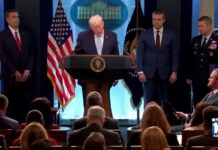
Vice President JD Vance said the U.S. and Iran concluded high-level negotiations in Islamabad, Pakistan, without an agreement after roughly 21 hours of discussions. According to Vance, the central issue was Iran’s refusal to accept American terms requiring a clear commitment not to pursue nuclear weapons or capabilities that could enable a rapid breakout. Vance described the discussions as substantive, but said the U.S. would not cross its stated red lines.
Vance also signaled the White House maintained tight coordination throughout the session. He said he stayed in frequent contact with President Donald Trump during the negotiations, alongside communication involving senior national security officials. In practical terms, that suggests the administration approached the meeting as a decisive test of whether Iran would accept a verifiable baseline for de-escalation—rather than an open-ended diplomatic process that risks buying time for Tehran.
The ceasefire clock is ticking, and that raises the stakes
The collapsed talks matter because they were designed to protect a fragile ceasefire that began April 7 and was set up as a two-week window to negotiate. The war, which began in late February, has already killed thousands and shaken global markets, according to the reporting cited in the research. With the U.S. delegation leaving Islamabad without a signed agreement, the immediate risk is straightforward: the ceasefire could fray quickly, pushing the conflict back into open warfare.
For Americans at home, this episode lands at the intersection of national security and cost-of-living pressure. When Middle East instability rises, energy markets tend to react first, and downstream prices often follow. Disputes extending beyond nuclear issues to strategic chokepoints like the Strait of Hormuz and broader regional tensions. Those flashpoints matter because they can turn a regional fight into a global economic shock with little warning.
What “final and best offer” signals about Washington’s posture
Vance said the United States left behind what he characterized as a “final and best offer” and a “method of understanding” for Iran to consider. That phrasing is a signal to multiple audiences at once: to Iran, it communicates that Washington believes it has already offered sufficient terms; to U.S. allies, it shows the administration is attempting diplomacy before escalation; and to the American public, it frames the decision as discipline rather than drift.
Supporters of a more restrained foreign policy will note a real tension: Americans want fewer open-ended conflicts, but they also don’t want Washington signing agreements that fail to address the nuclear question at the center of the crisis. Based on the reporting provided, the administration’s public position is that a ceasefire without an enforceable nuclear commitment is not a stable peace—it is simply a pause that could leave the same threat intact, or worse, harder to stop later.
Regional complications: Israel, Hezbollah, and the limits of one negotiating table
The negotiations unfolded while Israeli military operations against Iranian-backed Hezbollah in Lebanon continued, underscoring how difficult it is to isolate a U.S.-Iran ceasefire from the wider regional battlefield. Even if Washington and Tehran find narrow terms, other actors can still create escalation through retaliatory strikes, proxy attacks, or miscalculation. It identifies Iran’s parliamentary speaker Mohammad Bagher Qalibaf as a key Iranian negotiator, highlighting that internal Iranian politics can complicate any durable agreement.
Vice President JD Vance says U.S.-Iran talks ended without a deal after Iran refused American terms, calling the outcome bad news for Iran more than the United States.
— Nosheen Evan (@NosheenIsb) April 12, 2026
What remains unclear is what, if any, off-ramp now exists inside the current ceasefire window—or what verification, enforcement, or sequencing mechanisms were proposed but rejected. What is clear is that the administration is publicly prioritizing a nuclear non-proliferation commitment as the price of a broader settlement, and Iran is not accepting that condition as presented.
Sources:
The latest: US Vice President JD Vance says talks with Iran ended without an agreement
Vance says US-Iran talks end without deal after 21 hours of negotiations