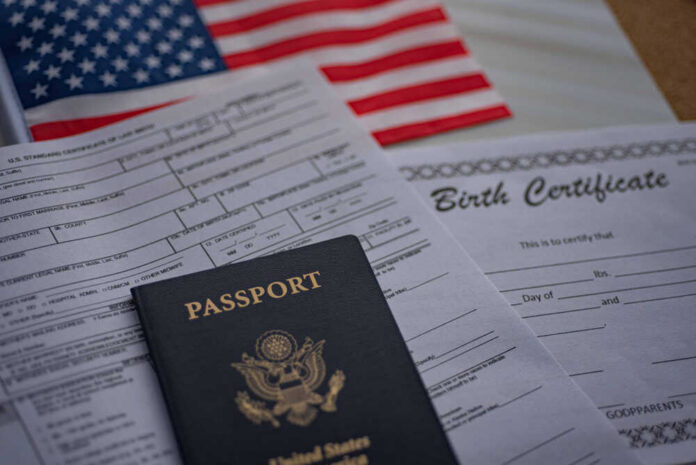
America’s birthright citizenship fight is no longer just about illegal immigration—it’s about whether an executive order can rewrite a constitutional guarantee that’s been understood for generations.
Story Snapshot
- Supreme Court oral arguments on April 1, 2026, tested President Trump’s 2025 executive order restricting birthright citizenship for children born to illegal immigrants.
- Justice Ketanji Brown Jackson’s questioning focused on “allegiance” and whether the administration’s proposed domicile requirement fits the 14th Amendment’s text and history.
- Lower courts have blocked the order so far, but the administration argues those rulings reflect a “fundamental misunderstanding of the Constitution.”
- The Court’s ruling could affect citizenship for children born after Feb. 20, 2025, and could reshape how “subject to the jurisdiction” is interpreted.
What the Court Is Actually Deciding
Supreme Court justices heard arguments April 1, 2026, in the challenge to President Trump’s February 2025 executive order limiting birthright citizenship for children born in the U.S. to parents who are in the country illegally. U.S. District Judge Joseph Laplante issued a preliminary injunction barring enforcement against babies born after Feb. 20, 2025, and lower courts have uniformly ruled the order unconstitutional to date.
The legal target is the 14th Amendment’s citizenship clause—granting citizenship to those “born … in the United States, and subject to the jurisdiction thereof.” That phrase is where the real battle sits: whether it broadly covers nearly everyone born on U.S. soil or whether it excludes children whose parents lack lawful status. The administration’s approach also raises a basic constitutional question for conservatives: how far executive power can go before it starts substituting for legislation.
Justice Jackson’s Questions Put “Allegiance” Under a Microscope
Justice Ketanji Brown Jackson zeroed in on the meaning of “allegiance” and “jurisdiction,” using a practical analogy about a U.S. citizen visiting Japan and being subject to Japanese law if she committed a crime there. Her point was straightforward: physical presence can create legal accountability. Jackson’s line of questioning pressed whether “subject to the jurisdiction” is about being governed by U.S. law while here, rather than a parent’s long-term legal status.
Jackson also challenged the administration’s push to read a domicile requirement into the Constitution—an idea that citizenship at birth should depend on parents having permanent domicile in the United States. She told the administration it faced significant hurdles to show the 14th Amendment departed from the common-law understanding of birthright citizenship. She further questioned whether prior language emphasizing domicile was more about public acceptance at the time than a strict legal requirement.
Why “Wong Kim Ark” and the Common-Law Rule Still Matter
The historical record matters because the modern framework largely traces back to the Supreme Court’s 1898 decision in Wong Kim Ark. That ruling held that a child born in the U.S. to resident aliens was a citizen, describing the 14th Amendment as affirming the “ancient and fundamental rule” of citizenship by birth within the territory, under U.S. allegiance and protection. Challengers argue the amendment deliberately embraced birth-based citizenship, not parentage-based citizenship.
The administration counters that the framers intended something narrower, pointing to commentary after adoption suggesting children of temporary visitors are not citizens and that illegal aliens do not qualify. During the argument, Justice Neil Gorsuch highlighted a key weakness in that theory: the Reconstruction-era debates do not prominently discuss parents, and the term “domicile” is not mentioned—an absence he described as striking. That tension is now central to whether the Court sees the order as interpretation or revision.
Political Stakes for Trump’s Base: Border Enforcement vs. Constitutional Method
President Trump amplified the political stakes after attending arguments, criticizing America’s birthright citizenship policy in blunt terms on Truth Social. Senator Ted Cruz backed ending birthright citizenship and argued it should be pursued through whatever lawful mechanism is available, naming constitutional amendment, legislation, executive order, or the courts. Those comments reflect a broader conservative frustration: voters want the border secured, but many also want the remedy to be constitutionally durable.
The immediate impact could be significant. The Court’s decision will help determine whether children born after Feb. 20, 2025, receive citizenship when their parents are unlawfully present. Challengers warn that narrowing birthright citizenship could cast uncertainty over the citizenship of millions of Americans going back generations. With the administration now responsible for federal action in Trump’s second term, the ruling will also signal whether major immigration changes should run through Congress—or whether executive orders will remain the preferred tool.
Sources:
Supreme Court oral arguments: Trump birthright citizenship — April 1
The key arguments in the birthright citizenship case
Supreme Court Oral Argument Transcript (2025 Term, Case 25-365)