The world’s most experienced Everest climber is now warning that the mountain he has summited more times than anyone alive may be loved to death — and the crowds he’s describing are hard to ignore.
Story Snapshot
- Kami Rita Sherpa, who holds the world record with 32 Everest summits, is calling for limits on the number of climbers allowed on the mountain each season.
- Nepal issued 494 climbing permits in a recent season, with nearly 1,000 climbers and guides expected on the mountain — a volume that has produced dangerous bottlenecks near the summit.
- A record 274 climbers reached the summit from the Nepalese side in a single day, illustrating how acute congestion can become when weather windows are narrow.
- The debate pits genuine safety concerns against real economic stakes — commercial climbs can cost up to $90,000 per person, and that revenue flows directly into Sherpa and local Nepali communities.
The Man Behind the Warning
Kami Rita Sherpa, born January 17, 1970, in Nepal’s Solukhumbu district, has summited Mount Everest 32 times — more than any other person in history. [2] Known widely as the “Everest Man,” he has built that record not as a recreational adventurer but as a professional high-altitude guide whose livelihood depends on the mountain. [4] That context makes his call for climber limits more than a personal opinion — it carries the weight of someone who has watched conditions on the peak change over decades of firsthand experience.
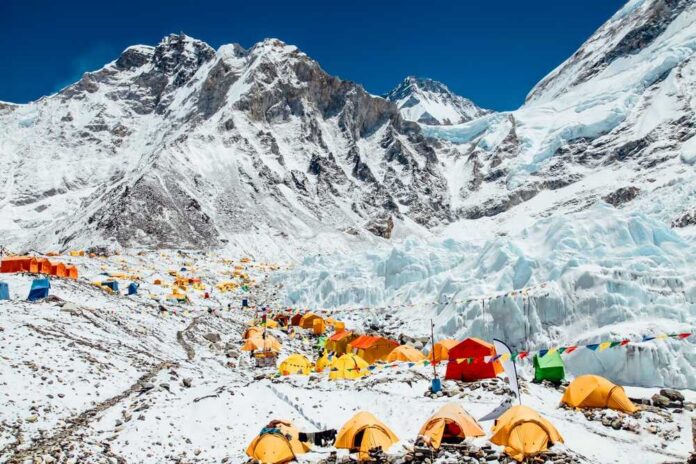
Sherpa’s concern centers on dangerous crowding that develops when hundreds of climbers converge on the same narrow route during the brief spring summit window. Nepal issued 494 climbing permits in a recent season, with nearly 1,000 climbers and guides expected on the mountain before the season closed in May. When favorable weather opens a summit window, that volume compresses onto a single path — producing the kind of traffic jam at extreme altitude where a delay of even a few minutes can become life-threatening.
When Records Become Warning Signs
The single-day summit record tells the story plainly: 274 climbers reached the top of Everest from the Nepalese side in one day. While that number is presented as a milestone, it also represents a serious logistical stress test. At elevations above 8,000 meters — the so-called “death zone” — the human body deteriorates rapidly, supplemental oxygen runs low, and rescue options are severely limited. A queue of climbers stalled on the fixed lines in those conditions is not a manageable inconvenience; it is a potentially fatal situation.
Nepal has begun responding to mounting pressure with new entry requirements. Recent rule changes require climbers to have successfully ascended a peak over 7,000 meters within Nepal before attempting Everest. [5] The intent is to filter out under-prepared climbers whose presence on the mountain increases both their own risk and the risk to guides and rescue teams. Whether those requirements go far enough to address the volume problem is the central question Kami Rita Sherpa is now pushing into public debate.
The Economic Tension No Policy Can Ignore
Any serious discussion of Everest limits runs directly into economics. Commercial expeditions generate critical income for the Sherpa population and for Nepal more broadly, with climbers paying up to $90,000 per ascent. [1] Permit fees flow to the Nepali government, while logistics, guiding, and support work sustain entire communities in the Khumbu region. A hard cap on permits would reduce that income in a country where high-altitude mountaineering is one of the most visible sources of foreign revenue.
A veteran mountain guide just pushed the limits of Everest yet again. Kami Rita Sherpa, 56, has now stood on the world's highest peak 32 times, extending his own record with… https://t.co/mBzk3EdLLf
— Newser (@Newser) May 18, 2026
This tension is not unique to Everest — it mirrors debates playing out globally wherever natural or cultural landmarks face overuse. The question is whether the entity managing access, in this case the Nepali government, has both the incentive and the political will to impose restrictions that reduce its own permit revenue. Kami Rita Sherpa’s public advocacy matters precisely because he represents the Sherpa community that benefits from that revenue but also bears the greatest physical risk from unchecked crowding. His voice complicates any framing that reduces the debate to outsiders versus local interests — he is the local interest, and he is saying the current trajectory is unsustainable.
Sources:
[1] Web – Kami Rita Sherpa & Lhakpa Sherpa: Most times to climb Everest
[2] Web – The Record-Breaking Journeys of Kami Rita Sherpa
[4] Web – Kami Rita Sherpa Explains Why Mount Everest Is Sacred
[5] Web – New Rules for Climbing Everest – Access Nepal Tour