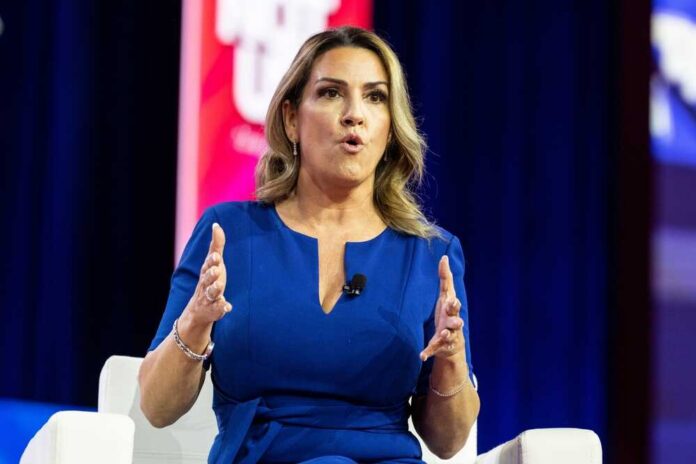
Drug Czar Sara Carter warns that Mexican cartels, battered by Trump administration border crackdowns, are now seeking alternative revenue streams as their fentanyl pipeline faces unprecedented disruption.
Story Snapshot
- Trump administration seizures of 369 million lethal fentanyl doses are squeezing cartel profits
- Enhanced border enforcement and China precursor crackdowns disrupt cartel supply chains
- Carter declares “days of cartels freely operating” are ending under aggressive new policies
- 80,000 American lives lost last year to overdoses, many from fentanyl-laced drugs
Border Crackdown Forces Cartel Adaptation
Sara Carter, confirmed as U.S. Drug Czar in January 2026, revealed that Mexican cartels are exploring income diversification strategies after Trump administration policies severely restricted their traditional fentanyl operations. The administration’s enhanced border enforcement has yielded massive seizures, including 47 million fentanyl-laced pills and 100,000 pounds of powder in the past year alone. Carter’s assessment signals a fundamental shift in the drug war landscape, where tightened controls are forcing criminal enterprises to reconsider business models that previously operated with relative impunity across America’s southern border.
Record Seizures Disrupt Cartel Supply Chains
The Trump administration’s designation of fentanyl and its precursor chemicals as weapons of mass destruction has enabled unprecedented interdiction efforts. Carter announced at the United Nations Commission on Narcotic Drugs in March 2026 that authorities have seized 369 million lethal doses, representing a staggering blow to cartel operations. These enforcement successes stem from a dual-pronged approach targeting both Chinese chemical manufacturers who supply precursors and Mexican cartel networks that process the deadly synthetic opioid. The scale of seizures suggests cartels are losing billions in potential revenue, creating economic pressure that may force them into other criminal enterprises.
China Connection Under Scrutiny
Carter’s remarks at the UN forum emphasized China’s critical role in enabling cartel operations through lax export controls on fentanyl precursor chemicals. The Trump administration has intensified diplomatic pressure on Beijing to crack down on chemical manufacturers who supply Mexican cartels with the raw materials for fentanyl production. This global coordination marks a departure from previous approaches that focused primarily on border interdiction. By attacking the supply chain at its source, the administration aims to make it economically unfeasible for cartels to continue mass-producing the synthetic opioid that killed 80,000 Americans last year.
Human Cost Drives Policy Urgency
The staggering death toll from fentanyl-laced drugs underscores the stakes in this “chemical war,” as Carter characterizes it. Cartels have adulterated cocaine, methamphetamine, and counterfeit prescription pills with fentanyl to maximize profits, showing callous disregard for user safety. In her April 2026 interview with The Washington Times, Carter framed the crisis as cartels waging warfare against American communities with minimal effort but devastating impact. The administration’s aggressive response reflects recognition that traditional drug enforcement strategies proved inadequate against synthetic opioids manufactured with industrial efficiency and distributed through established smuggling networks exploiting porous borders.
Carter’s background as a conservative journalist investigating government accountability issues before her Drug Czar appointment positions her as a trusted voice among Americans frustrated with bureaucratic ineffectiveness. Her messaging emphasizes that the Trump administration is finally confronting cartels with the seriousness the crisis demands, leveraging international alliances and treating fentanyl trafficking as a national security threat rather than merely a law enforcement challenge. Whether these policies will permanently dismantle cartel operations or merely force temporary adaptation remains uncertain, but the administration’s documented seizures represent tangible progress after years of escalating overdose deaths that devastated families across every demographic and region.
Sources:
Remarks by Director Carter at the United Nations Commission on Narcotic Drugs
WATCH: Sara Carter, Dir. Office of National Drug Control Policy sits with Alex