Iran’s push to choke off the Strait of Hormuz is forcing America to choose between letting a hostile regime hold the world’s oil supply hostage—or projecting hard power to reopen a vital sea lane.
Story Snapshot
- The Pentagon is sending the USS Tripoli and the 31st Marine Expeditionary Unit from Japan toward the Middle East as Iran targets shipping near the Strait of Hormuz.
- Reports describe at least six attacks on commercial vessels and warnings about possible mine-laying, driving a sharp disruption in maritime traffic and energy prices.
- President Trump and Defense Secretary Pete Hegseth have tied the deployment to freedom of navigation, with U.S. plans discussed for escorts and strikes on anti-ship threats.
- U.S. strikes hit military targets on and around Iran’s Kharg Island, while the administration warned Iran’s oil infrastructure could be next if interference continues.
Marines and the USS Tripoli Shift From Deterrence to Action
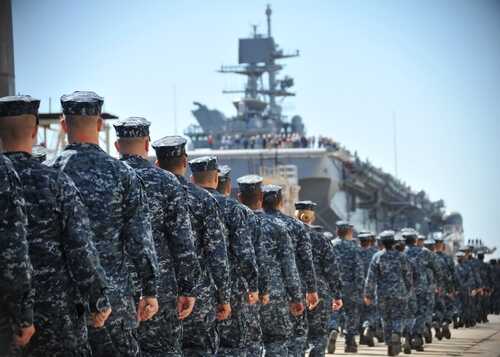
Defense officials say the amphibious assault ship USS Tripoli and its attached 31st Marine Expeditionary Unit are moving from Japan toward the Middle East at U.S. Central Command’s request. The force at roughly 2,500 personnel, with some accounts describing a broader total that could reach about 5,000 Marines and sailors tied to the deployment. The mission is framed around stabilizing a shipping crisis as Iran escalates attacks near the Strait of Hormuz.
The deployment matters because an amphibious ready force is built for flexible options: rapid crisis response, maritime security operations, and, if ordered, limited raids or evacuations. In plain terms, it gives the White House capability choices short of a massive ground commitment. For voters tired of endless wars, that distinction is real. For Iran, it also signals that Washington intends to contest any attempt to intimidate shipping through sheer disruption and uncertainty.
What Iran Is Doing in the Strait—and Why the Strait Matters
The Strait of Hormuz is a narrow chokepoint between Iran and Oman that carries about one-fifth of global oil flows. When Iran signals it can close or cripple traffic there, markets react quickly because replacement routes are limited. Recent reporting describes Iranian attacks on at least six commercial ships and a separate incident involving a Thai-flagged vessel with missing crew members. Mine-laying accusations have circulated, though confirmation has been contested.
Iran’s leadership rhetoric has sharpened the risk. Multiple accounts cite Iran’s new Supreme Leader, Mojtaba Khamenei, calling for blocking the Strait, while the Islamic Revolutionary Guard Corps signaled it would target shipping linked to the U.S. and Israel. That kind of threat is designed to pressure Washington through economic pain rather than conventional battlefield wins. It is also why the administration is emphasizing freedom of navigation: if the Strait becomes a bargaining chip, American leverage shrinks and everyday Americans pay more at the pump.
Trump Administration Response: Escorts, Strikes, and a Clear Red Line
Treasury Secretary Scott Bessent publicly tied the crisis to direct financial harm, citing an estimated $11 billion hit to the United States and indicating U.S. Navy escorts could begin soon. Defense Secretary Pete Hegseth has described the operational goal in blunt terms—defeat, destroy, and neutralize Iranian capabilities that threaten maritime traffic. Joint Chiefs Chair Gen. Dan Caine has been linked to planning focused on countering mines and anti-ship threats that can shut down commercial movement quickly.
Military pressure has already expanded beyond defensive postures. Reports say U.S. strikes hit military targets on Iran’s Kharg Island, a location tied to Iran’s export lifeline, while the administration signaled that oil infrastructure could become a target if interference continues. That sequencing—hitting military assets while warning about economic targets—appears designed to give Tehran an exit ramp.
Uncertainties, Risks, and the Cost Americans Actually Feel
Even with heavy U.S. naval and air advantages described, the biggest danger comes from asymmetric tactics: mines, drones, and missiles that can raise insurance costs and scare shipping companies off the route. One cited expert, former DIA official Harrison Mann, suggested U.S. forces may need to clear Iran’s coastline to protect tanker passage—an idea that underscores how quickly “escorts” can become a broader campaign. Other reports mention internal debate about limited special operations, though public messaging has been cautious about invasion talk.
Up to 2,500 Marines Are Headed to the Persian Gulf as Iranian Blockade of Hormuz Takes Center Stagehttps://t.co/n5xScIfqkC
— RedState (@RedState) March 14, 2026
The crisis has also carried a human cost. A refueling tanker aircraft crash in Iraq that killed 13 U.S. personnel, with additional injuries reported. Meanwhile, Americans at home face the familiar consequence of instability in a global energy chokepoint: higher fuel prices and rising costs that cascade through trucking, groceries, and household budgets. With the Biden-era foreign-policy approach now gone, the current administration is betting that credible force—and enforceable red lines—will restore predictable shipping and deter repeat attacks.
Sources:
U.S. Sending USS Tripoli, Thousands of Marines to Middle East
US dispatched marines to Mideast feeding Iran invasion warnings
US orders 2500 marines to Mideast
Pentagon to move more Marines, extra warships to Middle East amid Iran tensions
US forces headed to Middle East as tensions with Iran rise