Thousands marched through London demanding President Trump halt military strikes on Iran, waving portraits of Supreme Leader Ali Khamenei and openly defending one of America’s most dangerous adversaries while blaming the US for defending its ally Israel.
Story Snapshot
- Approximately 4,000 demonstrators rallied outside the US Embassy in London on March 7, 2026, protesting American and Israeli military operations against Iran and Lebanon
- Protesters carried images of Iranian dictator Ali Khamenei and placards reading “Stop Trump’s wars,” blending anti-American sentiment with explicit support for Tehran’s regime
- Rally organizers warned of wider Middle East conflict while critics note the protest defended a regime responsible for decades of human rights abuses and terror sponsorship
- The event exposed divisions among demonstrators, with some acknowledging Iran’s brutal IRGC oppression while others praised the regime’s “independence from America”
Anti-American Rally Defends Iranian Regime
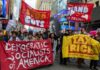
On March 7, 2026, approximately 4,000 protesters marched through central London to the US Embassy, denouncing American and Israeli military operations in Iran and Lebanon. Organized by the Stop the War Coalition and allied groups, demonstrators carried Palestinian and Lebanese flags alongside portraits of Iran’s Supreme Leader Ali Khamenei. Placards demanded “Stop bombing Iran” and blamed “Trump’s wars” for Middle East instability, framing US defensive actions as aggression rather than necessary responses to Iranian-backed terrorism and regional threats.
Trade union leaders and anti-war activists addressed the crowd, claiming the world faces its “most dangerous moment in decades” due to potential regional escalation. Speakers characterized Israeli Prime Minister Netanyahu and US leadership as perpetrators of “murder and mayhem,” ignoring Iran’s long history of sponsoring Hezbollah, Hamas, and other terrorist organizations responsible for countless civilian deaths. The rhetoric revealed a troubling willingness among leftist activists to side with authoritarian regimes against democratic allies, prioritizing anti-Western ideology over factual assessment of Middle East security dynamics.
Divided Protesters Expose Contradictions
Interviews with rally participants revealed stark contradictions in protester motivations and beliefs. Some demonstrators openly praised Iran’s post-1979 Islamic Revolution, claiming the current regime enabled national independence in science and technology while resisting American influence. One protester stated Iran “wants to be independent of America,” defending a theocratic dictatorship’s sovereignty. Others acknowledged the Islamic Revolutionary Guard Corps’ 47 years of oppressive rule, including brutal crackdowns on Iranian citizens seeking freedom, yet still condemned Western military responses as creating additional suffering without addressing root causes of instability.
This internal division highlights the intellectual bankruptcy of much anti-war activism, which simultaneously condemns authoritarian abuses while defending the regimes responsible. The presence of Jewish peace organizations alongside pro-Khamenei demonstrators further illustrates how far-left movements prioritize anti-Israel sentiment over consistency or moral clarity. For observers committed to American security interests and support for democratic allies, these protests represent dangerous moral equivalency that empowers adversaries like Iran while undermining legitimate defensive actions against terrorism and regional aggression threatening global stability.
Economic and Strategic Implications
Rally organizers cited soaring energy prices as justification for opposing military operations, arguing that conflict threatens wider economic consequences including rising food and transportation costs. While energy market volatility merits concern, this framing ignores Iran’s deliberate strategy of destabilizing oil supplies through proxy warfare and nuclear brinkmanship. Protesters demanding cessation of strikes against Iranian targets essentially advocate surrendering leverage that protects global markets from worse disruptions. Their position would embolden Tehran to escalate aggression, knowing Western publics prioritize short-term economic comfort over long-term security.
The rally concluded peacefully under police monitoring with no arrests, demonstrating Britain’s tolerance for dissent even when protesters support adversarial regimes. However, the event signals growing pressure on UK leadership to distance itself from US foreign policy, potentially weakening the Anglo-American alliance critical to countering Iranian influence. For conservatives watching these developments, the London protests underscore how leftist movements abroad mirror domestic challenges, where progressive activists consistently undermine national security while defending ideologies fundamentally opposed to Western freedoms and constitutional principles that protect individual liberty.
Sources:
Thousands March in London Against US-Israeli Military Actions