

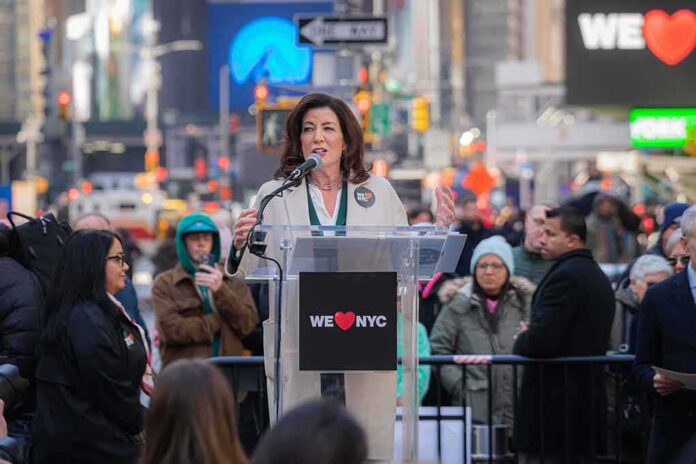
New York Governor Kathy Hochul said her job fighting “sky-high” antisemitism would be easier if Israel’s Benjamin Netanyahu lost power, tying local safety worries to a foreign leader’s war decisions.
Story Highlights
- Hochul linked New York antisemitism anxiety to Netanyahu’s leadership and Israel’s war strategy.
- She said Israel’s “overreach” shifted global opinion after October 7 and fueled backlash.
- Anti-Defamation League data show New York incidents hit a record in 2024, then declined in 2025.
- Critics say Hochul is dodging responsibility for safety on her watch and city politics.
What Hochul Said and Why It Matters
Governor Hochul told Politico her job would be “a lot easier” if Netanyahu lost office, while discussing antisemitism she called “sky-high right now” in New York. She argued Israel’s response to Hamas after October 7 went too far and turned world opinion. She said she warned Israeli officials that an “overreach” could flip support and fuel backlash. She also said she backs Israel’s security and wants leaders who will pursue a safe Palestinian state along with Israel’s safety.
Hochul tied the issue to her duties at home. She said she is focused on protecting Jewish New Yorkers, including security for synagogues and yeshivas, and that she represents “everyone” in the state. Her remarks link a global conflict to street-level safety. That is a risky but common frame when overseas wars echo in American cities. The claim highlights a shared public worry: people feel leaders explain problems away while residents still face threats.
The Measurable Trend in New York
The Anti-Defamation League reported 1,437 antisemitic incidents in New York in 2024, up 18 percent and the highest number the group has recorded for the state. New York City officials said Jewish New Yorkers made up 54 percent of hate-crime victims in the prior year and 62 percent in the first quarter of 2025, underscoring the burden on one community. In 2025, the Anti-Defamation League reported incidents fell to 1,160, a 19 percent drop, while assaults rose from 82 to 90.
Those mixed numbers complicate any simple story. The totals show a record spike, then a decline, but with more physical attacks. The data also do not prove what caused the incidents. Counts group harassment, vandalism, threats, and assaults, and do not assign motive to a single factor like Netanyahu or Israel’s military actions. The figures still give needed context: the problem has been large, visible, and uneven, which tracks with how conflict abroad can trigger or amplify bias at home.
What Research and City Actions Add
Prior studies on hate incidents show spikes can follow major global flashpoints. One time-series study found criminal antisemitic incidents rose during the 2014 Gaza war, suggesting a catalyst effect rather than a single cause. That lines up with a careful view: war coverage and political fights can activate preexisting hate, push fringe ideas into the open, and turn Jews abroad into proxy targets. But linking any leader’s choices to a given New York crime needs case-level proof.
New York City leaders have stressed local action. City Hall created a Mayor’s Office to Combat Antisemitism in 2025 and later moved to codify an international definition of antisemitism into city law. That frame points to policing, grants, and education as the first tools. It also reflects public frustration that government should secure streets now, while debates over global blame continue. Residents across parties see a system that reacts more to politics than to their safety needs.
The Pushback and the Open Questions
Republican Representative Mike Lawler blasted Hochul as “feckless,” saying she was repeating talking points and blaming Jews instead of fixing New York’s problem. Republican candidate Bruce Blakeman said antisemitism rose under Hochul, accused a city lawmaker of fueling it, and faulted her handling of campus protests and safety for Jewish students. These critics press a local accountability frame: use police, enforce laws, and name bad actors in the state.
Hochul says fighting antisemitism in New York would be "a lot easier" if Netanyahu loses.
Jews get attacked in her state, and she blames Israel's prime minister. Not the mobs. Not the campus radicals. Classic Democrat: blame the victim, coddle the haters.— Nathan Brumand (@NBrumand) October 28, 2026
Hochul’s argument includes a policy path she prefers for Israel and a pledge to protect Jewish New Yorkers. But gaps remain. The record documents her statements and the incident counts, not a direct causal chain from Netanyahu’s decisions to New York crimes. To test her case, investigators would need incident files, motives, timing, and links to specific war events. Until then, the debate will reflect a broader anger: people think elites explain while everyday New Yorkers absorb the risk.
Sources:
twitchy.com, politico.com, nyc.gov, nynj.adl.org, israelnationalnews.com, docs.house.gov, hotair.com, ground.news, onlinelibrary.wiley.com