
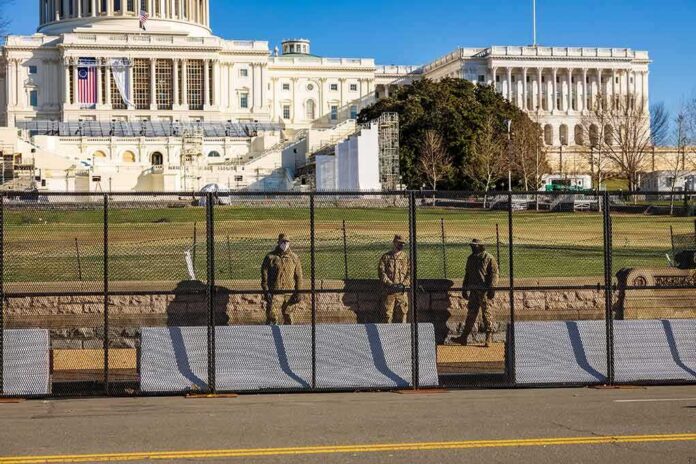
The Justice Department told the D.C. Council it has zero power to order governors to pull National Guard troops from the nation’s capital, setting up a sharp clash over who controls security in Washington.
Story Snapshot
- Justice Department rebuked D.C. Council for urging governors to withdraw National Guard units from Washington.
- D.C. officials and allies point to a recent federal court ruling that parts of the deployment were unlawful.
- California’s attorney general backed D.C.’s lawsuit challenging federal control of Guard forces in the city.
- The fight centers on home rule, public safety, and the limits on using troops for local policing.
What Sparked the Clash
The Department of Justice sent a blistering reply after members of the D.C. Council wrote to several governors urging them to recall their National Guard units from Washington. The department said the council showed “callousness” and “ignorance” about its authority and had no power to demand troop withdrawals. The National Guard has supported public safety missions in the city since last year, drawing protests from local leaders who say federal officials sidelined D.C.’s home-rule powers.
Justice Department officials framed the council’s outreach as political and toothless. They stressed that governors, not the council, command state Guard forces unless the federal government lawfully directs otherwise. Council members argued that troop patrols have blurred the line between military support and civilian policing. City officials said residents want local leaders, not far-off agencies, to make key calls on daily safety and street-level enforcement.
The Court Ruling Shifting the Legal Ground
U.S. District Judge Jia M. Cobb ruled that President Trump’s deployment of more than 2,000 Guard members in Washington for crime deterrence likely violated federal law and D.C.’s home rule. The court ordered an end to the extended deployment and questioned the use of out-of-state Guard units for routine law enforcement support in the District. That decision strengthened D.C.’s case that the mission exceeded the legal bounds for Guard activity inside the city.
The opinion focused on limits within federal statutes and the unique status of Washington, where Congress grants limited self-rule but keeps ultimate control. The judge found that using Guard troops to “deter crime” over time stepped into local policing, which belongs to civilian leaders. The ruling did not erase every possible Guard role in emergencies, but it drew a firm line against a standing troop presence for everyday law enforcement functions.
How States and Advocates Are Responding
California Attorney General Rob Bonta joined a multistate amicus brief supporting D.C.’s lawsuit to halt the deployment. He called the arrangement unlawful, unconstitutional, and undemocratic, underscoring the argument that Washington residents deserve control over local policing decisions. The filing urges the court to protect the District’s authority and to set clear guardrails on when and how troops can be used in civilian settings.
D.C. leaders said denials of their requests to shape the Guard’s duties showed federal agencies overriding local needs. They argued that when outside forces answer to distant officials, accountability fades and residents have less say. Supporters of the deployment counter that Guard units fill gaps, deter violence, and back up police. That tug-of-war over who decides, and when troops cross into policing, is the heart of this federalism fight.
Why This Matters Beyond Washington
Americans across the spectrum worry about safety, fairness, and government overreach. This case blends all three. The Justice Department’s pushback highlights strong executive control during public safety crises. The court’s ruling highlights the risks of using troops for routine policing. Together, they show how power can drift away from people closest to the streets. Many see that drift as one more sign that elites make the rules while everyday voices get tuned out.
What Comes Next
Further court steps will decide how fast the deployment winds down and what limits stick. Governors now face pressure from both the Justice Department and D.C. leaders. Any change will likely move in stages as orders shift and units rotate home. Watch for new guidance on when Guard forces can support cities, how long they can stay, and who signs off. Those answers will shape the balance between safety support and local self-government in the capital.
Sources:
thegatewaypundit.com, justthenews.com, washingtonpost.com, oag.ca.gov, dccouncil.gov, pbs.org, youtube.com