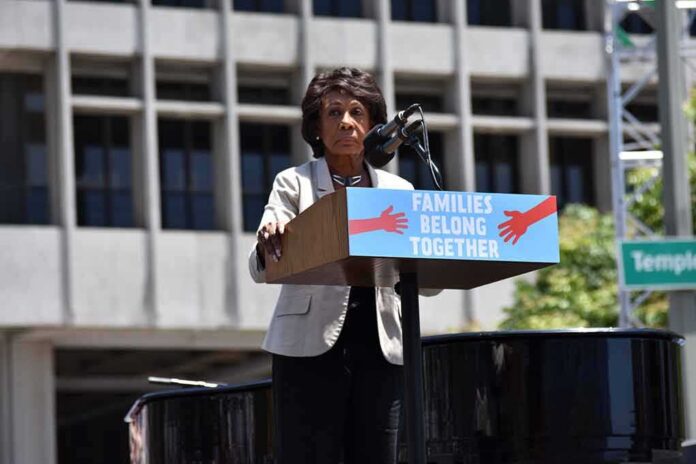
Maxine Waters’s charge that “white media” is manufacturing a Democratic civil war for ratings is less a fringe outburst than a distilled version of an argument she has made for years — and one that maps onto a media-economics reality researchers have documented for decades: conflict sells, and outlets of every ideological stripe are structurally rewarded for amplifying it.
Key Points
- Waters accused the “white media” of stoking division between the Democratic Party and its socialist-aligned flank, framing coverage of intra-party tension as manufactured for ratings rather than organically reported.
- The claim extends a consistent pattern in Waters’s public record of accusing media coverage of distorting Democratic and Black political priorities, dating back years before this specific remark.
- Academic research on “conflict framing” independently confirms that media outlets — across the ideological spectrum — are commercially incentivized to emphasize partisan discord because it reliably drives audience engagement.
- Polling shows deep partisan asymmetry in how Americans view media motives: Democrats have historically trusted the press far more than Republicans, complicating simple narratives about which “side” the press supposedly serves.
- The underlying tension Waters is reacting to — friction between the Democratic Socialists of America and the party’s establishment wing — is real and has been reported by multiple outlets independent of any single network’s editorial slant.
What Waters Actually Said and Why It Landed
Representative Maxine Waters, the veteran California Democrat and longtime member of House leadership circles, told an interviewer that coverage portraying a rift between the Democratic Party and the Democratic Socialists of America was less an honest account of internal disagreement than a commercial product — content engineered by “white media” outlets to generate ratings by dramatizing a Democratic “civil war.” The remark surfaced quickly across conservative commentary sites and social platforms, where it was treated alternately as an indictment of press bias and as an example of a sitting lawmaker deflecting from genuine intra-party strain by blaming the messenger.
Neither framing is new for Waters. She has spent much of her career publicly contesting how television news covers Black political leadership and the Democratic coalition, arguing repeatedly that networks flatten complex policy disputes into simplistic, ratings-friendly storylines. In a 2024 interview on Roland S. Martin Unfiltered, she pressed for party unity and dismissed symbolic media attention in favor of substantive support, telling her interviewer she didn’t need “another certificate” but resources to help the party and the Congressional Black Caucus. That instinct — to treat media framing itself as a political battleground, separate from the underlying policy fight — is the throughline connecting her earlier remarks to this one.
The Mechanism Behind the Complaint: Why Conflict Coverage Is Structurally Favored
Set aside, for a moment, whether any single outlet acted with the specific intent Waters describes. The broader mechanism she’s gesturing at is well established in media-effects research. Academic literature on “conflict framing” finds that news organizations — legacy broadcast, cable, and digital-native alike — disproportionately spotlight elite disagreement, ideological extremity, and intraparty discord because such coverage reliably outperforms consensus-oriented reporting in audience engagement and, by extension, advertising revenue. This isn’t a partisan finding; it describes an economic incentive baked into an ad-supported and subscription-dependent news ecosystem, one that predates cable news and has only intensified with social-media distribution, where outrage and disagreement travel faster than agreement.
Research on partisan gatekeeping adds a second layer: outlets don’t cover party messages neutrally even when reporting on the same underlying facts. Content analyses of party communications versus resulting news coverage show media reports are shaped by partisan bias in what gets amplified, not merely by objective newsworthiness. Put together, these findings mean Waters’s underlying grievance — that friction within the Democratic coalition gets covered more aggressively than friction resolved — describes a real structural tendency in American political journalism. Whether any specific network deliberately targeted Democrats along racial lines, as her “white media” framing implies, is a narrower and more contestable claim than the broader pattern it’s nested inside.
The Trust Asymmetry That Complicates the Narrative
One complicating fact deserves attention: survey data doesn’t support a simple story in which Democrats are uniquely victimized by an oppositional press. Gallup’s long-running trust tracking shows Democrats have consistently reported far higher confidence in the news media than Republicans — 54% of Democrats expressed a great deal or fair amount of trust in 2024, compared with just 12% of Republicans. Pew Research has found similarly lopsided results on questions of press fairness and the media’s watchdog function, with large Democratic majorities crediting the press with keeping political leaders accountable. That asymmetry matters here: if the press systematically favored dividing Democrats for profit, one would expect it to show up in comparably low Democratic trust numbers over time. It hasn’t. What the data does show is a media environment where conflict of any kind — including conflict inside a single party — is disproportionately newsworthy by commercial design, which is a different and more universal problem than a racially motivated campaign against one coalition.
The Democratic Coalition Strain Is Real, Independent of Framing
Strip away the “white media” framing and the underlying tension Waters is responding to is not manufactured. Friction between the Democratic Party’s establishment wing and its socialist-aligned flank, including the Democratic Socialists of America, has been documented across outlets with very different ideological orientations and audience bases, suggesting the disagreement itself predates any single network’s coverage decision. Research on digitally networked political factions finds that hyper-partisan media and networked elites can accelerate and sharpen intraparty radicalization once it exists, functioning as an amplifier rather than an originator. That distinction — amplification versus fabrication — is the crux of any fair assessment of Waters’s claim: the coverage may well be dramatized for engagement, consistent with documented industry incentives, without the disagreement it’s covering being invented from nothing.
What This Means Going Forward
Waters’s complaint will keep recurring in some form because the incentive structure she’s naming isn’t going away. As long as political media operates on engagement-driven revenue models, stories emphasizing party fracture will out-perform stories emphasizing party discipline, regardless of which party is in the frame. The durable lesson for readers isn’t to accept or dismiss any single lawmaker’s accusation of media motive wholesale, but to recognize the underlying commercial logic that makes conflict coverage the default output of the modern news business — and to evaluate specific claims of intraparty division on their own evidentiary merits, separate from whichever outlet happens to be reporting them.
Sources:
waters.house.gov, transcripts.cnn.com, atlantablackstar.com, youtube.com, news.gallup.com, nexttv.com