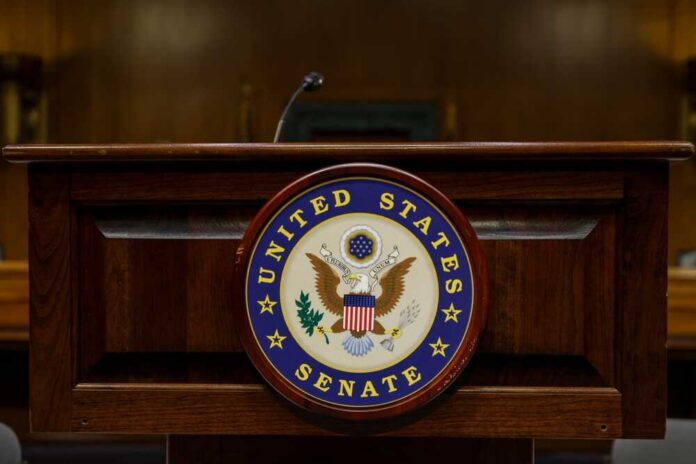
In an all-night “vote-a-rama,” the Senate quietly took a step that could lock in tens of billions for immigration enforcement with almost no meaningful say from the public — or from half the country’s elected senators.
Story Snapshot
- Senate Republicans used a budget “vote-a-rama” to push forward a reconciliation path for about $70 billion in Immigration and Customs Enforcement (ICE) and border funding without needing Democratic votes.[1][2][5]
- The budget resolution instructs key committees to write a multi‑year funding bill expected to cover immigration enforcement agencies through the rest of President Trump’s second term.[1][2]
- Democrats tried and failed to attach oversight “guardrails,” warning that Republicans are writing a huge check to agencies they accuse of abuse and lack of accountability.[2]
- The process itself — reconciliation plus vote-a-rama — has become another symbol of a Congress more focused on procedural power plays than on fixing a broken immigration system.[1][2][4]
What the Senate Just Did — And Why It Matters
After an overnight series of rapid-fire amendment votes, the Senate approved a Republican-written budget resolution by a narrow 50–48 margin.[1][2] That resolution does not itself send money to Immigration and Customs Enforcement or Customs and Border Protection, but it opens a special “reconciliation” fast lane for a future bill expected to total roughly $70 billion.[1][2][5] Republicans say that amount is designed to fund immigration enforcement agencies for about three to three-and-a-half years, effectively through the rest of Trump’s term.[1][2]
Because the reconciliation process allows budget-related bills to pass the Senate with a simple majority instead of the usual 60 votes, Republicans can move this funding without a single Democrat on board.[1][2] In a chamber where most legislation now dies in partisan gridlock, that is the point: reconciliation is a tool to get around the minority, not to bring the country together.[1][2] For many Americans across the spectrum, it reinforces the sense that big choices about money and power are made by narrow partisan majorities, not broad consensus.
How “Vote-a-Rama” Turns Serious Policy Into a Procedural Marathon
The all-night spectacle that preceded the vote was a classic Senate “vote-a-rama,” a quirky feature of the Congressional Budget Act.[1][4] Once debate time expires on a budget resolution or reconciliation bill, senators can offer an unlimited number of amendments, each getting a quick up‑or‑down vote with little real discussion.[4] In theory, that gives every senator a chance to put ideas on the record; in practice, it often produces a political obstacle course of messaging votes, gotcha amendments, and exhaustion.[1][4]
Reports indicate this vote-a-rama stretched for hours into the early morning, with dozens of amendments flying.[1][2][3] Democrats used the process to push for oversight conditions and reforms, while Republicans largely focused on protecting the core enforcement money and swatting down changes they considered “handcuffs” on agents.[2] For people watching from outside Washington, it can look less like careful lawmaking and more like a late-night endurance contest run by insiders who already know the outcome.
Republican Argument: Secure the Border, Bypass the Stalemate
Republican leaders frame the reconciliation plan as a necessary corrective after years of what they see as deliberate underfunding and politicized obstruction of front‑line agents.[1][2][3][5] They argue that Immigration and Customs Enforcement and Customs and Border Protection have been asked to manage record border pressures, drug smuggling, and violent criminal networks while Democrats and the media paint them as villains instead of law enforcement professionals.[2][3] For conservatives who have watched border crises deepen, the promise of multi‑year, insulated funding looks like long‑overdue backup for agents on the ground.
The resolution’s instructions are narrowly focused: the Judiciary Committee and the Homeland Security and Governmental Affairs Committee are told to draft language enabling up to $70 billion in additional immigration-enforcement spending.[1][5] That keeps the spotlight on detention, removal, and border operations rather than broader Department of Homeland Security programs.[1][5] Supporters say this targeted approach prevents the White House or future Congresses from diluting enforcement money into unrelated projects, a concern that has grown as big omnibus bills bundle dozens of priorities together.[1][2][5]
Democratic Objections: No “Blank Check” for Agencies Under Fire
Democrats, for their part, say the problem is not just the size of the check but the lack of strings attached.[2] Senator Patty Murray and others have cited specific incidents — including tear-gassing a family after a basketball game, pepper-balling a priest, and deaths in federal custody — as evidence that immigration enforcement agencies cannot be trusted with more money without new safeguards. Their demands have included body cameras, clearer training standards, warrants for certain enforcement actions, and protections for sensitive locations like churches and schools.
Wow they actually did something.
JUST IN: Senate Republicans have just ADVANCED the $70 billion ICE and Border funding reconciliation bill, 53-46
If passed, the agencies will be FUNDED through 2029
This comes after Senate Republicans already MISSED President Trump's June 1st… pic.twitter.com/qG6O1N4RVK
— JohnTitor17 (@JTitor17) June 4, 2026
These concerns resonate with many liberals who see “America First” enforcement as trampling civil rights and deepening the divide between citizens and the state, but they also speak to a broader unease shared by independents and some conservatives. When large, armed federal agencies receive huge, fast-tracked funding with limited transparency, people across the spectrum worry about abuse of power. Yet the record so far shows Democrats failing to secure major reforms through amendments, leaving them to watch from the sidelines as Republicans drive the process.[1][2][4]
A Broken Process That Both Sides Say They Hate — But Still Use
This fight unfolds against a larger backdrop that should trouble anyone who believes government is supposed to serve the people rather than itself. Both parties have used reconciliation to jam through big-ticket items: Republicans for tax cuts, Democrats for pandemic relief and climate spending, and now Republicans again for immigration enforcement funding.[1][2] Each time, the majority calls it “necessary,” the minority calls it “abuse,” and ordinary Americans see another example of the rules being bent to keep power in the same hands.
The deeper issue is that Congress is no longer seriously debating comprehensive immigration reform, oversight, and long-term border strategy.[1][2] Instead, leaders wait for a crisis or a shutdown, then weaponize complex budget tools to reward favored agencies or constituencies while blaming the other side. Whether you worry more about crime and illegal immigration, or about government overreach and civil liberties, this episode illustrates the same uncomfortable truth: a political class skilled at grinding through vote-a-ramas, but increasingly incapable of delivering a fair, transparent, and durable immigration system that reflects the country’s values.
Sources:
[1] Web – Senate to hold “vote-a-rama” on ICE funding ahead of final passage
[2] Web – Senate Republicans Pass Budget Resolution Laying Groundwork …
[3] Web – Senate adopts budget resolution after marathon “vote-a-rama” as …
[4] YouTube – Senate Votes to Advance $70 Billion Funding Plan for ICE, Border …
[5] Web – U.S. Senate: “Vote-aramas”