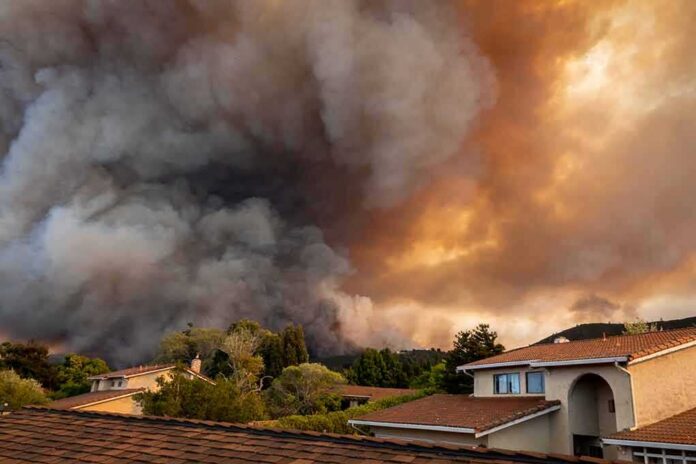
As smoke from hundreds of Canadian wildfires pushed Chicago’s air into “worst in the world” territory, more than 100 million Americans were reminded again how decisions far above their pay grade keep turning daily life into a health hazard.
Story Snapshot
- More than 100 million Americans face air quality alerts as Canadian wildfire smoke blankets the Midwest and Northeast.
- Chicago, Detroit, and other cities briefly ranked among the most polluted on Earth, with air quality reaching hazardous levels.
- Over 800 active Canadian wildfires and years of policy drift have turned cross‑border smoke into a new “normal.”
- Both left and right see another example of distant elites failing to protect basic health, infrastructure, and transparency.
Wildfire Smoke Turns Ordinary Cities Into Global Pollution Hotspots
Across the Midwest and Northeast, more than 100 million Americans have been placed under air quality alerts as a thick blanket of smoke drifts south from Canada. National Weather Service bulletins and multiple news outlets report alerts stretching from Minnesota and Wisconsin through Michigan, Illinois, Pennsylvania, New York, and down the East Coast. Chicago, Detroit, and Minneapolis at times ranked among the most polluted major cities on Earth, with air labeled “unhealthy” or worse for millions of residents.
Canadian fire data show why the skies turned gray so fast. Reports describe more than 850 active wildfires across Canada this season, with well over 100 categorized as out of control, many burning in remote boreal forests that are hard to reach and costly to fight. Winds then carried massive plumes of fine smoke particles over the Great Lakes and into major American population centers, a pattern now familiar from the record‑breaking 2023 season and repeated flare‑ups in 2024 and 2025.
Health Risks Hit Everyday People While Officials Repeat the Same Script
Doctors and health agencies warn that the tiny particles in wildfire smoke, called fine particulate matter, can get deep into lungs and even enter the bloodstream. Health Canada and United States experts link these particles to coughing, shortness of breath, aggravated asthma, and higher risks for heart and lung problems, especially for older adults, children, and anyone with existing disease. During this smoke wave, residents from Chicago to New York report sore throats, headaches, and fatigue, matching what health research has long warned about these events.
Government responses followed a now‑standard playbook. Officials issued broad alerts, told people to stay indoors, and recommended or distributed high‑filtration masks in some cities. In Chicago and parts of New York and New Jersey, agencies limited outdoor events and warned commuters about hazardous conditions on platforms and buses. These steps likely helped some people avoid the worst exposure. But they also highlighted a deeper problem: once again, the system waited until the smoke was already here before acting, and most of the burden fell on families who have the least flexibility to stay home.
A Recurring Pattern Reveals Deeper Policy Failure, Not a One‑Off Crisis
Scientists now say these smoke emergencies are no longer rare accidents but part of a long‑term shift in North American air quality. A recent analysis of seven decades of data found that 2023 produced the highest wildfire smoke levels on record, with smoke or haze reports roughly double the previous peak and seven times higher than in the mid‑twentieth century. NASA and other researchers show that Canadian wildfires now routinely push heavy smoke into the United States, affecting surface air quality hundreds or even thousands of miles away.
For many Americans, this pattern feeds a familiar frustration. Conservatives see years of poor forest management, red tape, and global climate deals that did little to harden forests or protect communities. Liberals see warnings about climate change and inequality ignored while wealthy interests profit and working families breathe the fallout. Both sides watch the same thing happen again and again: agencies issue warnings, politicians trade talking points, and the structural problems that fuel megafires and fragile power grids remain mostly untouched.
Trust Gaps Grow As Media, Experts, And Agencies Speak With One Voice
During this latest smoke wave, major outlets across the spectrum—television networks, newspapers, and digital sites—framed the conditions as clearly hazardous and pointed to Canadian wildfires as the source. Weather agencies in both countries backed that view, and local leaders amplified it with their own alerts and press events. On paper, this looks like responsible coordination. But to many citizens who already distrust “the system,” such uniform messaging feels less like clarity and more like a closed circle that never answers harder questions.
Detroit's air quality ranks among the world's worst due to Canadian wildfire smoke. Hazard alerts across Michigan, Minnesota, Chicago, Philadelphia, and NYC. Visibility down to half a mile; officials urge people to stay indoors. #Wildfires #AirQuality pic.twitter.com/ofD6GvxeLZ
— Apprise.News (@Apprise_news) July 17, 2026
Those questions cut across party lines. Why, after the “most significant” Canadian fire season in 2023, did North America still enter 2026 without tougher prevention, better controlled burns, or modernized forest and power infrastructure at scale? Why is there so little public, real‑time data on hospital visits tied to each smoke episode, when that information could guide smarter local choices? And why do ordinary people keep getting told to mask up and stay indoors while the financial and political incentives that drive risky land use, underfunded firefighting, and slow adaptation stay largely intact?
Sources:
facebook.com, cnn.com, youtube.com, cbc.ca, globalnews.ca, foxweather.com, sciencedirect.com, toronto.citynews.ca, nytimes.com