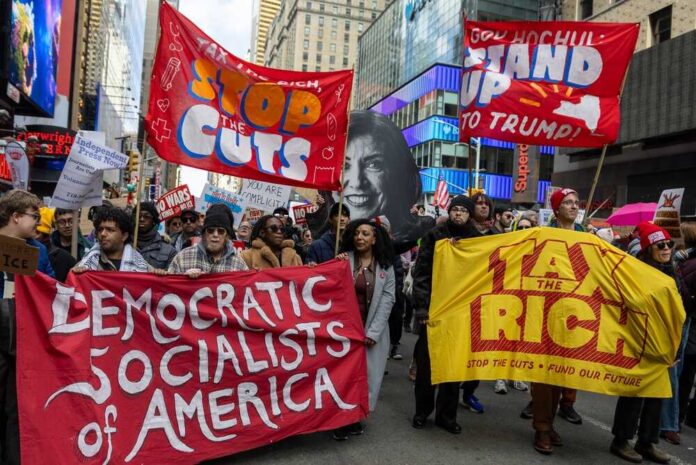
The Democratic Socialists of America just put on paper a plan to scrap the Senate, the presidency, and the Supreme Court and draft a brand‑new socialist constitution for the United States.
Story Snapshot
- DSA’s new “Workers Deserve More” platform openly calls to abolish the U.S. Senate and Electoral College.
- The plan would replace the president and Supreme Court with an executive and judiciary fully controlled by Congress.
- The platform declares a goal of drafting a new constitution and creating a “democratic socialist republic.”
- The move reflects deep anger at the current system from the far left, while alarming many across the spectrum.
DSA’s Platform: What It Says About Remaking the Government
The Democratic Socialists of America released a national program called “Workers Deserve More” that goes far beyond standard policy debates. The platform’s democracy section calls for a new political system where the working class “governs,” not just votes. Key proposals include abolishing the Electoral College and replacing it with a national popular vote, expanding the House of Representatives, and using proportional representation and ranked choice voting in all elections. These ideas aim to weaken what DSA sees as elite control and increase direct voter power.
Most striking, the program calls to “abolish the Senate” and to “replace the President and Supreme Court with an executive and judiciary chosen by and subordinate to Congress.” In practice, that would erase the current checks and balances between three separate branches of government. Congress would sit alone at the top, with other institutions serving under it. The document goes further, vowing to “win the battle for democracy, draft a new constitution, and create a democratic socialist republic,” signaling an overhaul of the entire American constitutional order rather than mere reform.
How This Fits a Longer History of Radical Constitutional Demands
Radical calls to scrap core parts of the U.S. Constitution are rare but not new. In the 1800s, one wing of the abolitionist movement led by William Lloyd Garrison publicly burned copies of the Constitution and denounced it as a “pact with slavery,” demanding that it be abolished and replaced. Other abolitionists, such as Frederick Douglass, argued instead that the Constitution could be used to fight slavery from within. In the end, slavery was ended through the Thirteenth Amendment, which changed the existing Constitution instead of replacing it outright.
That history matters because it shows how extreme DSA’s call is compared with the usual path of reform. For more than two centuries, even major changes—like ending slavery, expanding voting rights to women, and limiting presidential terms—were handled by the amendment process and rulings inside the current system. There has never been a successful mass movement in the United States that eliminated entire branches of the federal government and wrote a new charter from scratch. DSA is placing itself in a long line of “abolition” language, but targeting the structure of the state itself rather than a single unjust practice.
Why This Alarms Many—and Still Resonates With Deep Frustration
City Journal and other outlets describe the platform as aimed at “destroying constitutional checks and balances” and building a “democratic socialist republic” through sweeping structural change. The program does not only target government design. It also calls for public ownership of the largest corporations and essential industries, aggressive wealth taxes, a federal jobs guarantee, and universal rent control. Foreign policy planks demand defunding the Department of War, closing overseas bases, and lifting sanctions on countries like Cuba, Venezuela, and Iran. Together, these measures point to an effort to end capitalism and centralize economic and political power under a new socialist order.
For conservatives, this confirms fears that the far left wants to tear down the country’s founding principles—separation of powers, federalism, private property—and replace them with one‑party rule and state control of the economy. For many liberals, the idea of Congress controlling the executive and judiciary raises worries about abuse of power and loss of civil liberties, even if they share DSA’s anger at corporate influence and inequality. Yet underneath the shock, the platform taps into something broader: a feeling on both left and right that the current system serves elites, not ordinary people, and that normal reforms have failed to fix corruption, gridlock, and economic pain.
Political Reality: Powerful Signal, Limited Immediate Impact
The Democratic Socialists of America is a relatively small organization compared with the major parties, but it has grown in influence, with over 90,000 members and elected officials in several big cities. Its platform was adopted by the group’s National Political Committee and now serves as its main public program. However, the path from a party document to actual law is long and steep. Abolishing the Senate or rewriting the Constitution would require massive political support, constitutional amendments, and state ratification—or a revolutionary break, which the platform hints at but does not spell out.
We can find senior members of the GOP and Dems who say things that are equally as batshit.
I do not agree with such statements, but none of those statements represent any party platform.
Anything I can find on 'destruction of the US' is hyperbole referencing entrenched systems…
— Adam Cochran (adamscochran.eth) (@adamscochran) July 19, 2026
Today, Republicans control Congress and the presidency, and there is no sign that either major party backs DSA’s blueprint. Still, the platform matters because it shows how far some activists are willing to go when they believe the system is rigged beyond repair. For readers across the spectrum who already suspect that national leaders care more about their careers than fixing deep problems, DSA’s document is both a warning and a symptom: a warning that fringe ideas to tear down institutions are gaining attention, and a symptom of how badly trust in the federal government has eroded.
Sources:
facebook.com, platform.dsausa.org, convention2021.dsausa.org, city-journal.org, youtube.com, washingtonexaminer.com, townhall.com, wikimedia.brussels, courses.lumenlearning.com, academic.oup.com