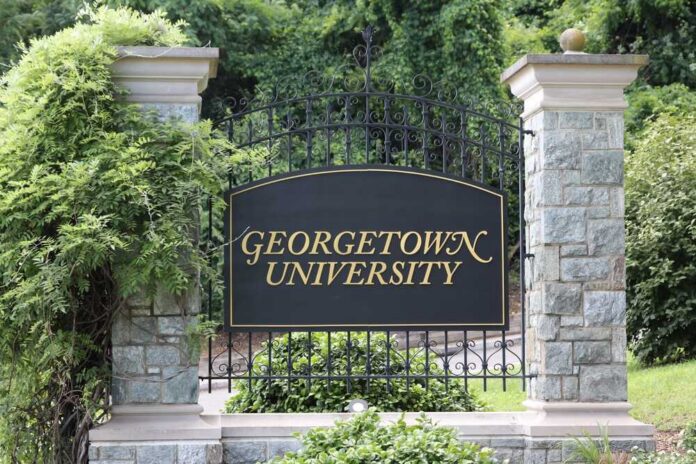
Foreign-funded academic programs live or die by one question: can an institution take the money and keep its independence—procedurally, contractually, and culturally—when the donor’s interests intersect with a strategic rival’s political agenda.
At a Glance
- Georgetown launched its Initiative for U.S.-China Dialogue in 2016 with a $10 million gift from the Hong Kong–based Spring Breeze Foundation, itself supported by Thailand’s CP Group.
- The Department of Education later alleged Georgetown fell short of Section 117 foreign gift reporting—specifically naming Spring Breeze and asserting $2.36 million tied to “intermingling” with the CCP’s Central Committee—claims the university denies.
- The Initiative has run student fellowships, workshops, and public events, creating sustained contact between students and PRC-linked institutions; critics say this furnishes soft-access to future policymakers, while Georgetown cites independent, often critical output.
- The core dispute is not whether the money arrived, but whether its terms, transparency, and program governance adequately firewall academic independence in a domain rife with underreported foreign funding across U.S. higher education.
What the Georgetown case actually establishes—and what it doesn’t
Start with the uncontested facts. Georgetown publicly announced a $10 million gift in support of its Initiative for U.S.-China Dialogue on Global Issues, crediting the Spring Breeze Foundation and stating Spring Breeze is supported by Thailand’s CP Group, a major conglomerate. That money seeded a suite of activities—research groups, fellowships, dialogues, and public events—meant to convene stakeholders across the U.S.-China policy space. By 2019, the program counted dozens of fellows and events, indicating real scale and continuity. On the government side, the Department of Education (DoED) opened a Section 117 inquiry and, in public-facing materials, alleged Georgetown failed to fully disclose foreign gifts; those allegations cite Spring Breeze and reference $2,360,807 derived via “significant intermingling with the People’s Republic of China,” naming the CCP’s Central Committee.
These points matter because they narrow the question. We’re not adjudicating whether foreign money touched an elite U.S. campus; it did. The real issues are whether Georgetown complied with statutory disclosure, whether the donor has political entanglements material to academic freedom, and whether the Initiative’s structure insulates scholarly judgment from donor leverage.
Disclosure law, the “who” behind the money, and why provenance matters
Section 117 of the Higher Education Act requires reporting of foreign gifts and contracts at or above $250,000 in a calendar year; it exists to surface potential influence channels, not to ban foreign support. The DoED’s 2020 enforcement push documented widespread underreporting nationwide, with billions in unreported funds across multiple regimes, a pattern later echoed in outside analyses of the federal database and compliance risks. In that context, the Department’s allegations against Georgetown are part of a national compliance story, not a one-off anomaly. Georgetown has categorically denied wrongdoing, asserting it fulfilled reporting obligations and preserved academic freedom; however, categorical denials are not dispositive without documentary rebuttal tracing the questioned funds and agreements to the ledger line.
The donor provenance question is more subtle. Georgetown’s release identifies Spring Breeze as supported by CP Group and describes CP as a Thai multinational; it does not label CP “CCP-linked”. Critics cite a DoED description of Spring Breeze as financed by CP Group with “extensive commercial relationships with the CCP,” and point to CP’s footprint in China as a vector for influence risk. Separately, campus reporting flagged that the foundation backing the gift had been tied, via external journalism, to labor abuses in Thai fisheries—a reputational hazard distinct from political influence but still relevant to donor ethics screening. These threads do not, by themselves, prove CCP direction over program content; they do establish that the Initiative’s primary benefactor sits within a network of commercial and reputational risks that any robust gift acceptance process should confront directly, in writing, with enforceable independence clauses and disclosure.
Access versus influence: how student-facing programs can become leverage points
Universities are magnets for future public servants; that is neither new nor nefarious. The security question is whether structured contact with state or party-adjacent institutions creates durable access and agenda-shaping opportunities before students enter sensitive roles. The Initiative’s activity record—fellows, workshops, and public dialogues—demonstrates repeated, programmatic interactions that could, in theory, create such pathways. That’s the risk vector critics emphasize. Georgetown’s rejoinder is that the Initiative operates on principles of independence, transparency, balance, and academic excellence and has published work critical of the PRC and the CCP, which, if verified at scale, cuts against a capture narrative. Both statements can be true in part: a program can host critical content and still provide contact opportunities useful to foreign political actors. The operative question is governance—who sets agendas, who selects speakers and fellows, what are the preclearance and conflict-screening protocols, and what disclosures accompany engagements with state or party organs.
Evidence in the public record does not show contractual content control by the donor. Nor, however, has Georgetown released the unredacted gift agreement to demonstrate explicit academic independence clauses, funding firewalls, or veto prohibitions. Absent that, the public must infer from outcomes and process signals. As a rule, inference is a weak substitute for documentary proof—on both sides.
What the Department of Education alleged—and what remains unresolved
The DoED’s allegation that Georgetown “derived $2,360,807” through “significant intermingling” with the PRC, naming the CCP Central Committee, is specific enough to warrant a documentary answer: where did that figure come from, what transactions or co-funding arrangements underlie it, and what was misreported or undisclosed? The university’s denial is broad—compliance and academic freedom were maintained—but does not, in public materials, anatomize the dollar figure or the “intermingling” mechanism. Until a final adjudication or a point-by-point rebuttal appears, this remains an open compliance question, not a settled scandal or an exoneration.
Separately, congressional scrutiny—such as Rep. Mike Gallagher’s letter calling for examination of the Spring Breeze/CP Group connection and warning about proxy exploitation of the public-private revolving door—signals policy salience. It does not, however, substitute for evidence of donor-driven content or selection bias within the Initiative; it frames the risk and calls the question, which is what oversight letters are designed to do.
The broader pattern: higher education’s foreign funding blind spots
Georgetown’s case sits inside a larger compliance and governance pattern: American universities have long depended on foreign gifts and contracts, while their internal controls, disclosure practices, and donor-diligence protocols have lagged geopolitical reality. The DoED’s 2020 probe concluded that colleges underreported billions—a conclusion summarized by legal and policy analyses warning of institutional exposure when gift acceptance and 117 reporting diverge. Because the law focuses on transparency rather than content, the quality of institutional guardrails—contract language, donor due diligence, conflict-of-interest screening, and public disclosure—determines whether a program can earn public trust when donors come from politically entangled ecosystems.
That backdrop clarifies why the Georgetown dispute persists years after the initial gift: the unresolved, document-level answers matter more than assertions of virtue or allegations of capture. Without them, both narratives will continue talking past each other.
What credible resolution would look like
Three steps would convert speculation into verification. First, publish the unredacted gift agreement with Spring Breeze, including any side letters, amendments, and compliance addenda: independence clauses, non-interference language, governance of programming and fellow selection, and any termination-for-cause provisions tied to political interference or human-rights concerns. Second, issue a granular, transaction-level reconciliation answering the DoED’s $2.36 million “intermingling” allegation: counterparties, dates, amounts, and why Georgetown concluded no additional reporting was required—or, if errors occurred, what corrective filings and controls were implemented. Third, commission an independent, methodologically transparent audit of the Initiative’s outputs and processes since 2016: topic coding for stance diversity, speaker affiliation mapping (government, party, SOEs, NGOs, academia), and selection protocols for fellows and workshop participants, with the dataset made public for replication. Together, these measures would either corroborate Georgetown’s claims of independence at scale or surface specific weaknesses to be fixed.
Practical governance standards going forward
For programs operating in politically sensitive domains, credible independence is engineered, not assumed. The benchmark toolkit looks like this: risk-rated donor due diligence that assesses political ties and human-rights exposure; contracts that prohibit content control, selection influence, or prior review; standing disclosure that names funders on every program output and event page; a balanced speaker mix audited annually against quantifiable targets; selection committees insulated from donors and documented conflict checks; and a public archive of gifts and contracts linked to an institutional Section 117 dashboard, updated quarterly. None of this hampers scholarship; it protects it.
Applied to Georgetown’s Initiative, these standards would not preclude collaboration with Chinese scholars or institutions; they would simply ensure that such collaborations are transparent, pluralistic, and governed by the university—not by donors or political intermediaries. That is the line that keeps dialogue from becoming conduit.
Bottom line
The record supports three firm conclusions. Georgetown took a large foreign-backed gift to build a durable U.S.-China program; federal regulators later questioned the university’s foreign gift reporting, naming the donor network and citing a specific dollar figure, which Georgetown disputes; and the Initiative has generated extensive student-facing activity that, while not evidence of capture, creates precisely the type of contact surface that warrants extraordinary transparency and governance. The charge that the program is “unacceptable and dangerous” overshoots the public evidence; the claim that it is safely independent is unproved until the documents and audits surface. In contested geopolitical space, trust is not a press release—it’s a paper trail.
Sources:
thegatewaypundit.com, georgetown.edu, washingtonpost.com, georgetownvoice.com, thehoya.com, sfs.georgetown.edu, meforum.org