
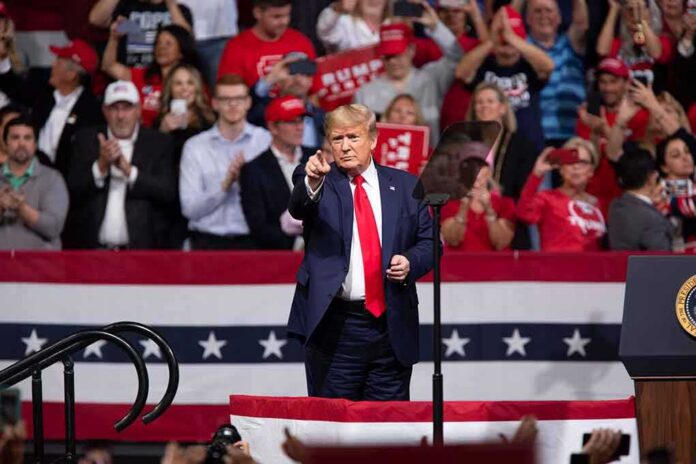
President Trump is opening October with back-to-back rallies in Oklahoma and Alabama, locking in his base as the midterms near.
Story Snapshot
- Trump is set to rally in Durant, Oklahoma, on Thursday and Mobile, Alabama, on Friday.
- The Trump 47 Committee and the Republican National Committee are organizing both events.
- The Oklahoma rally has an official Republican Party event listing with time and venue details.
- Rallies in solid Republican states can lift turnout among strong Republicans, research shows.
What Was Announced and Where
Republican officials said President Trump will appear in Durant, Oklahoma, on Thursday, followed by a rally in Mobile, Alabama, on Friday. The Trump 47 Committee, working with the Republican National Committee, is facilitating both events. The Oklahoma stop has a formal Republican event page that lists the Choctaw Event Center as the venue, doors at 2:00 p.m. Central, and a 6:00 p.m. start time. These details confirm a two-night push across deep red terrain.
The scheduling places Trump in states that backed him by wide margins. National outlets described the plan as a start to October in two of the most Republican states in the country, with Durant on Thursday and Mobile on Friday. The short gap between dates suggests a linked push, not one-off appearances. The campaign’s joint structure with the Republican National Committee shows party-level coordination around message, turnout, and fundraising.
Why These Stops Matter Now
The calendar shows fewer than six weeks until Election Day, a period when parties try to lock in loyal voters and boost down-ballot candidates. Past research on presidential rallies found the clearest turnout gains among strong Republicans, including higher intent to vote when a rally lands close to Election Day. That makes high-safety states useful for energizing the base, training volunteers, and collecting small-dollar donations that can fund tight races elsewhere.
Starting in safe states can also streamline logistics. Venues are easier to fill, and local leaders are more eager to appear with the president. That can produce images of unity and momentum that campaigns can broadcast into contested areas. While swing-state visits often get more national attention, reliable crowds in friendly markets can provide large email and text lists. Those lists feed get-out-the-vote drives and late ad buys that matter in the final stretch.
What Each State Brings to the GOP
Oklahoma offers a staging ground for regional outreach. The Choctaw Event Center in Durant sits near the Texas border, within drive time for activists from multiple counties. Party committees can train volunteers, test messaging, and set goals for early voting. The Friday stop in Mobile, Alabama, draws from the Gulf Coast media market. That area includes active conservative networks tied to churches, veterans groups, and small businesses that power phone banks and door-knocking.
Trump plans campaign stops in Texas, Alaska, Iowa and Florida ahead of the midterms.
⁰He has pledged to campaign across roughly 35 key races.
⁰The push comes as Republicans defend their House and Senate majorities. 🇺🇸 pic.twitter.com/zqCFuqFFz8— Midterm Wire (@Midterm_Wire) September 26, 2026
Both states also help Republican candidates align with the party’s national themes on border enforcement, crime, energy pricing, and inflation. Supporters who feel Washington is failing them often respond to direct contact and shared community settings. Rallies give them a chance to hear priorities first-hand and to sign up for rides to the polls. For voters on the left and right who worry about elites and broken systems, these events can feel like a rare moment of access and voice.
How This Fits the Bigger 2026 Map
Campaigns balance risk and reward. A contested district visit can swing a day’s news but also drain staff time and create security burdens. A deep-red rally can refill the tank: money, volunteers, and media clips that speak to core supporters. Reporting from major outlets has framed these stops as a strategic opening to October, with firm dates in Durant and Mobile and party infrastructure behind them. The work now is turning that base energy into votes where margins are thin.
Sources:
pbs.org, ground.news, events.gop.com, washingtonpost.com