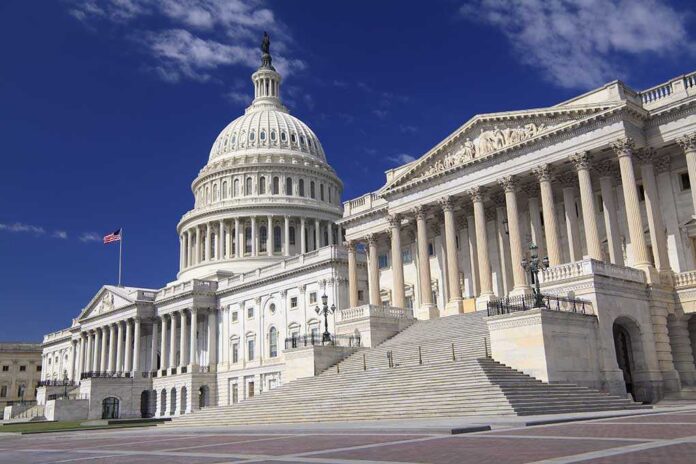
Even with a national mood tilting blue, the 2026 Senate map still gives Republicans the edge.
Story Snapshot
- Several forecasts keep Republicans slightly favored to hold the Senate despite Democratic gains.
- Analysts point to structural advantages baked into this year’s Senate class and state map.
- Models split on control odds, showing anything from a narrow GOP edge to a near coin flip.
- Nine to ten battlegrounds will likely decide control, with many races within polling error.
Forecasts Signal A Narrow Republican Edge
Forecast trackers updated this week show Republicans still holding a small advantage in the Senate. PollsMax projects a chamber near 51-49 with control odds of 76 percent for Republicans and 24 percent for Democrats, as of September 18, 2026. The 270toWin consensus table also leans Republican in its control column, reflecting a map that requires Democrats to run the table in several states to flip control. These signals point to a tight, state-by-state fight rather than a wave outcome.
Decision Desk Headquarters pegs the chamber close to even, rating Senate control as a near toss-up and listing multiple “toss-up” races across both parties’ seats. News coverage and model notes highlight that many contests sit within typical polling error, keeping outcomes uncertain until late shifts in turnout or late-breaking news. The mix of probabilities across sources shows a competitive landscape, but the central takeaway remains clear: small edges favor Republicans holding the gavel.
Why The Map Favors Republicans In 2026
Political science research ties Senate outcomes to the map of states up in each cycle. Alan Abramowitz’s revised model argues Republicans hold a structural edge in Senate elections, which is especially strong in the class of seats on the ballot this year. Equal state representation amplifies smaller, more rural states that lean Republican. That pattern forces Democrats to win in tougher terrain even when national polls look favorable, widening the gap between a national “blue wave” and actual seat gains.
Analysts further explain how models blend polls with fundamentals, like past state results, incumbency, and presidential approval, then run thousands of simulations to turn those inputs into probabilities. This design helps explain the split among forecasts. Some models weigh the national environment more. Others give more weight to state partisanship and the current class of seats. The shared point is that structure can check a national swing, which is what several trackers now show.
The Deciders: A Handful Of Tight Battlegrounds
News outlets and handicappers identify roughly nine to ten states as the core battlegrounds that will decide control. Many of these races are inside the margin of error in recent polling, making turnout, ticket-splitting, and late movement crucial. In practice, Democrats likely need to flip several Republican-held seats while defending their own close holds. That is a steep climb in a chamber where each state has equal power, no matter its size.
For voters angry at both parties, the pattern can feel familiar. National signals say one thing, but the rules and the map deliver another. That gap fuels the sense that Washington is stuck and more focused on power than results. The Senate’s design also means smaller states can overrule broader national moods. That reality is not new, but it matters this fall. The path to change still runs through a few states and a few points, not a simple national wave.
Sources:
redstate.com, usatoday.com, newsweek.com, callthemap.com, votes.decisiondeskhq.com, thehill.com, nytimes.com