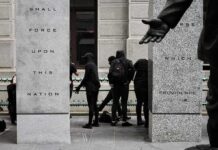
Newly unsealed police body-camera videos show officers arresting Luigi Mangione inside a McDonald’s in Altoona, Pennsylvania, and recovering items prosecutors say link him to the killing of UnitedHealthcare Chief Executive Officer Brian Thompson.
Story Snapshot
- Body-camera footage shows officers confronting, handcuffing, and searching Mangione inside a McDonald’s.
- Reporters say police recovered a gun, a magazine, and a silencer from Mangione’s backpack, according to the video release.
- Prosecutors played the recordings during court hearings over what evidence can be used at trial.
- The release reflects wider fights over when police videos are public and how judges control access.
What The Newly Released Videos Show
News outlets reported that the unsealed body-camera recordings capture officers approaching Mangione inside a McDonald’s, asking his name, and moving to detain him days after Thompson was shot and killed in New York. The videos, described as hours long, include scenes of officers handcuffing Mangione, searching him, and taking him from the restaurant. The release centers on what police did and saw at the scene, giving the public a closer look at the arrest sequence.
NBC News reported that officers found a gun, a magazine, and a silencer in Mangione’s backpack during the encounter, according to the body-camera release. That detail speaks to why the footage is central to the case. It shows what police discovered and when. Such details can affect courtroom debates about searches, probable cause, and whether evidence stays in or gets thrown out before a jury ever hears the facts.
How The Videos Entered The Court Record
Prosecutors made portions of the videos available and played them during pretrial hearings about what evidence may be allowed at trial. Judges often require that sensitive materials be handled through court orders and controlled disclosures. That standard process helps protect the integrity of the case and the rights of everyone involved. It also explains why the public sometimes sees only parts of a longer record while legal questions are still being argued.
Reporters covering the hearings said the court used the recordings to anchor testimony and arguments about the stop, the search, and items police seized. A supervising officer on scene was heard flagging that police “probably” needed a warrant to keep searching the backpack, a line that defense lawyers are likely to highlight in suppression arguments. Such disputes are routine in major cases. Courts test whether police followed the rules before a jury can weigh guilt or innocence.
Why This Release Matters Beyond One Case
This release fits a larger national pattern in which body-camera videos are treated as investigative records, with access controlled by judges rather than automatic public posting. Many states let courts decide when release serves the public interest and will not harm an active case. That system can frustrate both sides of the political aisle. People want transparency, but they also want fair trials. Both values pull in opposite directions when evidence is sensitive.
For readers who feel elites bend the rules, this case shows a process that should apply the same to all: police actions get tested in court, and key videos become part of that test. For readers who worry about government overreach, the same process can block tainted evidence. The point is not a win for one party or the other. It is whether the law is followed, the facts are preserved, and the public can see enough to trust the outcome when the verdict comes.
Sources:
insiderpaper.com, cnn.com, bbc.com, cbsnews.com, hindustantimes.com, 6abc.com