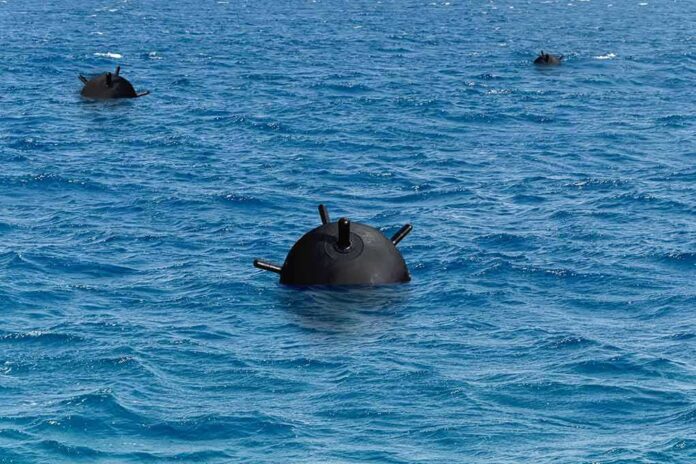
Competing official accounts of tanker blasts in the Strait of Hormuz now clash over whether sea mines, boat‑placed explosives, or a projectile caused the fires.
Story Snapshot
- Iran’s Revolutionary Guard said three tankers hit naval mines and caught fire; identities remain unknown.
- United Kingdom Maritime Trade Operations reported a tanker fire from devices attached by a small boat, not a mine.
- United States Central Command said mine claims on the main route were false and that it remained mine‑free.
- Another tanker was reportedly hit by an unidentified projectile; crews were safe and damage was contained.
What Iran Claimed Happened in the Strait
Iran’s Islamic Revolutionary Guard Corps said three oil tankers struck naval mines while moving through what it called an unauthorized southern route of the Strait of Hormuz. Iranian state outlets amplified the claim, adding that the ships had turned off navigation systems and ignored warnings. The account did not name the vessels or give exact coordinates. Reporters and maritime agencies said they could not verify the claim. The lack of ship identities limits cross‑checks with tracking data.
Iran’s description included operational details. It said the alleged route choice, disabled radar, and missed warnings led to the blasts. Those specifics aim to portray the tankers as at fault and Iran as an enforcer of rules. But outside confirmation has not surfaced. Without logs, crew statements, or bridge audio, the warnings cannot be validated. That leaves a sharp claim, but one still rooted in a single source: the Iranian military and state media summaries.
What Independent Maritime Reports Say
The United Kingdom Maritime Trade Operations reported a real incident in the same area. It said a small boat placed two explosive devices on a tanker’s hull. The devices detonated and sparked an engine‑room fire. That mechanism differs from a ship striking a submerged mine. The report confirms a hostile act and a fire, yet points to a different cause than Iran’s mine story. It did not attribute the attackers or link the event to Iran’s three‑tanker claim.
United Kingdom Maritime Trade Operations also circulated a separate warning about an outbound tanker hit by an unknown projectile near the strait. The fire was extinguished, the crew was safe, and the environmental impact was still unclear. The notice did not identify a weapon type or assign blame. These alerts establish that physical strikes occurred during the period in question. They also show why early attribution is risky when evidence is limited and incidents may be distinct.
The U.S. Position and the Mine Dispute
United States Central Command said reports that ships hit sea mines while transiting the strait were false and stated the primary transit route remained free of mines. That denial addresses the core hazard claim and challenges the idea of a mined shipping lane. It does not rule out other types of attacks, such as boat‑placed devices or a projectile. The statement adds a direct, named contradiction to Iran’s mine narrative on at least the main route.
The split between a mine claim and reports of attached devices matters. A moored or drifting mine explodes when a hull makes contact. A device placed above the waterline points to a team that approached and set charges. Each points to different tactics, gear, and intent. Insurance risk, naval patrol patterns, and the case for escorts change with that distinction. For now, verified forensics are still missing in public view to settle the mechanism across all reported incidents.
Why the Strait’s Fog of War Keeps Returning
The Strait of Hormuz is a choke point for global oil and gas. During the 1980s “Tanker War,” mines, missiles, and small‑boat attacks hit commercial ships in the region. That history shows how fast a real blast can turn into a blame contest. Today, different authorities control the key records: military sensors, ship trackers, crew logs, and seabed scans. When those stay closed, the public sees clashing claims and little shared evidence, which feeds doubt and anxiety.
Possibly up to five vessels were targeted or struck across the Strait of Hormuz, the Persian Gulf, and the Gulf of Oman on October 30, 2026, alongside at least six incidents on October 29 and one on October 28. On October 30, IRGC Navy claimed responsibility for striking a fourth… https://t.co/gOWAKe5VZk pic.twitter.com/o58x6MGuIv
— Hexagone Intel (@osinthexagone) October 30, 2026
Americans across the political spectrum worry that strategic chaos overseas spikes fuel costs at home while leaders trade talking points. Clear facts are scarce here. What we do know is that at least one tanker caught fire from placed explosives, another was hit by a projectile, and the main route is said to be mine‑free by the United States military. Until ship names, coordinates, and damage photos are released, firm blame and the exact method for each incident will remain unsettled.
Sources:
iranwire.com, argusmedia.com, english.alarabiya.net, yahoo.com