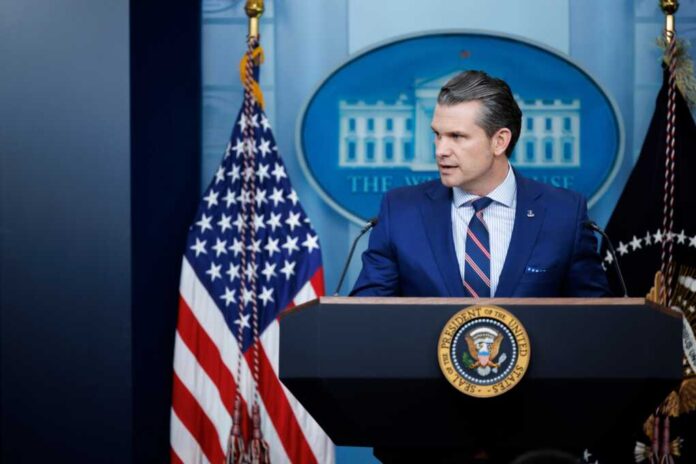
On October 14, 2025, Secretary of War Pete Hegseth addressed military leaders at Marine Corps Base Quantico, announcing a series of reforms aimed at refocusing the U.S. military on warfighting capabilities. These changes, supported by President Trump, include new directives for physical standards, promotions, and training, alongside the rebranding of the Department of Defense as the Department of War.
Story Highlights
- Secretary of War Pete Hegseth announced reforms to restore a warfighting culture and reduce non-combat-related distractions within the military.
- President Trump publicly endorsed these changes, emphasizing national security.
- Ten new directives include tougher physical standards, merit-based promotions, and a reduction in non-combat training.
- The Department of Defense has been renamed the Department of War, with immediate implementation of reforms across all service branches.
Hegseth’s Speech Outlines Military Policy Shift
Secretary of War Pete Hegseth delivered a speech at Marine Corps Base Quantico on October 14, 2025, to top generals and flag officers, detailing reforms intended to enhance the military’s warfighting focus. Hegseth stated that the reforms address what he described as “politically correct” distractions that have impacted combat effectiveness and leadership. President Trump subsequently expressed full support for Hegseth’s agenda, citing national security threats that necessitate a military concentrated on its primary mission.
The Department of Defense has been formally rebranded as the Department of War, a change intended to underscore the military’s core mission of readiness. Hegseth indicated that new policies would be implemented immediately. Directives include the establishment of tougher, gender-neutral physical standards, daily physical training for all active-duty personnel, accelerated removal of underperforming individuals, streamlined merit-based promotions, and a reduction in mandatory non-combat training. These measures, according to Hegseth, are designed to reinforce a warrior ethos and ensure the armed forces are prepared for conflict.
Key Stakeholders and Policy Implementation
Secretary Hegseth is leading this policy shift, with President Trump providing support. Senior military leaders are tasked with executing these directives. The War Department has identified border security, missile defense, and readiness for both foreign and domestic threats as priority areas.
The changes are expected to have a significant impact on active-duty and reserve service members. Higher physical and leadership standards may lead to the removal of individuals unable to meet the new criteria, while merit-based promotions are intended to reward competence. Communities near military installations may also experience effects as the military’s role evolves. While some observers view these changes as a necessary reorientation, others, including professional associations and military analysts, have raised questions regarding potential effects on morale and cohesion, particularly concerning the reduction of diversity and inclusion initiatives.
Short-Term and Long-Term Implications
In the short term, the introduction of new standards and expectations may result in resignations among officers who do not align with the new culture. The military’s increased emphasis on border security and missile defense could influence spending priorities and procurement strategies, affecting defense contractors and training institutions. Over time, the reforms could contribute to a more focused military force, though potential tensions related to the reduction of diversity and inclusion efforts have been noted.
Broader U.S. society, particularly areas surrounding military installations, is expected to observe the implementation of the War Department’s new directives. The political implications for the Trump administration and opposition parties are emerging, with discussions centered on the balance between national security, individual liberty, and government oversight. The long-term impact on readiness, recruitment, and public perception will become clearer as the reforms progress.
Analyses from defense publications and official transcripts confirm the scope of Hegseth’s agenda. While factual reporting is consistent, interpretations of the long-term impact vary. The Trump administration’s commitment to re-establishing a warfighting culture represents a notable shift from recent military policies.
Watch the report: Secretary of War Pete Hegseth FULL REMARKS at the WAR DEPARTMENT ADDRESS
Sources:
Secretary of War Pete Hegseth Addresses General and Flag Officers at Quantico
Hegseth announces series of War Department reforms in sweeping speech to top military brass
Pentagon’s Mystery Meeting with Top-Ranking Generals
Hegseth Wants Basic to Go Old-School—What Policies Must Change First?