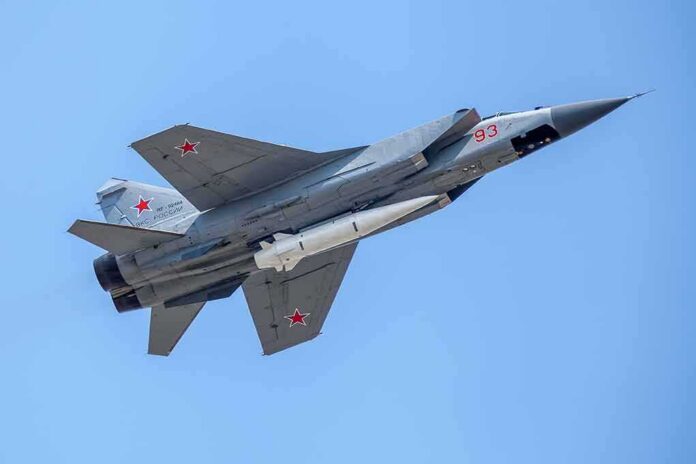
A NATO ally fired an air-to-air missile inside its own borders to stop a drone that crossed deep into Romanian airspace.
Story Snapshot
- Romania’s Defense Ministry says an F-16 shot down a drone after it traversed national airspace.
- President Nicușor Dan confirmed the strike and said the area was uninhabited, reducing risk.
- Allied jets scrambled as radar tracked the drone on a westward path across Romania.
- Officials link recent incidents to Russian-made systems, while Moscow denies responsibility.
What Romania Says Happened, and Where
Romania’s Ministry of National Defense reported radar contact over the Black Sea, then a path inland. Officials listed a course from near Sulina toward Brăila and Fetești, ending with an intercept near Padina in Buzău County. A Romanian F-16 launched an air-to-air missile and brought the drone down over an unpopulated area. The account frames a clear airspace breach, not a near-border brush-by, and cites safety measures taken to avoid civilian harm.
President Nicușor Dan confirmed the action and time window, emphasizing that the pilot fired where no people lived. That detail matters. It shows commanders weighed risk to the public while acting to defend sovereignty. Early statements did not fix the drone’s origin, but later reporting about similar cases pointed to Russian-made systems used in strikes near the Danube corridor. That pattern has shaped political and military responses in Bucharest and among allies.
How the Intercept Unfolded and Why It Matters for NATO
Romanian officials said multiple aircraft launched to track the drone. Reports mention both Romanian F-16s and allied Eurofighter Typhoons from a base near the Black Sea. That response signals an active air-policing posture and close coordination with partners. It also shows the alliance is treating low, slow drones as live threats, not curiosities. For citizens, the bigger point is credibility: leaders say defenses work, and the intercept is their proof.
Reuters and others describe follow-on incidents where authorities labeled downed drones as Russian or Russian-made. Romania’s president condemned repeated airspace breaches as “intolerable.” Those statements build a public case that these are not random strays but part of a broader pattern tied to the war next door. Yet the first announcements about this shootdown kept some caution on origin, since debris analysis takes time. That mix of speed and restraint will likely continue in future cases.
Disputed Attribution, Evidence Gaps, and Public Trust
Russia’s Foreign Ministry rejected Romania’s claims and called them unfounded. Russian officials and state-linked voices have also suggested the events were staged or a provocation from Ukraine. Those charges come without shared forensic proof. They aim to shift blame and muddy the debate. Romania, for its part, has not publicly released a full technical report with serial numbers or component photos for this drone, leaving room for doubt among skeptics.
This is where many Americans see a familiar problem. Governments speak in absolutes while details remain sealed. People across the political spectrum have learned to ask for receipts. In this case, Romania’s narrative rests on radar tracks, aircraft launches, and a controlled shootdown over empty land. That is solid operational evidence. Final source attribution, however, lives in labs and classified files. Authorities say they are investigating wreckage to confirm the model and origin in related incidents.
Spillover Risks, Civilian Safety, and Costs
Drones that cross borders force quick calls with high stakes. Commanders must balance sovereignty, safety, and escalation. Romania highlighted that the pilot fired over an uninhabited area, showing rules of engagement geared to protect civilians. Recent months have seen reported injuries in Romania from separate drone crashes, which raised public pressure to act. Each intercept also consumes expensive missiles and pilot hours, feeding a debate over budgets and the need for cheaper counter-drone tools.
NATO fighter jet shoots down drone over Romania – https://t.co/JBNOCmCcOR https://t.co/yKqoLVYgxS
Follow @NewsHubGlobe for 24/7 breaking news from around the world. pic.twitter.com/AYYGd8QAcP
— News Hub (@NewsHubGlobe) August 17, 2026
For NATO, every successful intercept tests readiness and messaging. For Moscow, every denial buys time and sows doubt. For citizens, the core question is simple: are leaders giving straight answers, backed by evidence? On the facts here, Romania defends its airspace and shows a timeline that fits a real incursion. On origin, some outlets cite Russian-made gear in nearby cases, but full forensic publication for this shootdown is still limited in open sources.
What to Watch Next
Watch for an official debris report with photos, component labels, and chain-of-custody details. Look for shared radar plots or timelines from allies that support the track across Romania. Track whether future intercepts use lower-cost countermeasures to reduce strain on budgets. Finally, watch if evidence links these flights to strikes on Ukrainian river ports, which would tighten the chain from launch to impact and reduce space for denial in the public square.
Sources:
kfgo.com, reuters.com, bbc.com