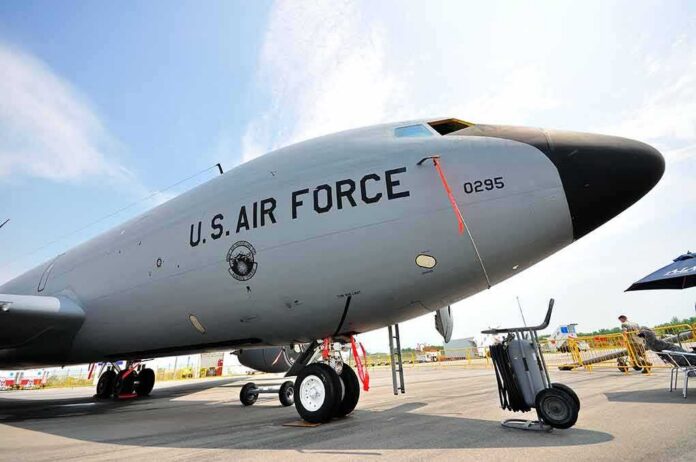
Eight Americans are presumed dead after a B-52 bomber exploded on takeoff during a test mission in California, raising fresh questions about secrecy, safety, and who really pays the price for America’s permanent war posture.
Story Snapshot
- A U.S. Air Force B-52 bomber crashed just after takeoff at Edwards Air Force Base, with eight people now presumed dead.
- Officials say the crash was “unsurvivable” and happened during a radar modernization test mission, but the cause remains unknown and under investigation.
- The incident highlights the risks of flying 70-year-old bomber designs that are still at the core of U.S. power projection worldwide.
- The sparse early information and tight control of details feed long-standing public distrust toward the military, contractors, and government “elites.”
What Happened At Edwards Air Force Base
Military officials say a U.S. Air Force B-52 Stratofortress crashed shortly after takeoff late Monday morning at Edwards Air Force Base in California’s Mojave Desert.[1] The aircraft went down on or near the airfield around 11:20 a.m. local time, creating a massive fireball and thick black smoke visible across the high desert region.[1] Base leaders later told reporters that eight people were on board and that “initial indications are that the crash was not survivable,” with all eight now presumed dead.[1][2]
Video from local and national outlets shows almost nothing left of the bomber, just scorched ground and scattered debris near the runway.[1] Edwards Air Force Base first confirmed the crash in a short social media post, saying only that a B-52 had crashed shortly after takeoff, that emergency crews responded, and that the “situation is ongoing,” with more information to come.[5] Within hours, officials closed the airfield, diverted incoming flights, and suspended visitor passes to focus fully on emergency response and investigation.[1]
A Routine Test Flight On An Aging Warhorse
Military leaders say the aircraft was flying what they described as a “routine test mission” tied to a radar modernization program.[1][2] The B-52 has been in U.S. service since the 1950s and is one of the longest-serving bombers in history, repeatedly upgraded instead of replaced. The Air Force still relies on it for long-range missions around the world. That means test flights out of bases like Edwards, a major center for flight testing and weapons development, happen regularly and usually without public notice.
The bomber typically carries a crew of about five, including two pilots, a radar navigator, a navigator, and an electronic warfare officer. Officials have not publicly detailed the exact mix of aircrew, test personnel, or contractors on this flight, and no names have been released while families are notified.[1] The military also has not said whether the bomber was carrying any munitions, only that the aircraft crashed and burst into flames shortly after lifting off.[2] Investigators will review flight data, maintenance records, and witness reports to determine what failed and why.
Safety, Secrecy, And A Pattern Of Information Gaps
For people watching from the outside, this tragedy follows a familiar script. After major military accidents, the public usually gets a short, carefully worded statement confirming time, place, and basic facts, but almost nothing about cause or accountability for weeks or months. That slow drip of information is often justified by safety rules and the need to notify families. Yet it also fuels suspicion on both left and right that the Pentagon and its contractors hide bad news until the headlines move on.
The B-52’s long history includes several deadly crashes over the decades, some tied to mechanical failures, some to pilot error, and some to problems during takeoff or landing. That track record does not prove what happened at Edwards. But it reminds people that flying heavy bombers, packed with fuel and sometimes weapons, is always dangerous work. When officials ask for patience while keeping details close, many Americans who already distrust “the system” see another example of ordinary servicemembers bearing the risk while powerful decision-makers face little personal cost.
Why This Hits Nerves Across The Political Spectrum
Conservatives who worry about waste, aging equipment, and endless deployments see this crash as part of a larger problem. The United States keeps pushing Cold War–era hardware like the B-52 to its limits while pouring billions into modernization programs that benefit big contractors more than frontline troops. Liberals who focus on the human and social costs of U.S. military power see eight more lives lost in a defense system they feel is already bloated and shielded from real public oversight. Both sides see a government that rarely admits failure.
Military leaders at Edwards have been careful in their words. One commanding officer called those lost “eight great Americans” and emphasized the grief of families and the base community.[2][1] That is real and deserves respect. At the same time, many citizens are asking deeper questions. Why are we still flying bombers designed before many of today’s leaders were born? Who profits from keeping them in the air? And when tragedy strikes, will the final report lead to genuine change, or just another closed chapter in a long list of preventable losses?
Sources:
[1] Web – A U.S. Air Force B-52 Bomber Crashed At Edwards Air Force Base In …
[2] Web – B-52 bomber crashes at Edwards Air Force Base in California
[5] Web – U.S. Air Force B-52 Stratofortress crashes after takeoff on Edwards …