A cutting-edge U.S. Army Apache helicopter crashed in one of the world’s most dangerous waterways and had to be saved by a robot boat, while Washington still cannot clearly explain why it went down.
Story Snapshot
- A U.S. Army AH-64 Apache crashed into the sea near the Strait of Hormuz while on patrol, and both crew members were rescued and are in stable condition.
- The military used an unmanned surface “sea drone” to help pull the pilots from the water, reportedly the first U.S. rescue of its kind.
- Officials say the cause is still under investigation, with questions about mechanical failure versus possible hostile fire in a tense standoff with Iran.
- The slow, guarded answers from leaders feed a familiar concern across left and right that Americans are told just enough to calm them, not enough to fully inform them.
Apache crash in a global choke point
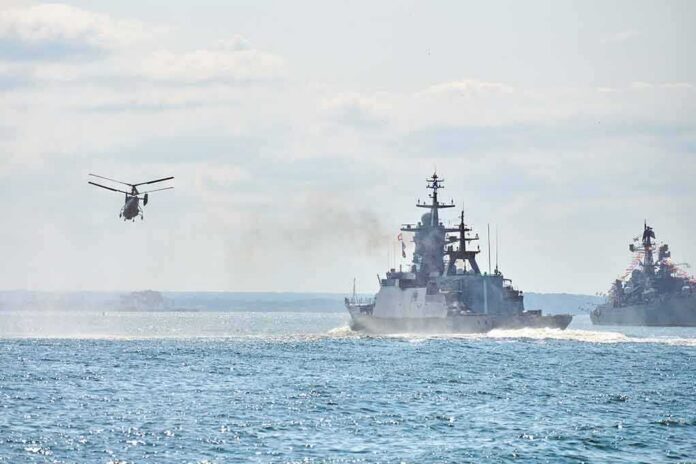
U.S. Central Command said a U.S. Army AH-64 Apache attack helicopter went down in the sea near the coast of Oman, close to the Strait of Hormuz, while patrolling regional waters on Monday evening.[1][2] Central Command reported that the helicopter crashed at about 7:33 p.m. Eastern time and that it had been conducting a security patrol in this critical shipping lane when the incident occurred.[1][2] Officials emphasized that the aircraft was operating in international waters tied to ongoing regional operations.[2]
Military statements and media reports agree that both soldiers on board survived the crash.[1][2][3] Central Command said the crew members were rescued within about two hours and were in stable condition after recovery.[1][2] President Donald Trump later told reporters that “the pilots are fine” and that there were no injuries, while promising that a formal report on the mishap would follow.[1][2][5] That promise highlights how much the public still does not know about why a front-line helicopter suddenly fell from the sky.
A first-of-its-kind rescue using a sea drone
Central Command said the soldiers were “rescued by American forces” but did not immediately give technical details on the recovery.[1][2] Military officials later told one outlet that an unmanned surface drone, operated by a Navy unit known as Task Force 59, was used to find and recover the crew in what they described as the first such U.S. water rescue carried out by a sea drone.[1][5] The command also credited U.S. Naval Forces Central Command and the 82nd Airborne Division with leading the rescue, supported by Air Force and Navy units.[2]
According to reporting, the maritime drone that picked up the pilots had a speedboat-like design, allowing it to move quickly to the crash site and then carry the soldiers back to land.[2][5] For many Americans, this detail is a double-edged symbol: it shows that the U.S. military can use advanced tools to save lives, yet it also reminds people that more and more life-and-death decisions in war zones depend on uncrewed systems run far from public view. Critics who already worry about an unaccountable “deep state” see one more example of complex technology racing ahead of clear oversight.
Unanswered questions and risk of spin in a tense conflict
Central Command said plainly that “the cause of the incident is under investigation,” and so far officials have not publicly confirmed whether the Apache was hit, suffered a mechanical failure, or faced another problem.[1][2][3] Some reporting says U.S. officials are looking into whether Iranian fire might have brought the helicopter down, while other coverage stresses that mechanical trouble remains a strong possibility.[3][4][5] This mix of possibilities, without firm answers, creates space for speculation and for each side in the region to push its own story.
Centcom said the AH-64 Apache went down at around 3am local time on Tuesday (4am PKT) near the coast of Oman while patrolling regional waters.
It gave no reason for the crash.https://t.co/BEDkF4Lf0o
— Dawn.com (@dawn_com) June 9, 2026
The crash comes during an ongoing conflict and blockade pressure on Iran, in a narrow sea lane where even one incident can spike oil prices and raise fears of a wider war.[1][3][7] For conservative readers, the event raises concerns about over-stretched forces, expensive hardware at risk, and the cost of long, unclear missions far from home. For liberal readers, it adds to worries about secretive military choices, the power of defense contractors, and a foreign policy that often feels detached from the daily struggles of ordinary Americans.
Why this episode feeds distrust in Washington
Across the political spectrum, many people see a familiar pattern around this crash: leaders share the bare minimum, promise a report later, and move on while the public is left guessing. Central Command has not released a full mishap report, detailed flight data, or a clear timeline for public findings.[1][2][3] Major questions remain about maintenance history, mission risk, and whether this crash was preventable, even as officials highlight the successful rescue and praise the new technology that made it possible.
Americans who feel the federal government is run by distant elites see this as one more example of power without full transparency. The government can deploy advanced helicopters and drones thousands of miles away, but it struggles to give straight, timely answers about what went wrong and who, if anyone, will be held accountable. Until a detailed, public explanation appears, this Apache crash near the Strait of Hormuz will stand as a small but sharp reminder of why so many voters on both the right and the left no longer trust Washington to level with them.
Sources:
[1] Web – NEW: Two U.S. soldiers are safe after a dramatic rescue operation off …
[2] Web – US Army Apache crew rescued after crash near coast of Oman
[3] YouTube – US Apache helicopter crashes near the Strait of Hormuz
[4] Web – Crew rescued after U.S. helicopter goes down near Iran – Axios
[5] Web – McDonnell Douglas AH-64A Apache – Aviation Safety Network
[7] Web – [PDF] AH-64 Crash Rescue.cdr – AVIATION ASSETS