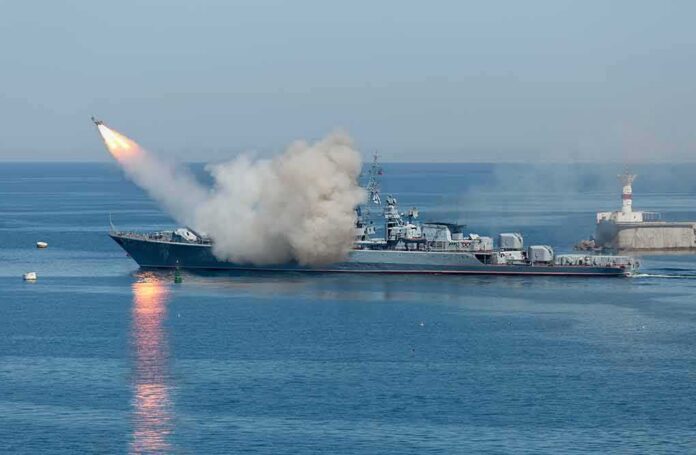
Iran’s strike cycle with the United States widened fast, and Gulf states were caught in the middle.
Story Snapshot
- The United States and Iran traded strikes for a second day, raising fears of a broader war.[1][2]
- Iran said its missiles and drones hit U.S.-linked sites in Jordan, Bahrain, and Kuwait.[2][4][7]
- U.S. Central Command said its latest strikes targeted Iranian military surveillance, communications, and air defense sites.[1][2]
- Reports from the region showed air defenses activated and alarms sounding in Gulf states.[2][6][8]
How the Exchange Escalated
U.S. and Iranian forces exchanged fire again after a first round of strikes tied to the downing of an Apache helicopter near the Strait of Hormuz.[2][4] U.S. Central Command said its latest attacks were a response to Iran’s “unwarranted and ongoing aggression.”[1][2] The command said it struck Iranian military surveillance systems, communications networks, and air defense sites, but it did not give a damage estimate.[1][2]
Iran’s response went beyond its own borders and reached Gulf states that host American forces.[2][4][7] Iranian state outlets and military statements said the attacks targeted U.S. bases or U.S.-linked military sites in Bahrain, Kuwait, Jordan, and other places.[4][5][7][8] Jordan said it intercepted incoming missiles, and reports from Bahrain and Kuwait described heightened air defenses and alarms as the exchange spread across the region.[2][6][8]
What Iran Said It Was Doing
Iran framed the attacks as retaliation for U.S. strikes on Iranian targets.[4][5][8] Iranian Foreign Minister Abbas Araghchi said the United States violated Iran’s sovereignty and that Iran had a right to answer in self-defense.[5] The Islamic Revolutionary Guard Corps said it hit American military sites in Jordan, Bahrain, and Kuwait, and some reporting said the force claimed the strikes were proportional to earlier U.S. attacks.[4][5][7]
That claim is important, but the public record remains thin. The available reporting relies heavily on official statements, television transcripts, and news summaries, not on full strike logs or independent battle-damage reviews.[1][2][4][5][7][8] The sources do not independently prove that every Iranian strike was limited to military targets, and some reports also mention possible hits on public facilities or residential areas.[2][7]
Why Gulf States Feel Exposed
The strikes put Jordan, Bahrain, Kuwait, and nearby Gulf states in a dangerous position. Those governments are not just watching a distant fight. They are dealing with missiles, air defense alerts, and the risk that their territory could become a battlefield for a conflict they did not start.[2][6][8] That helps explain why regional leaders usually condemn the attacks quickly and then push for restraint instead of immediate escalation.
IRAN WAR UPDATE — JUNE 11, 2026
🟢The United States launched a fresh round of strikes across Iran for a second straight day.
CENTCOM said American forces targeted Iranian surveillance systems, communications sites and air defence positions, describing the operation as… pic.twitter.com/1AUgefp9cD
— Mansa Tesla (@MansaTesla) June 11, 2026
For many people in the region, the larger problem is not one side’s speech but the gap between official claims and public proof. Washington describes its strikes as self-defense, Tehran calls its attacks retaliation, and civilians in the middle get the costs if the shooting keeps spreading.[1][2][5] That pattern fuels a familiar frustration across the political spectrum: major powers make the moves, while smaller states and ordinary people absorb the risk.
Sources:
[1] YouTube – Iran responds to second day of US strikes by firing at Gulf states and …
[2] Web – U.S. conducts retaliatory strikes after Trump says Iran shot down …
[4] YouTube – Iran retaliatory strikes on US bases in the UAE, Bahrain …
[5] YouTube – Iran launches new retaliatory strikes at U.S. allies in Persian Gulf
[6] YouTube – Iran targets US bases with retaliatory strikes
[7] YouTube – U.S. completes retaliatory strikes against Iran after helicopter …
[8] Web – Iran’s Strikes on the Gulf States | Alhurra