
The D.C. Circuit Court of Appeals has handed the Trump administration a significant procedural victory in its campaign to reshape federal election mail — but the legal, constitutional, and practical battles surrounding this rule are far from settled, and the stakes for how Americans vote in November 2026 could hardly be higher.
At a Glance
- The D.C. Circuit granted a stay allowing USPS to enforce its proposed election-mail rule while litigation continues — clearing the path for implementation ahead of the 2026 midterms.
- The rule, required by Executive Order 14399, would force states to register with a federal portal, submit complete voter lists, and assign serialized barcodes to every mail ballot at least 30 days before mailing — or lose USPS delivery of those ballots entirely.
- Multiple federal courts have already permanently blocked related provisions of Trump’s executive order, including the citizenship-proof requirement for voter registration, on separation-of-powers grounds.
- The underlying fraud claims driving the policy are contradicted by the evidence: confirmed noncitizen voting cases number in the dozens nationally over two decades, and Trump’s own White House adviser acknowledged on camera that the intelligence community has “zero evidence that someone has flipped a vote in 2020, 22, or 24.”
- The rule’s compliance deadline creates a real disenfranchisement risk: states that refuse to submit voter rolls could see millions of mail ballots go undelivered, affecting a voting method used by tens of millions of Americans.
What the Rule Actually Requires
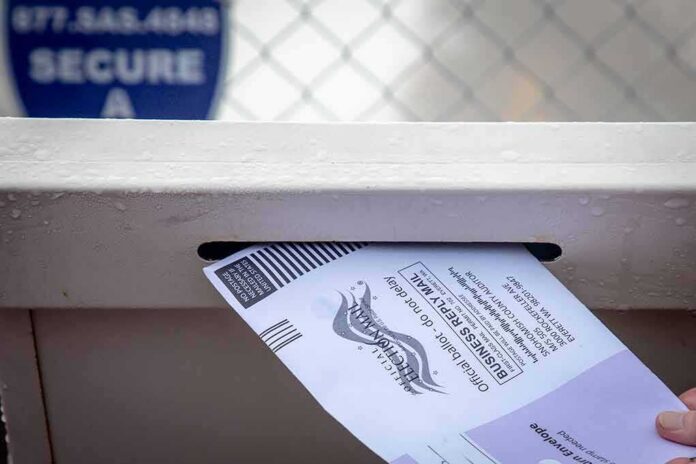
The mechanics of the proposed USPS rule are more sweeping than the headline suggests. Under the proposed Domestic Mail Manual provision 705.24.4.2, any state that permits mail-in or absentee voting in federal elections must register with a new USPS Federal Ballot Mail Portal and submit — at minimum 30 days before ballots are sent — the full name, address, and a unique serialized barcode for every voter who will receive a mail ballot. States that decline to comply would find the Postal Service simply refusing to carry their mail ballots. Postmaster General David Steiner made this explicit in congressional testimony in June 2026, stating flatly that USPS would not deliver mail ballots in non-complying states.
The rule flows directly from Executive Order 14399, signed March 31, 2026, which directed USPS and other federal agencies to condition ballot delivery on prior citizenship verification. What makes the rule structurally novel — and legally contested — is that it transforms USPS from a passive carrier of election mail into an active gatekeeper with the authority to determine which states’ ballots move through the system at all. That is a role the Postal Service has, by its own institutional tradition, always declined to play.
The Court Ruling: What It Does and Doesn’t Decide
The D.C. Circuit’s July 17, 2026 stay order is a procedural win for the administration, not a ruling on the merits. A three-judge panel concluded that USPS met the legal standard for a stay pending appeal — meaning the agency demonstrated a likelihood of success on the merits, risk of irreparable harm without the stay, and that the balance of equities favored proceeding. The stay lifts a lower court injunction that had blocked the rule, allowing USPS to move forward with implementation while the underlying litigation continues.
That litigation is substantial and multi-fronted. A federal district court in Massachusetts had already ruled that Executive Order 14399 itself was unconstitutional and ultra vires — beyond the president’s lawful authority. Separately, a federal judge permanently blocked the citizenship-proof requirement for voter registration that formed another pillar of the same executive order, finding it violated the separation of powers because the Constitution assigns no direct role to the president in setting voter qualifications. The NAACP has argued in a separate action that the USPS rule violates a prior court settlement requiring expedited election mail handling. Twenty-two states, led by Nevada, filed suit arguing the rule unconstitutionally intrudes on state authority over elections. The D.C. Circuit’s stay keeps the rule alive for now; it does not resolve any of these constitutional questions.
The Fraud Predicate: What the Evidence Actually Shows
Every element of this policy rests on a factual predicate: that mail-in voting is meaningfully vulnerable to fraud at a scale that warrants federal intervention. That predicate is weak. Confirmed noncitizen voting cases in the United States from 1999 through 2023 number approximately 77 nationwide — not 278,000, as Trump claimed in his July 2026 prime-time address. Voting rights attorney Mark Elias and Colorado Secretary of State Jenna Griswold both noted that noncitizen voting is “extraordinarily rare,” and the DHS database Trump cited as the source of the 278,000 figure was deemed “unreliable” by a federal judge. The Brookings Institution has estimated mail-in ballot fraud at roughly 0.00006% — a rate the institution compared to the odds of traveling to the moon.
The intelligence picture is equally unflattering to the fraud narrative. John Solomon — a conservative journalist appointed as a White House special government employee specifically to help build the election-integrity case — acknowledged on camera after Trump’s July speech that “the intelligence community has zero evidence that someone has flipped a vote in 2020, 22 or 24,” and confirmed that Venezuela did not tamper with U.S. voting machines. Former DHS Chief of Staff Miles Taylor, who served under Trump, stated that the declassified documents Trump released showed no evidence of votes being flipped, and that the intelligence community successfully protected both campaigns’ integrity in 2020. The White House briefing that preceded Trump’s speech reportedly included Catherine Engelbrecht of True the Vote — the organization behind the thoroughly debunked “2000 Mules” film — alongside other activists whose claims an administration official familiar with the underlying intelligence described by saying “the intelligence just doesn’t say what they wanted to say.”
The Constitutional Fault Line: Federal Power vs. State Authority
The deeper dispute here is structural, not merely partisan. The U.S. Constitution assigns the administration of elections to the states; Article I, Section 4 gives Congress authority to regulate the time, place, and manner of federal elections, but courts have consistently held that the executive branch cannot unilaterally rewrite those rules by administrative fiat. The permanent injunction blocking the citizenship-proof requirement explicitly cited this principle, noting the Constitution “assigns no direct role to the president” in voter qualification. That same logic underlies the multi-state lawsuits challenging the USPS rule: Nevada Secretary of State Cisco Aguilar stated the core objection plainly — “elections should be run by each state, and there’s no room for the federal government to step in and make new rules.”
The administration’s counter-argument is that USPS, as a federal agency controlling the physical infrastructure of mail delivery, has inherent authority to set conditions on what it carries — and that the executive order provides the statutory hook. Whether that argument survives appellate review is the central legal question the D.C. Circuit stay does not answer. What the stay does establish is that the question is genuinely contestable, not frivolous. Courts have previously blocked similar federal overreach on election rules, including a 2024 attempt to impose new voter-identity documentation requirements that was struck down for violating separation of powers. The pattern suggests the rule faces serious constitutional headwinds at the merits stage, even if it proceeds operationally in the near term.
The SAVE Act (Safeguard American Voter Eligibility Act), also known as the SAVE America Act, is a proposed federal bill that would impose nationwide requirements for proving U.S. citizenship when registering to vote in federal elections and showing photo identification when…
— Jenna (@Anarita510Jenna) July 17, 2026
The Practical Stakes for November 2026
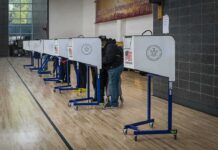
The rule’s real-world consequences turn entirely on state compliance decisions made under significant time pressure. States that refuse to submit voter rolls to the federal portal — either on constitutional principle or data-privacy grounds — would face the prospect of USPS declining to deliver their mail ballots in a federal general election. Several state secretaries of state, including Maine’s Shenna Bellows, have already publicly opposed the rule. Given that mail-in voting has expanded dramatically since 2020, with tens of millions of Americans now routinely voting by mail, non-compliance by even a handful of large states could affect millions of ballots in a midterm election cycle.
The 30-day pre-mailing submission requirement adds an operational layer of complexity that election administrators have flagged as potentially unworkable for jurisdictions that finalize voter rolls close to ballot-mailing dates. A USPS Inspector General audit from 2024 found that a majority of postal facilities audited had already failed to follow existing election mail procedures — a baseline that raises legitimate questions about whether USPS has the operational infrastructure to administer a new federal ballot verification system reliably at scale, independent of the legal questions.
The D.C. Circuit’s stay is, in the end, exactly what courts call it: a temporary measure preserving the status quo pending full review. It is a meaningful procedural victory for the administration — it keeps the rule operative and places the burden on challengers to win on the merits before the election. But it does not validate the fraud claims that animate the policy, does not resolve the constitutional questions about federal authority over state elections, and does not answer whether USPS can execute the rule without disrupting the very election integrity it is nominally designed to protect. Those questions will be decided in the courts and, ultimately, at the ballot box.
Sources:
townhall.com, nypost.com, grayhairsoftware.com, redstate.com, reuters.com, thegatewaypundit.com, schiff.senate.gov, lynnwoodtimes.com, votingrightslab.org, njlm.org, brookings.edu, ldad.org, aclu.org