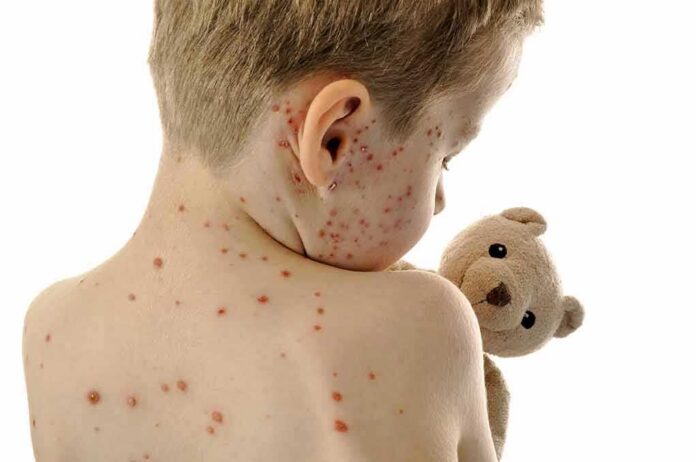
Measles has hit its highest U.S. level in 35 years, with more than 2,300 confirmed cases by late July 2026 — and nearly all of them in people who skipped the vaccine.
Story Snapshot
- The Centers for Disease Control and Prevention (CDC) confirmed 2,318 measles cases in 2026, topping all of 2025’s 2,289 cases and marking the highest count since 1991.
- About 93% of this year’s cases hit people who were unvaccinated or whose vaccination status was unknown.
- Outbreaks have spread across dozens of states, including a South Carolina cluster that grew past 900 cases.
- Health officials warn the U.S. could lose its official “measles elimination” status if outbreaks keep spreading past January 2027.
Case Count Breaks a Three-Decade Record
The CDC reported 2,318 confirmed measles cases in the United States as of late July 2026, according to agency data updated that Friday. That number already beats the 2,289 cases recorded for all of 2025. Health officials call it the highest yearly total since 1991, when the country logged more than 9,600 infections before measles was declared eliminated in 2000.
The climb happened fast. The country crossed 1,000 cases by late February, passed 2,000 by June, and kept climbing through midsummer with five months still left on the calendar. That pace put 2026 on track to become the worst year for measles in the country in over three decades, according to health researchers tracking the outbreaks state by state.
Vaccination Gaps Drive the Spread
Public health officials point to one main cause: falling vaccination rates. Roughly 93% of this year’s cases hit people who never got the measles-mumps-rubella (MMR) shot or whose vaccination records were unclear. That pattern held true in earlier outbreaks too, including one in South Carolina where more than 90% of patients had skipped the vaccine.
Measles spreads easily among people who lack protection, since the virus can linger in the air for up to two hours after an infected person leaves a room. Once vaccination coverage in a community drops below the level needed to stop outbreaks, health experts say the disease finds unprotected pockets and spreads through schools, churches, and neighborhoods.
Outbreaks Ripple Across Multiple States
Cases have shown up in nearly every part of the country. A South Carolina outbreak alone reached more than 900 cases before officials declared it over in the spring. The virus also spread to North Carolina, Ohio, Washington state, and other states, with new clusters appearing throughout the year. Texas recorded over 760 cases in an earlier outbreak that included two deaths, both unvaccinated children.
Federal officials confirmed cases in 45 jurisdictions this year, with a small number tied to international travelers bringing the virus into the country. The wide geographic spread shows the outbreak isn’t limited to one region or one community, but reflects a national decline in vaccination coverage that health officials have tracked for years.
Elimination Status Now at Risk
The United States earned “measles elimination” status in 2000, meaning the disease no longer spread continuously within the country. Health policy researchers warn that status could be lost if the current outbreak chain continues past January 2027, since elimination status requires stopping any single outbreak within 12 months. National MMR vaccination rates have kept declining, with many communities now below the coverage level needed to block outbreaks.
The United States is recording its most severe measles year in 35 years.
By July 23, officials had confirmed 2,318 cases, already exceeding the 2,289 cases reported for the entire year of 2025. This marks the highest annual total since 1991, with more than five months still… pic.twitter.com/yvyaBzOjjD
— Massimo (@Rainmaker1973) July 26, 2026
For families across the political spectrum, the numbers raise a shared worry: a disease once considered defeated is back, and public health messaging hasn’t stopped its return. Whether the cause is distrust in institutions, gaps in local health funding, or personal choices about vaccines, the case count gives both sides of the debate hard evidence to weigh rather than guesswork.
Sources:
abcnews.com, nbcnews.com, scientificamerican.com, cnn.com, theguardian.com, cidrap.umn.edu, upday.com, reuters.com, usnews.com