
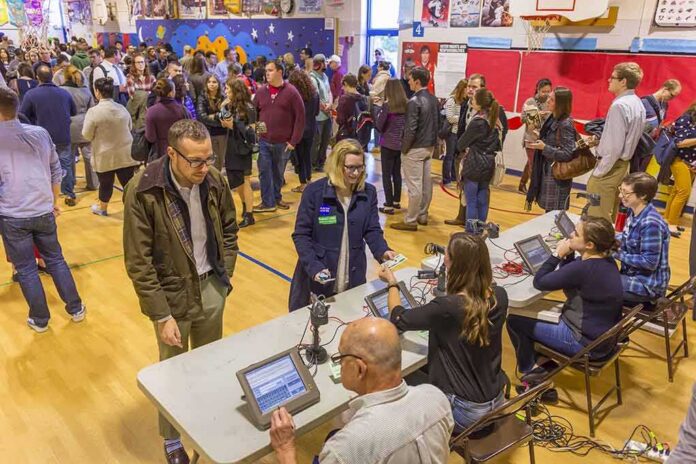
The Supreme Court let New Hampshire bar student IDs at the polls for November while the legal fight continues, tightening rules days before voting begins.
Story Snapshot
- The Court stayed a lower-court order and let New Hampshire enforce its student ID restriction for November.
- HB 323 removed student IDs from the list of documents that qualify as voter identification.
- A federal judge said student IDs could still help verify identity under a fallback process, but that is paused.
- State guidance pointed students to licenses, passports, or military IDs; residency can be shown with mail.
What the Supreme Court Did and What It Did Not Decide
On October 22–23, the Supreme Court put a lower-court ruling on hold and allowed New Hampshire to enforce its restriction on student IDs for the November election. The order addressed timing and election stability, not the final merits. The justices applied the usual caution about changing rules close to an election. The appeal will continue after November. The stay means local officials will follow the state’s stricter guidance at the polls during this period.
Judge Joseph Laplante of the United States District Court previously ruled that while student IDs are not qualifying voter identification under state law, officials could consider them as part of a safety-valve process for voters without a qualifying ID. That ruling pushed back on guidance from the Secretary of State that discouraged any use of student IDs. The Supreme Court’s stay pauses that relief. For November, the tighter rule stands while the case proceeds.
What New Hampshire Law HB 323 Changed
House Bill 323 removed student IDs from the list of documents that voters can present as qualifying photo identification to obtain a ballot. The state kept a separate fallback process for voters without a qualifying ID. That backup lets voters establish identity in other ways, such as by affidavit and supporting evidence. The legal dispute centers on whether a student ID can still count as supporting evidence in that process, even if it is not a standalone credential.
The Secretary of State issued guidance to implement the changes and direct students to other documents. Students can use a driver’s license from any state, a passport, or a military ID to prove identity. Residency can be shown with items like a utility bill or bank statement. Advocates say that many students do not have those documents handy, especially first-time voters or out-of-state students living on campus.
Why the Timing Matters for Voters and Poll Workers
The state argued that changing instructions weeks before Election Day would confuse voters and poll workers and disrupt training and materials. The Supreme Court’s stay signals concern about last-minute shifts, known in election cases as an application of timing caution. Critics counter that reversing the district court so near the election creates its own confusion and places new hurdles on students who expected to use familiar IDs.
Both claims reflect a broader pattern in voting fights. Election officials want stable rules close to voting. Voter groups want clear, inclusive instructions that match real documents people have. The record here shows a law, fast-changing guidance, and a close calendar. It does not show hard evidence that student IDs caused fraud, nor data proving the rule change will stop abuse. That evidence gap fuels mistrust on both sides.
How This Fits the National Voter ID Debate
This case highlights three separate questions that often get blurred: whether identification can be required at all, whether a specific document is reliable, and whether there is a real fallback for people without the preferred ID. New Hampshire’s fight centers on the third question. The district court said the fallback could include student IDs as supporting proof. The state’s guidance said no. The Supreme Court’s stay preserves the state’s stricter view through November.
Supreme Court lets New Hampshire enforce student ID voting ban pic.twitter.com/YCquRLqOfG
— NEK News (@NEKNews01) October 23, 2026
Research on voter ID’s impact is mixed, but several large studies find little effect on overall turnout and no clear drop in fraud. That does not end the policy debate. People across the spectrum worry that complex rules help insiders and confuse regular voters. Many see a system that changes late and leaves citizens guessing. Clear rules, fair access, and transparent data could ease that distrust, whatever the final ruling decides.
Sources:
cbsnews.com, nhd.uscourts.gov, scotusblog.com, courthousenews.com, cnn.com, nbcboston.com, nhpr.org, vox.com, repository.belmont.edu, povertyactionlab.org