The new U.S.–Saudi nuclear deal quietly trades away key safeguards while promising decades of profit and power.
Story Snapshot
- The United States approved a 30-year civilian nuclear agreement that lets Saudi Arabia enrich uranium using American technology.
- The deal skips a major international inspections rule and instead relies on U.S.–Saudi “bilateral” safeguards that critics see as weaker.
- The agreement opens a multi‑billion‑dollar market for U.S. companies but raises fears of a future nuclear arms race in the region.
- Supporters say American control will keep the program peaceful; skeptics worry Washington is relaxing standards to help an ally.
What Exactly Did Washington Approve?
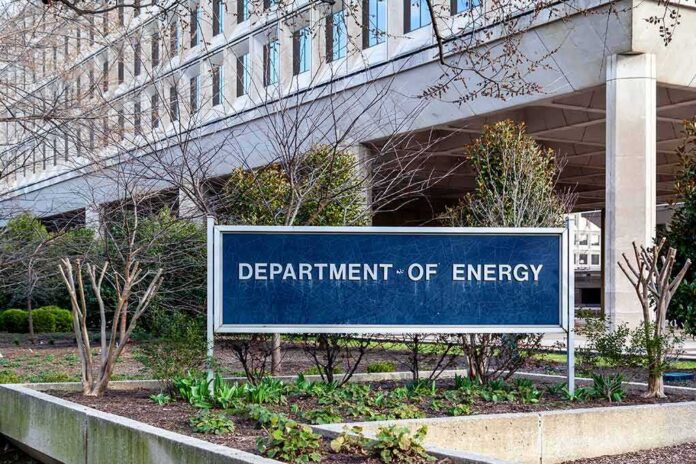
The United States Energy Department says it has reached a civil nuclear power agreement with Saudi Arabia that allows the kingdom to build nuclear reactors with American technology and to enrich uranium. Officials describe it as a 30‑year “123 Agreement,” the legal framework that lets U.S. firms export nuclear equipment and know‑how to foreign partners. The pact is valued in the tens of billions of dollars and is meant to lock in American companies as Saudi Arabia’s main nuclear partners.
Energy Secretary Chris Wright and Saudi Energy Minister Prince Abdulaziz bin Salman signed the agreement and a linked bilateral safeguards deal, which together establish standards for nuclear safety, security, and nonproliferation. The administration says the accord follows the nonproliferation rules in the U.S. Atomic Energy Act, which it calls some of the strongest in the world. White House and Energy Department statements stress that the deal will expand U.S. nuclear exports, create American jobs, and strengthen energy and national security.
Enrichment Rights and Missing Guardrails
The agreement leaves open, and in some reporting affirmatively grants, the possibility that Saudi Arabia will enrich uranium inside its borders for its civilian nuclear program. A joint U.S.–Saudi study will examine whether building a domestic enrichment plant makes commercial sense, and if it does, American firms could help construct such a facility in the kingdom. Unlike “gold standard” deals with partners such as the United Arab Emirates, this accord does not permanently bar enrichment or reprocessing activities.
The deal also does not require Saudi Arabia to adopt the International Atomic Energy Agency’s Additional Protocol, which allows more intrusive “snap” inspections at nuclear sites and suspected undeclared locations. Instead, the framework relies on safeguards and verification measures that Washington and Riyadh would manage bilaterally, outside that stronger international system. Earlier congressional testimony has treated acceptance of full‑scope international safeguards and tight limits on enrichment as key conditions in standard U.S. nuclear cooperation agreements.
How Supporters and Critics Frame the Risks
Supporters in the administration argue that bringing Saudi Arabia’s nuclear plans under American technology and rules will make the program safer than if the kingdom turned to other suppliers like Russia or China. They say the deal still follows core nonproliferation commitments under U.S. law and that any future enrichment would remain focused on fuel for power reactors, not weapons. Pro‑industry analysts also highlight that the agreement could revive the American nuclear supply chain and keep the United States competitive in global reactor sales.
Critics, including nonproliferation experts and some members of Congress, warn that allowing enrichment without the Additional Protocol erodes hard‑won standards and gives Saudi Arabia a latent path toward nuclear weapons if politics change later. They note a pattern in U.S. civil nuclear diplomacy where partners push for more rights to enrich and reprocess, while Washington tries, with mixed success, to hold the line. In the Saudi case, outside observers say they cannot fully judge the safeguards because the detailed text of the agreement has not been made public.
Why This Deal Hits Nerves Across the Political Spectrum
Longtime conservatives who distrust global institutions may welcome a push for U.S. energy dominance but still question why Washington is relaxing rules that once protected American security. Many ask why the same government that drags its feet on fixing border security or the economy can move so fast on a complex nuclear deal that happens to benefit big corporate interests. For them, this looks like another case where elites bend rules for a wealthy foreign monarchy while everyday Americans face rising costs and stagnant wages.
Older liberals, who worry about climate change and social inequality, often support clean energy but are uneasy about a fossil‑fuel‑rich ally gaining tools that could someday support nuclear weapons. They see the lack of strong international inspections as a step backward from global cooperation, and as proof that foreign policy still favors powerful insiders over public accountability. Both camps share a deeper fear: that Washington’s foreign policy choices are driven less by principle than by profits, campaign donors, and quiet deals with other powerful players.
What Comes Next and What to Watch
Under U.S. law, Congress has a formal role in reviewing 123 Agreements and can push back if it believes nonproliferation standards are too weak. Lawmakers from both parties have already said that any civil nuclear deal with Saudi Arabia must not spark a regional arms race, especially given tensions with Iran. They can demand more transparency, insist on stronger safeguards, or seek to block certain cooperation if they judge the risks too high. How far they go will show whether oversight still works in practice.
For citizens on the left and right who feel shut out of decisions made in Washington, this deal is a test case. It touches national security, energy costs, corporate power, and America’s role in the world—all at once. If the safeguards are strong and truly enforced, the agreement could support cleaner power and tighter control over a sensitive program. If they are weak or hollow, it may confirm a growing belief that the “deep state” and connected elites are willing to gamble with long‑term security for short‑term gain.
Sources:
humanevents.com, abcnews.com, armscontrol.org, gao.gov, brookings.edu, newsmax.com, energy.gov, reuters.com, docs.house.gov, fdd.org, lawfaremedia.org, armscontrolcenter.org, heritage.org, thebulletin.org, ans.org