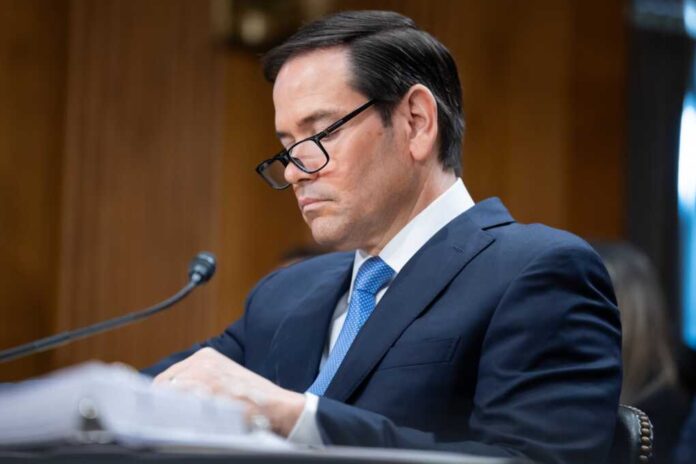
US Secretary of State Marco Rubio and top European diplomats met to coordinate a response to Iran’s nuclear activities, with EU powers preparing to reimpose sanctions for alleged violations of the 2015 deal.
At a Glance
- Rubio held talks with UK, French, and German foreign ministers
- The diplomats reaffirmed opposition to Iran acquiring nuclear weapons
- France, Germany, and the UK plan to restore sanctions over pact violations
- UN inspectors have been denied access to key enrichment sites
- The 2015 nuclear deal continues to erode amid diplomatic standoffs
Coordinated Pressure Builds
Secretary Rubio convened with French Foreign Minister Jean-Noël Barrot, German Foreign Minister Johann Wadephul, and UK Foreign Secretary David Lammy to reaffirm a unified Western stance on Iran’s nuclear ambitions. The meeting, according to the US State Department, underscored the shared objective of preventing Iran from developing a nuclear weapon.
Watch now: Explained: Europe Moves To Trigger UN ‘Snapback’ · YouTube
European diplomatic sources indicated that the E3 (France, Germany, UK) will soon initiate a “snapback” of United Nations sanctions. This mechanism—built into the Joint Comprehensive Plan of Action (JCPOA)—allows original signatories to restore sanctions if Iran is found in breach of its commitments.
This action comes in response to ongoing concerns about Iran’s refusal to provide full access to its nuclear facilities. International Atomic Energy Agency (IAEA) officials have repeatedly flagged a lack of transparency, particularly regarding uranium enrichment beyond limits agreed in the 2015 accord.
Enforcement and Erosion
The potential reimposition of sanctions reflects the broader erosion of the JCPOA, which has frayed since the US withdrew from the agreement in 2018. While the Biden administration had previously sought to revive diplomatic talks, Rubio’s current posture signals a shift toward alignment with European enforcement mechanisms.
This snapback provision does not require Security Council approval, making it a potent unilateral tool. Analysts suggest its activation could further strain Iran’s already embattled economy, potentially stalling negotiations indefinitely.
Diplomatic channels remain open, but there is growing skepticism about Tehran’s willingness to reengage under current terms. As inspectors remain sidelined and nuclear stockpiles grow, the risk of escalation persists.
Broader Implications
The transatlantic consensus may also reflect renewed geopolitical urgency. With Iran reportedly accelerating its enrichment capabilities and limiting oversight, Western powers are recalibrating their strategies.
Regional powers, including Israel and Saudi Arabia, have expressed support for a firmer stance. Within the UN, however, divisions remain—particularly among Security Council members like Russia and China, which have previously opposed the automatic restoration of sanctions.
As Rubio signals a tougher line and European ministers prepare punitive measures, the coming weeks could determine whether diplomacy is merely paused—or permanently sidelined.
Sources