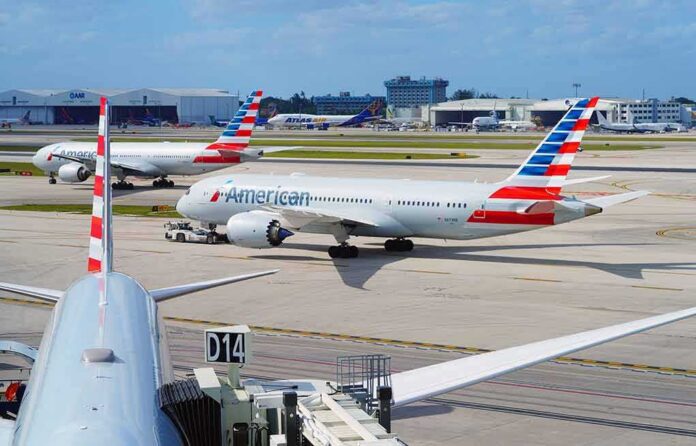
When a packed American jet had to slam the brakes on takeoff because another plane was suddenly on its runway, it exposed how even basic safety at a major U.S. airport now depends on split‑second luck instead of trustworthy systems.
Story Snapshot
- An American Airlines flight to Bermuda aborted takeoff in Miami after a business jet rolled onto the same active runway.
- Air traffic control audio captures confusion over who was cleared to cross, raising questions about communication and accountability.
- Federal regulators opened an investigation amid a broader pattern of runway incursions at busy U.S. airports.
- The close call highlights how complex, crowded airports and strained systems leave travelers relying on frontline crews, not Washington, to stay safe.
How a routine takeoff turned into a runway close call
On a busy Saturday evening, American Airlines Flight 308 was accelerating for takeoff from Miami International Airport, headed to Bermuda, when the pilots suddenly rejected the takeoff roll.[1] The crew had received takeoff clearance and was rolling down the runway when they spotted another aircraft ahead and decided to stop.[1] The other aircraft was a NetJets Embraer Phenom 300 business jet, identified as Flight EJA434, which had entered the same active runway used by the American flight.[1][6] Passengers later continued to Bermuda after a delay.[1][2]
Media reports and an Instagram post from an aviation enthusiast group describe the event as a “runway incursion,” a term used when an aircraft or vehicle is on a runway without proper clearance.[2][3] ABC News and other outlets reported that the two aircraft came within roughly one-third of a mile of each other at the closest point, close enough to be considered a serious safety event even without contact.[5][7] No injuries were reported, but people on board described a hard braking run and a tense atmosphere afterward.[1] The Federal Aviation Administration (FAA) opened an investigation into the incident.[5]
What the cockpit and control tower audio reveals
According to air traffic control recordings cited by CNN, the Miami controller told the business jet crew, “You just crossed an active runway.”[1] The pilot of the smaller jet pushed back, saying, “You just instructed me to cross the runway, sir,” making clear he believed he had been told to proceed.[1] The controller replied, “No, we said Amerijet 461,” suggesting the crossing clearance was meant for a different aircraft entirely.[1] That short exchange captures the heart of the problem: in a crowded, fast‑moving environment, one unclear call can put hundreds of lives at risk.
So far, there is no public release of the full FAA transcript or the official sequence of clearances, which makes it hard for outsiders to judge exactly who misunderstood what.[1] Social media and some aviation pages have shared partial clips that focus on the most dramatic lines, but those do not replace a complete, time‑stamped record. What we do know is that the American Airlines crew followed their training and rejected the takeoff as soon as they saw the runway was not clear.[1][2] The quick action turned what could have been a disaster into a near miss.
Who was responsible for the business jet, and why that matters
CNN reports that the business jet involved was operated under the NetJets brand but, at the time of the incident, was being managed by a third‑party maintenance vendor rather than NetJets’ own flight department.[1] NetJets confirmed this point when asked, but declined to give further public detail about the crew, procedures, or internal review.[1] That gap in information leaves passengers and the public guessing about who sets standards, who trains pilots, and who is held accountable when something goes wrong on a shared runway used by commercial airliners.
This structure, where one company’s name is on the side of the jet while another company actually runs the flight, is common in modern aviation. It can also make responsibility blurry when regulators and the public look for answers. American Airlines, the FAA, the airport, NetJets, and the maintenance operator all have different incentives in how this story is told. If the narrative centers only on “pilot error” in the small jet, it shields deeper questions about communication standards in the tower and runway design at Miami.
Miami’s crowded runways and a pattern of close calls
Miami International Airport is one of the busiest and most complex airports in the country, with multiple long runways, intersecting taxiways, and heavy international traffic.[13][14] Research on runway safety shows that airports with more intersections and “conflict points” have higher rates of runway incursions and more severe events.[9][16] A recent report to Miami‑Dade County noted that federal data recorded 12 runway incursions at Miami over a monitored period, underscoring that this is not a one‑off fluke.[12]
American Airlines plane forced to abort takeoff after another jet veers onto same runway at Miami airport https://t.co/ZGlokPyEjp
— TruthWillCome2.0 (@SandyCee2400) June 29, 2026
In response to this broader pattern, Miami has been working on “Runway Incursion Mitigation” projects designed to fix known hot spots where confusion tends to happen, as required under an FAA safety mandate.[9][10][15] That includes reworking taxiways, adding better markings, and improving detection systems. Yet this near‑collision happened anyway, during those very years when billions in federal and local dollars are supposed to be making air travel safer. For many Americans, that fits a familiar pattern: big promises, complex plans, and another close call that frontline workers prevent at the last second.
Why this incident taps into deeper public frustration
For people on both the right and the left, this story hits a nerve. Travelers expect that something as basic as keeping two airplanes off the same runway should be the bare minimum of a functioning government and regulatory system. Instead, we see overworked controllers, complex airports, overlapping corporate operators, and an investigation that may take months before the public sees clear answers. Many Americans already feel that federal agencies are better at press releases than at solving core problems.
Runway incursions are a known, major threat that the FAA has been trying to reduce for decades through plans, guidance, and technology upgrades.[10][16] Yet serious events keep happening, and the fixes often seem to come only after close calls make headlines. Conservative readers may see another example of a bloated system that cannot get the basics right. Liberal readers may see a safety‑critical sector where profit, outsourcing, and thin staffing undercut public protection. Both sides can agree on this: passengers on Flight 308 were protected more by the quick judgment of a flight crew than by any elite in Washington.
Sources:
[1] Web – American Airlines plane forced to abort takeoff after another jet …
[2] Web – American Airlines Flight AA308 was rolling down a Miami runway …
[3] Web – Runway Incursion Forces Aborted Takeoff at Miami – Instagram
[5] Web – On June 26, American Airlines Flight AAL308 rejected takeoff after …
[6] Web – American Airlines Flight 308’s Aborted Takeoff Sparks Tense …
[7] Web – A dangerous close-call on a busy Florida runway, two aircraft …
[9] Web – Runway Incursion in Miami Forces American Airlines Flight to Abort …
[10] X – Runway Incursion in Miami Forces American Airlines Flight to Abort …
[12] Web – Runway Incursion Forces Aborted Takeoff at Miami – Facebook
[13] Web – A potentially serious runway incident unfolded at Miami International …
[14] YouTube – LIVE MIAMI INTERNATIONAL AIRPORT Close Plane and Train Action
[15] Web – Company News | Private Jet Blog & Articles – NetJets
[16] Web – [PDF] Investigating Runway Incursions in The United States Airports