
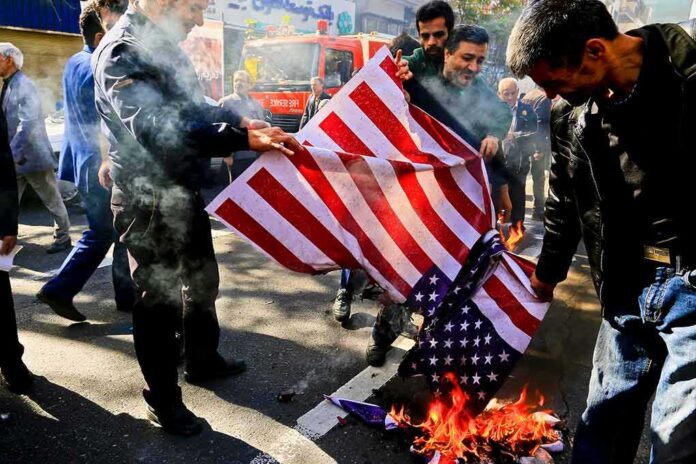
Iranian government organizers set American and Israeli flags on fire in Tehran this week, calling the Republican loss of Congress a win for Iran.
Quick Take
- Tehran demonstrators burned U.S. and Israeli flags and effigies of President Trump and Israeli Prime Minister Benjamin Netanyahu after Democrats won control of both chambers of Congress.
- Iran’s parliament speaker said American voters sent a “no to war” message and warned of consequences if the U.S. government ignores it.
- Iran’s Supreme Leader separately said the election would not change Washington’s hostility toward Tehran, no matter which party runs Congress.
- The Tehran rally was organized by the Iranian government and tied to the anniversary of the 1979 U.S. Embassy takeover, not a spontaneous public gathering.
Tehran Crowd Celebrates Democratic Wins
Iranian demonstrators gathered in Tehran this week to celebrate after Democrats took control of both the House and Senate in the midterm elections. The Associated Press reported protesters burned American and Israeli flags, chanted anti-U.S. and anti-Israel slogans, and held up effigies of President Trump and Netanyahu. The event doubled as a government-organized rally marking the anniversary of the 1979 U.S. Embassy takeover.
A video report from USA Today, published the same day, documented the scene and said Iranian protesters directly called the Democratic wins a “victory” for Iran. The footage lines up with other outlets covering the same Tehran gathering, giving the public a clear record of what happened on the ground that day.
Iranian Officials Frame Election As Rejection of War
Iran’s parliament speaker, Mohammad Bagher Ghalibaf, posted on social media platform X that “Americans said NO TO WAR, and we endorse this message.” He added that the U.S. government would face consequences if it ignored what voters decided. His statement turned the midterm results into a direct political message aimed at Washington, tying Democratic control of Congress to opposition to military conflict with Iran.
The election followed months of tension between the U.S. and Iran, including fears of renewed fighting around the time of the vote. Associated Press reporting noted that worries about war-related fuel and consumer costs weighed on American voters heading into the midterms, giving Iranian officials an opening to connect economic frustration with their own anti-war narrative.
Supreme Leader Pushes Back on Victory Claim
Iran’s Supreme Leader, Mojtaba Khamenei, delivered a message calling it “seriously mistaken” to expect a shift in U.S. behavior just because Republicans lost seats. He said American hostility toward Iran would continue no matter which party holds power in Washington. That statement came out around the same time as the Tehran celebration, creating two very different messages from Iran’s own government.
A separate Iranian lawmaker, Ebrahim Azizi, who chairs the parliament’s national security committee, said Tehran sees little difference between Republicans and Democrats when it comes to U.S. policy toward Iran. He accused President Trump of repeated miscalculations but did not suggest Democratic control would meaningfully change Washington’s approach, echoing Khamenei’s more cautious tone.
What The Celebration Does And Does Not Show
The Tehran rally offers a real, documented example of how Iran’s government chose to interpret a major U.S. election. It does not prove that Iran policy drove American voters to the polls. News coverage tied the midterm result to broader concerns, including fuel and consumer prices, not a single issue like the Iran conflict.
It also does not show that the election changed any actual U.S. policy toward Iran. No sanctions were lifted, and no military posture shifted as a result of the vote. Khamenei’s own warning that hostility would continue regardless of party control undercuts the idea that the celebration reflected a real shift in American government policy.
For Americans watching from home, the split inside Iran’s leadership — public celebration paired with private warnings that nothing will really change — says as much about how foreign governments read U.S. politics as it does about the election itself. Both parties in Washington now face a foreign government publicly weighing in on domestic results, a reminder that overseas actors watch and react to U.S. elections closely, regardless of who wins.
The regime “hanged” Trump on live state TV while it hangs real Iranians for tweets.
On the night of November 4, Iranian state TV aired a staged execution from Tehran’s Tajrish Square. An actor in a Trump mask and prison clothes was “hanged” by a man in a Revolutionary Guards… pic.twitter.com/2PxkjQG2pU
— Siaxares 🇮🇷 🇺🇸 (@siaxares) November 5, 2026
Sources:
youtube.com, bbc.com, apnews.com, heraldonline.com, indianexpress.com