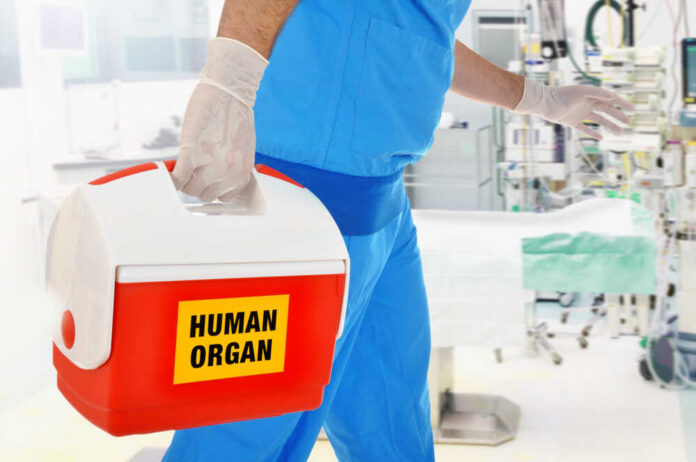
Texas A&M scientists have cracked a 100-year barrier to freezing human organs without damage, promising to end the deadly transplant waitlist crisis that claims 20 lives hourly.
Story Highlights
- Texas A&M researchers, led by Dr. Matthew Powell-Palm, discovered higher glass transition temperatures in vitrification solutions prevent cracking during rapid cooling of large organs.
- This breakthrough targets indefinite organ storage, far beyond current ice-based limits of hours or days.
- Over 100,000 Americans wait for transplants amid daily discards due to short viability windows.
- Next steps focus on biocompatible solutions to bring science fiction cryopreservation to clinical reality.
The Breakthrough in Organ Cryopreservation
Dr. Matthew Powell-Palm and his team at Texas A&M University’s J. Mike Walker ’66 Department of Mechanical Engineering published their findings on September 17, 2025. They identified that vitrification solutions with higher glass transition temperatures significantly cut cracking risks in large organs during ultra-rapid cooling. Vitrification creates a glassy state that avoids destructive ice crystals, a century-old hurdle in cryopreservation. This method promises storage at sub-zero temperatures without structural failure, unlike traditional ice storage limited to 4-16 hours for hearts and kidneys.
Overcoming Decades of Transplant Limitations
Current organ preservation relies on static cold storage at 4-8°C in ice boxes or advanced devices like Paragonix Sherpa Pak, which use phase-change materials for precise cooling. These extend viability slightly but cannot freeze organs without ice damage or ischemic injury. Vitrification uses cryoprotective agents (CPAs) to bypass ice formation, yet cracking plagued large tissues for over 100 years. Texas A&M’s focus on solution chemistry shifts the paradigm, enabling potential indefinite banking and eliminating geographic mismatches that discard viable organs daily.
Stakeholders Driving Innovation Forward
Dr. Powell-Palm, an assistant professor in mechanical engineering, leads the effort motivated by solving transplant shortages. Texas A&M publishes the core discovery, while the National Science Foundation funds related biopreservation centers. Supporting players include Paragonix for cooling tech, UTMB for nanoparticle thawing, and University of Minnesota for super-cold trials. Academia drives fundamental advances, industry commercializes tools, and no conflicts mar these collaborations. Powell-Palm emphasizes biocompatible high-transition solutions as the next priority.
Impacts on Patients and the Healthcare System
Short-term gains include better research organ protocols extending beyond 16 hours. Long-term, successful cryopreservation could end waitlists for 100,000 U.S. patients, cut ~20 hourly deaths, and reduce discards. Economic savings hit billions by slashing rushed airlifts; social equity improves access regardless of location. Politically, it bolsters policies addressing shortages without expanding government welfare. Conservatives applaud private innovation reducing reliance on failing systems, while shared frustrations with elite-driven healthcare inefficiencies unite both sides.
Expert Views and Remaining Challenges
Powell-Palm calls glass transition temperature the “dominant” cracking factor, urging high-Tg aqueous solutions. Paragonix experts view vitrification as the leap beyond 4-8°C cooling risks. Science reports CPA refinements reviving frozen organs like pig livers, but NSF notes CPA toxicity hurdles. UTMB’s nanoparticles aid thawing. Consensus holds cracking partially solved; biocompatibility and human trials remain unproven. No post-2025 clinical data exists, demanding real-time verification amid 2026’s push for American ingenuity over bureaucratic delays.
Sources:
Texas A&M Researchers Pioneer Cryopreservation Method to Prevent Organ Cracking
PMC Article on Organ Preservation
A 100-Year-Old Problem Solved? Scientists Discover How to Freeze Organs Without Cracking Them
UTMB: Keeping Organs for Transplantation on the Shelf
NSF: Biopreservation Material Could End the Wait for Organ Transplants
University of Minnesota: Freezing Time for Organ Transplantation
Science: How to Deep-Freeze an Entire Organ and Bring It Back to Life