As a choking cloud from a burning “green” warehouse spread across Los Angeles, a bitter fight over who failed the public flared up just as fast.
Story Snapshot
- A massive Boyle Heights warehouse fire spewed smoke for days, triggering shelter-in-place orders and relief centers.
- Mayor Karen Bass declared a local emergency and sought state and federal help as air quality worsened.
- Spencer Pratt, who lost his home in earlier fires, blasted Bass for acting too slowly and caring more about travel and image than residents.
- The clash highlights deeper anger on left and right that urban leaders, green policies, and big business leave regular people breathing the costs.
What Happened In Boyle Heights
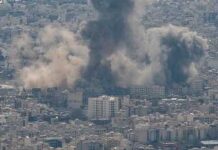
The Boyle Heights fire started at a huge cold-storage warehouse east of downtown Los Angeles and kept burning for days, sending thick smoke over nearby neighborhoods.[1] The building stored an estimated 85 million pounds of meat and other food, which began to rot as firefighters struggled to reach deep hot spots inside the damaged structure.[1] Officials said ammonia used in the refrigeration system was removed, but foam insulation and stored goods kept feeding the fire and the smoke.[1]
City and county leaders told nearby residents to shelter in place when smoke and fumes grew heavy, warning people to shut windows, turn off air conditioning, and stay in one room if possible.[4] Los Angeles and county agencies opened around-the-clock smoke relief centers so families who could not seal their homes had somewhere safer to breathe.[1] Fire crews also worked to ventilate the building, which sometimes reduced inside heat but briefly pushed more smoke into the air around Boyle Heights.[1]
How City Hall Responded
On Saturday, several days into the blaze, Los Angeles Mayor Karen Bass declared a local emergency, which formally activated the city’s emergency system and opened the door to more state and federal aid.[1] Her order asked California officials to speed access to disaster programs under state law and to waive rules that might slow firefighting and cleanup.[4] Bass said the main goal was to protect the health of people under the smoke and to move toxic and rotting material away before it caused a wider environmental problem.[4]
City leaders stressed that this was a rare, complex industrial fire, not a routine building blaze.[1] Fire officials pointed to roof solar panels, ammonia lines, and now rotting food as hazards that made the fire tough and dangerous to attack.[4] Crews used helicopters, fire-suppressing gel, and even robots to limit risk as they cut into steel walls and tried to reach deep-burning pockets.[4] As of Bass’s weekend briefing, authorities reported no injuries to residents or firefighters, even as air quality remained a serious concern.[5]
Spencer Pratt’s Attack On Bass
Former reality television star and past independent mayoral candidate Spencer Pratt saw the smoke as proof that Bass had failed again.[1] Pratt, whose home was destroyed in the 2025 Palisades Fire, has built a political brand on accusing Bass of letting his community burn while she was traveling abroad.[3] In his latest criticism, he claimed Bass was “sipping cocktails in Chicago” when the Boyle Heights fire began, comparing it to earlier trips he says showed she put image over emergency response.[1]
Pratt also blasted the warehouse itself, arguing that rooftop solar panels and batteries were spewing “deadly heavy metals” into the air and that liberal green-energy policies turned an industrial site into a toxic smoke bomb.[1] He tied this to his broader charge that Bass cut needed fire funding and brushed off warning signs, including a reported earlier fire at the same facility.[1] His message resonates with many residents on both sides of the aisle who feel that elite climate agendas are tested on working-class neighborhoods first, while the well-connected stay far from the fallout.
What We Know – And What We Still Do Not
Public records so far show that Bass did eventually use the tools of her office: she declared an emergency, requested outside help, and backed relief centers, masks, and air purifiers for residents under the plume.[1][5] Reports also note that hazardous chemicals like ammonia were secured, and official monitoring described the remaining smoke as similar to a very large structure fire rather than an ongoing chemical leak.[4] Those facts undercut claims that city hall simply ignored the fire or treated it as business as usual.
Boyle Heights warehouse fire causing health concerns https://t.co/njniXZMnkM
— Orlando Morgan (@orlandosadie1) June 22, 2026
At the same time, nothing in the public record yet offers a minute-by-minute timeline of when leaders first understood the scope of the smoke problem and when warnings, shelters, and supplies actually reached each neighborhood.[10][12] That gap feeds frustration in communities that have heard “everything is under control” before only to learn later that officials downplayed risk. Both conservatives and liberals who distrust the political class see the same pattern: big press conferences, slow transparency, and no clear way to hold anyone accountable if decisions came late or were shaped by politics.
Why This Fire Hits A Nerve Nationwide
Urban-fire experts warn that as cities grow denser and add more complex technology, major fires will become harder to control and more dangerous for nearby neighborhoods.[18] They also stress that smoke and fine particles can make indoor air unsafe far from a blaze, which means governments must act early and clearly to warn people and reduce exposure.[18] That takes planning, tough enforcement on industrial sites, and honest communication that treats working-class residents as partners, not statistics.
The Boyle Heights fire shows the cost when that trust is already broken. Many on the right see another example of green industrial projects, lax oversight, and big promises about “clean energy” that leave regular people coughing. Many on the left see a system that lets a massive private warehouse store risky materials near crowded communities, while leaders rush to manage headlines more than health. Both sides suspect that if this smoke were drifting over wealthy enclaves instead of Boyle Heights, the urgency and transparency might look very different.
Where Accountability Must Go Next
To move beyond sound bites, Los Angeles would need to release a detailed response timeline, including fire logs, air monitoring data, and when each warning and shelter order was made.[12] Independent engineers and health experts could then judge whether the fire’s length and the smoke exposure were mainly due to building design and bad luck or to slow decision-making in city and state government.[16][18] Without that kind of outside review, every big fire will simply restart the same angry cycle.
For Americans watching from outside California, this story fits a bigger picture. Whether it is fires, trains, water systems, or the border, many feel the people in charge always seem surprised, always blame “complex conditions,” and rarely face real consequences. The Boyle Heights warehouse may eventually be cleaned up and rebuilt. The deeper question is whether our leaders will rebuild trust by proving they put ordinary people’s lungs ahead of donors, green branding, and political travel plans.
Sources:
[1] Web – LA suffocates under ‘toxic’ smoke as massive warehouse fire rages — as …
[3] Web – Los Angeles Mayor Declares Emergency Over Warehouse Fire
[4] YouTube – Los Angeles mayor declares emergency over warehouse fire
[5] Web – LA mayor seeks state aid as Boyle Heights warehouse fire sends …
[10] X – Mayor Karen Bass declared a state of emergency after a stubborn …
[12] Web – State of emergency declared as Boyle Heights fire continues to burn
[16] Web – Here’s what we know about the Boyle Heights warehouse fire – Reddit
[18] Web – Firefighters faced renewed challenges Saturday at a large Boyle …