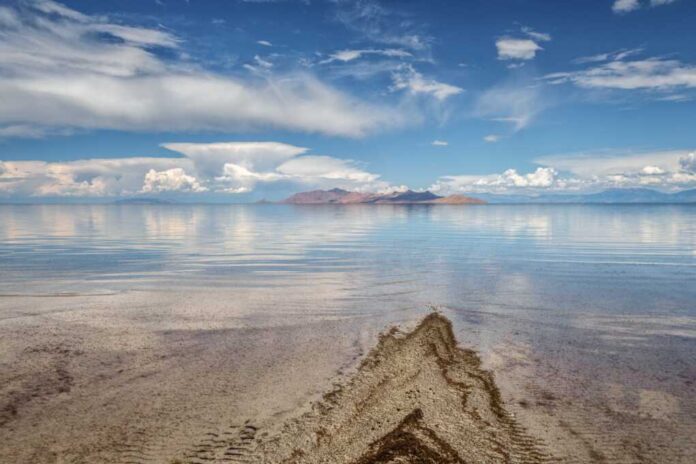
Scientists have revealed fragile groundwater-fed oases beneath the shrinking Great Salt Lake, raising fresh disputes over water rights and management.
At a Glance
- University of Utah researchers found reed-covered groundwater oases under the exposed lakebed.
- Hundreds of hidden springs were mapped using piezometers and aerial surveys.
- Utah’s lake decline stems from a century of diversions and mismanagement.
- Experts caution the oases are fragile and unsuitable as a water source.
Fragile Oases Beneath the Lake
Geologists from the University of Utah have uncovered reed-covered mounds on the exposed southeastern shore of the Great Salt Lake. These features, created by groundwater pressurized beneath drying sediments, first appeared as the lake receded to record lows between 2022 and 2024. Using piezometers and advanced aerial electromagnetic surveys, scientists identified hundreds of such oases, revealing a vast subsurface freshwater network that challenges long-standing assumptions about the basin’s hydrology.
Watch now: Discovering Hidden Oases Beneath the Great Salt Lake
The findings come at a time of heightened water stress in Utah. A prolonged drought, paired with increasing urban demands, has accelerated the lake’s decline to unprecedented levels. Communities now face intensifying dust storms, ecological degradation, and growing economic risks. Despite these conditions, state and federal authorities have long struggled to craft a cohesive response that balances conservation, growth, and local water needs.
A History of Mismanagement
The Great Salt Lake, a vestige of ancient Lake Bonneville, has historically been sensitive to shifts in inflows and evaporation. Human interventions dating back more than a century—including large-scale diversions for agriculture and municipal use—have amplified its vulnerability. Over time, regulatory approaches, coupled with unchecked urban expansion, contributed to the current ecological crisis.
The appearance of hidden groundwater-fed features underscores both the complexity of the region’s water systems and the unintended consequences of centralized management. Past research focused heavily on surface flows, often ignoring subsurface hydrology. Now, as the lake continues to recede, the exposure of fragile oases highlights how institutional neglect and overreach have compounded environmental stress.
Struggle Over Control and Conservation
Lead researcher Bill Johnson and his colleagues emphasize that the newly mapped oases are delicate and easily disturbed. They warn against considering them as a potential water supply, stressing that further study is needed to understand their role in the broader hydrological system.
Meanwhile, decision-making remains concentrated in the hands of state regulators, academic researchers, and advocacy groups. This structure has left local communities and water users divided. Farmers, industries, and households dependent on the lake’s stability argue for greater protection of livelihoods, while conservationists push for restrictions to safeguard habitats and mitigate dust storms.
The discovery has sharpened a broader debate about who should shape Utah’s water future. While scientists provide new data, many residents argue that genuine solutions must come from locally grounded stewardship rather than external mandates. With the lake’s decline threatening both ecology and economy, the question of governance looms as large as the drying basin itself.
Sources