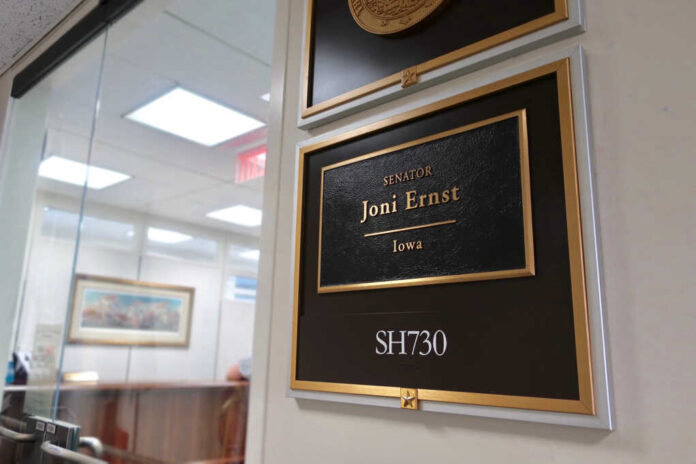
Senator Joni Ernst’s demand for $2 trillion in federal spending cuts is igniting a fierce battle in Washington, putting the future of government programs and America’s fiscal direction on the line as the threat of a shutdown looms.
Story Snapshot
- Senator Ernst calls on the Trump administration and Republicans to enact $2 trillion in federal cuts, pressing for aggressive fiscal reform.
- The unprecedented scale of proposed cuts would target a wide range of discretionary and entitlement programs, especially non-defense spending.
- The push for cuts comes as Congress faces a government shutdown deadline, increasing pressure on both parties to reach an agreement.
- Debate intensifies over the impact of deep cuts, with supporters citing fiscal responsibility and critics warning of harm to public services.
Ernst’s $2 Trillion Demand: A New Standard for Fiscal Discipline
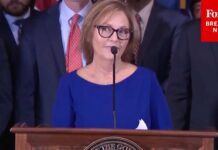
In September 2025, Senator Joni Ernst (R-IA) publicly called for the Trump administration and Congressional Republicans to pursue $2 trillion in federal spending cuts as Congress raced against the clock to avoid a partial government shutdown. Frustrated with years of overspending, Ernst’s bold rhetoric—urging the Trump team to “make DC squeal”—resonates with conservatives demanding real action, not empty promises. This callback to her 2014 campaign signals a renewed drive to cut “pork” and restore fiscal sanity in the nation’s capital.
Ernst’s proposal is not just symbolic. The Trump administration’s May 2025 budget request already outlined a 22.6% reduction in non-defense discretionary spending, seeking to rein in the bloated federal apparatus while increasing funds for defense and border security. By September, as partisan divisions deepened and the deadline drew near, Ernst’s $2 trillion figure became a rallying point for fiscal conservatives. Her demand is now shaping the Republican negotiating position, making large-scale cuts a litmus test for GOP credibility on spending restraint.
Ernst demands $2T in federal cuts, urges Trump team to 'make DC squeal' amid shutdown fight https://t.co/TTIkRaM774
— Fox News Politics (@foxnewspolitics) October 3, 2025
Shutdown Threat Looms Amid Partisan Gridlock
The 2025 budget cycle is marked by heightened political polarization. Republicans control the White House, while Democrats maintain a narrow Senate majority. With no final budget agreement in early October, the risk of a government shutdown is growing. Negotiators remain entrenched, with Ernst and other fiscal hawks pressing for deep cuts, while Congressional Democrats warn that slashing funding for science, public health, and social programs would harm vulnerable Americans and weaken critical services. The standoff has intensified as both sides use the threat of a shutdown as leverage.
The rhetoric from both camps is heating up. Ernst insists, “We need real, lasting cuts—not just empty promises.” The Trump administration emphasizes “rightsizing” government and eliminating “woke” and “inefficient” programs. Meanwhile, some Republican lawmakers express concern over specific program impacts, revealing cracks within the GOP over how far cuts should go. As the shutdown deadline approaches, the outcome will hinge on whether bipartisan compromise can be reached—or if the government will once again grind to a halt.
Impact: Redefining Priorities, Risks to Services
The proposed $2 trillion in cuts would have far-reaching consequences. In the short term, a partial shutdown would disrupt federal services and payments, creating immediate uncertainty for government employees, contractors, and beneficiaries of targeted programs. Long term, if enacted, the cuts could reduce federal deficits and signal a permanent shift in priorities toward defense and border security at the expense of public health, scientific research, and social safety nets.
Critics warn that deep cuts to agencies like NIH, CDC, and EPA could undermine disease prevention, medical research, and environmental protection—areas already strained by previous years of reductions. Economic analysts caution that abrupt, large-scale spending cuts could slow economic growth, particularly in regions dependent on federal funding. Supporters counter that “rightsizing” government would restore fiscal balance and relieve taxpayers, arguing that Washington’s addiction to spending threatens the nation’s long-term prosperity and security.
Perspectives: Debates Over Fiscal Responsibility and Social Consequences
Policy analysts are sharply divided. Fiscal conservatives argue that the federal government’s spending trajectory is unsustainable and that bold action is necessary to prevent a mounting debt crisis. They see Ernst’s proposal as a much-needed course correction after years of fiscal mismanagement. However, public health leaders and social welfare advocates warn that “draconian” cuts could devastate essential services, increase hardship for vulnerable populations, and stifle American innovation by gutting research and development.
Political observers note that past attempts at large-scale federal cuts have often been blocked or watered down by Congress, especially when popular programs are threatened. Despite this, Ernst’s challenge is forcing lawmakers to confront the consequences of runaway spending and to debate the size and scope of government itself. With the 2026 midterms on the horizon, the outcome of this showdown will shape not only the federal budget but also the broader debate over America’s future direction.
Sources:
White House Office of Management and Budget, Fiscal Year 2026 Discretionary Budget Request
Proposed Federal Budget Cuts Could Exacerbate Behavioral Health Crisis