French President Emmanuel Macron has greenlit the massive €10.25 billion Porte-Avions Nouvelle Génération (PANG) nuclear aircraft carrier project, a move that underscores Europe’s growing push for military independence amid doubts over U.S. commitment to NATO. Set to replace the aging Charles de Gaulle by 2038, the PANG will be Europe’s largest warship at 80,000 tons. This ambitious project, which will boost 800 French companies, is framed by Macron as a necessary step to project French power and ensure deterrence “in an era of predators” like Russia.
Story Highlights
- Macron announced the Porte-Avions Nouvelle Génération (PANG) on December 21, 2025, to replace the aging Charles de Gaulle by 2038.
- PANG will be Europe’s largest warship at 80,000 tons, featuring U.S.-sourced catapults for 30 fighter jets and nuclear propulsion.
- €10.25 billion project boosts 800 French companies, emphasizing strength “in an era of predators” like Russia’s Ukraine aggression.
- Launch tied to EU defense autonomy concerns, including perceived U.S. hesitance on NATO commitments.
Announcement Details
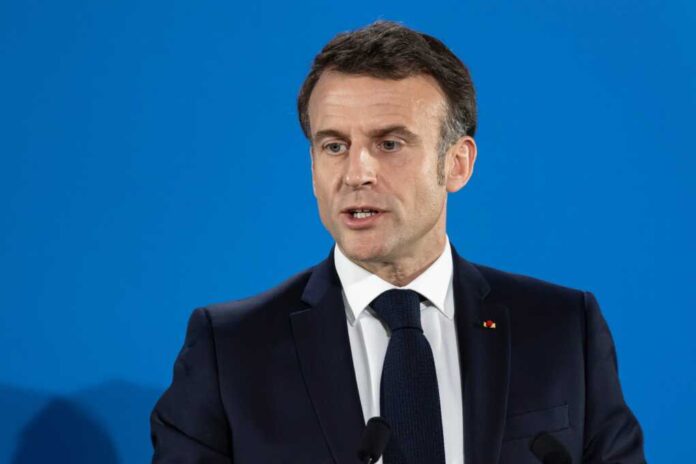
French President Emmanuel Macron announced the PANG program launch on December 21, 2025, during a Christmas speech to 900 troops at a French base in Abu Dhabi near the Strait of Hormuz. The event coincided with military drills and a holiday meal, underscoring UAE-France ties from 2019 agreements and a 2021 Rafale jet deal. Macron positioned the carrier as vital for France’s maritime power and nuclear deterrence amid global threats. He committed personally as guarantor, with a site visit planned for February 2026. This move finalizes the order under France’s 2025 defense budget adopted in February.
🇫🇷 🇦🇪 France Advances Next-Gen Aircraft Carrier Project
• President Macron has initiated construction of France’s next-generation aircraft carrier, the Porte-avions de nouvelle génération (PA-NG).
• The vessel is set to replace the Charles de Gaulle and enter service by 2038.… pic.twitter.com/OODz2q2VUD— WashingtonAmerica.Net (@WADailyNews) December 22, 2025
Project Specifications and Advancements
The PANG carrier displaces nearly 80,000 tons, stretches 310 meters long, and carries 30 fighter jets, dwarfing the Charles de Gaulle’s 42,000 tons and 261 meters. It incorporates U.S. electromagnetic catapults due to timeline and cost advantages over French options. Nuclear propulsion work started in 2024, with first welding on boiler room containment completed September 25, 2025, at Naval Group’s Cherbourg site. TechnicAtome handles nuclear components, which require a 12-year lead time. Joint ventures with Chantiers de l’Atlantique manage hull construction. Entry into service targets 2038, post-Charles de Gaulle retirement.
Project planning began in 2018 as the Charles de Gaulle nears its 25th anniversary in 2026. The carrier, commissioned in 2001 after a 1994 launch, remains France’s sole nuclear-powered vessel and the EU’s only one, key for power projection. PANG sustains this capability for decades.
Budget and Economic Boost
The project costs €10.25 billion ($12 billion), with the 2025 budget committing €7.3 billion initially but low near-term outlays: €68 million in 2025 and €112 million in 2026. Payments ramp up post-2027, as companies advance funds. This supports 800 companies, especially SMEs, driving industrial growth and jobs for 2,000 sailors. Armed Forces Minister Catherine Vautrin confirmed details, focusing on post-retirement readiness. Macron highlighted benefits to France’s industrial base.
Geopolitical Motivations
Macron framed the launch as resolve “in an era of predators,” citing Russia’s Ukraine war and U.S. reliability concerns, including Trump-era NATO hesitance. The announcement promotes EU strategic autonomy, positioning France as Europe’s nuclear carrier leader. UAE base setting reinforces alliances near critical oil routes. Long-term, PANG enhances deterrence and spurs naval tech, though budget risks persist with deferred spending.
Watch the report: Emmanuel Macron announces France will build a new aircraft carrier
Sources:
- France to build new aircraft carrier, Macron tells troops based in Gulf | Reuters
- France to build new aircraft carrier — Macron – DW – 12/21/2025
- France will replace Charles de Gaulle ship with new carrier, Macron tells Gulf troops
- Macron OKs Nuclear Supercarrier To Replace Charles de Gaulle; France Set To Operate Europe’s Most Powerful Aircraft Carrier