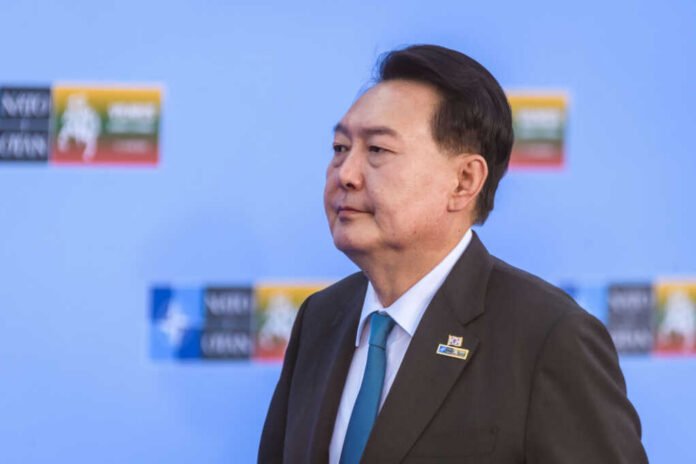
A former U.S.-aligned president just got 30 years in prison for a secret drone scheme his own government now calls a fake war crisis.
Story Snapshot
- South Korea’s ex-president Yoon Suk Yeol was sentenced to 30 years for ordering drones over North Korea’s capital.
- Prosecutors and the court say he tried to “fabricate wartime conditions” to justify martial law and keep power.
- Yoon and his lawyers deny he ever approved the operation and claim it was self-defense against North Korean provocations.
- The case highlights how security tools, secret operations, and “deep state” style politics can collide in modern democracies.
What Yoon Was Accused Of Doing With Military Drones
South Korean judges say former President Yoon Suk Yeol used the country’s military drones in October 2024 to fly into North Korean airspace above Pyongyang, the North’s capital. Reports say the drones dropped large numbers of propaganda leaflets, which North Korea had publicly accused the South of doing at the time.[3] Prosecutors argued this flight was not just a routine mission but a planned act to stir up a security crisis on the Korean Peninsula.[2]
According to the special prosecutor’s team, the goal was to provoke North Korea into some form of retaliation, such as military fire or a sharp rise in tension. They said Yoon wanted to “fabricate wartime conditions” that would let him declare martial law inside South Korea and squeeze the opposition in the legislature.[1] That charge turns a border incident into a claim that the commander in chief tried to weaponize national fear to hold onto power.
How The Court Ruled And Why The Sentence Is So Harsh
A Seoul court found Yoon guilty of abuse of power and aiding the enemy for his role in the covert drone operation.[1] Judges ruled that he directly ordered the mission, used military assets for private political goals, and risked national security by inviting a North Korean response. The court said this helped create conditions to justify emergency rule at home, rather than protect the country from an actual attack.[1] That logic supported the 30-year term.
This 30-year sentence does not stand alone. Yoon had already been convicted earlier of leading an insurrection tied to a failed martial law attempt and received a life sentence. The drone case was treated as one more piece of the same power struggle. Together, the rulings paint a picture of a leader who tried to bend the military and security tools toward his own survival, not just toward defending the border.[1] Yoon’s legal team has already filed an appeal.[1]
Yoon’s Defense: No Order, Self-Defense, And Political Payback
Yoon and his lawyers strongly reject the court’s story. His legal team says there was “no prior order or subsequent approval” from Yoon for the drone operation that prosecutors described.[1] They argue there is no clear command chain tying him personally to the flight, which often becomes the key question in national security trials. They say the case leans on assumptions about his intent rather than hard, direct proof.[1]
⚖️ SOUTH KOREA SENTENCING
Ousted ex-President Yoon Suk Yeol sentenced to 30 years in prison over drone flights into North Korea and martial law plot.#SouthKorea #News #Politics
— The Current Feed (@thecurrentfeed) June 12, 2026
The defense also claims the drones, if used, were part of a “legitimate act of self-defense.” They point to North Korea’s use of trash-filled balloons and other provocations against the South.[1][3] From this view, any drone flights were aimed at pushing back against harassment, not staging a crisis to grab more power. Yoon’s camp frames the huge sentence as political payback, saying rival forces are rewriting security policy choices as “treason” in the courts.[1][3]
Why This Case Feels Familiar To Frustrated Americans
For many Americans watching from afar, this sounds less like a distant drama and more like a pattern. A trusted ally’s president stands accused of using secret military tools to shape domestic politics, while he claims the “system” and political enemies are out to destroy him.[1] That echoes fears here at home that the security state, courts, and political class are tangled together in ways regular citizens never fully see.
In South Korea, a special counsel, career prosecutors, and judges now say a leader tried to “manufacture” a security emergency for personal power.[1] In the United States, people on both the right and left have grown suspicious that elites use crises—terror threats, pandemics, foreign wars, or border surges—to expand their own control while basic life gets harder. The facts differ by country, but the worry is the same: the tools meant to keep people safe can be turned inward against them.
Deep State Fears, Civil-Military Power, And What Comes Next
This case also highlights a deeper problem every modern democracy faces. When military and intelligence operations are secret by design, it becomes hard for citizens to know who really gave an order, why they did it, and whose interests were served.[1] That fog allows two competing stories to grow: one about a leader abusing power, and one about a system punishing someone who challenged the insiders.
Whether Yoon’s appeal changes the verdict or not, the damage is already done. South Koreans must now ask if their leaders can be trusted with powerful tools, and if the system will hold future presidents to the same standard.[1] Americans face a similar question as drones, surveillance, and emergency powers spread. If citizens on both the right and the left feel the game is rigged for the elites, cases like this are a warning sign, not just a foreign headline.
Sources:
[1] Web – Ousted South Korean President Yoon Given Prison Term for Drone Flights …
[2] Web – South Korea’s ex-president gets 30 years over North Korea drone …
[3] Web – Prosecutors seek 30-year sentence for ex-South Korean President …